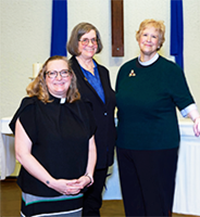
 Clergy from left, Deacon Amy Schmuck, Deacon Cynthia Biddlecomb, retired, and The Rev. Mary Ann Hill. Photo by Nate Limback/ladailypost.com
By Deacon Cynthia Biddlecomb (ELCA), retired
Last Sunday was Trinity Sunday, the First Sunday after Pentecost. In many of our churches we change the paraments (banners, and frontispieces) from the red of Pentecost Sunday to the white used for a special Feast Day. But this annual feast day differs from others.
Trinity Sunday is about our theology, our understanding of the mystery of God. It addresses the basic doctrine of the Trinity held by the Christian Church, a doctrine taken directly from the words of Jesus, as reported at the end of the Gospel of Matthew (28:19-20):
[Jesus said] “All authority in heaven and on earth has been given to me. Go therefore and make disciples of all nations, baptizing them in the name of the Father and of the Son and of the Holy Spirit, and teaching them to obey everything that I have commanded you. And remember, I am with you always, to the end of the age”.
Preachers struggle to find words to describe the mystery of how the Almighty can be “one in three persons”. Modern attempts have included these words for the roles God takes on: “Creator, Redeemer, and Sustainer.” The Trinity is about how we experience God, how we come to know God. All three of the personas of this God are involved in all three of those acts. Indeed, God manifests as a relationship, a community within the Godhead. Faith in this God will not be individualistic, without other believers. We need each other so we can keep nudging one another back towards Jesus’ teachings.
In the Matthew text above, Jesus was addressing his closest followers who were, truth be told, simple folk who worked in the trades. Thankfully for us, he kept his wording simple.
If we read through the gospels to follow the disciples’ story, listening with them as they learn at Jesus’ feet, we see that the God who was already known to them could now be understood as Jesus’ Father, a close, all-loving parent who wants only the best for us.
They began to see that Jesus himself was sent to embody the mercy and love of God, and that his giving his all on the cross was the ultimate act of self-giving love, proving once and for all that God’s intention is to free us from the sins that imprison us.
A few days after this, on the Day of Pentecost, the disciples would experience the breath of God, the Holy Spirit, blowing through their community and uniting their hearts. They experienced God in these three ways and it shaped how they built the first Christian communities.
The Divine Presence of God is experienced in our own lives in many ways, but the concept and doctrine of the Trinity helps us put relationship names to those experiences.
Editor’s note: ‘All Shall Be Well’ is a column written by local women clergy, including The Rev. Mary Ann Hill, Rector, Trinity on the Hill Episcopal Church (momaryannhill@gmail.com); Deacon Amy Schmuck, Bethlehem Evangelical Lutheran Church (deaconamy@bethluth.com); and ELCA Deacon Cynthia Biddlecomb, M.Div., retired (czoebidd@gmail.com).