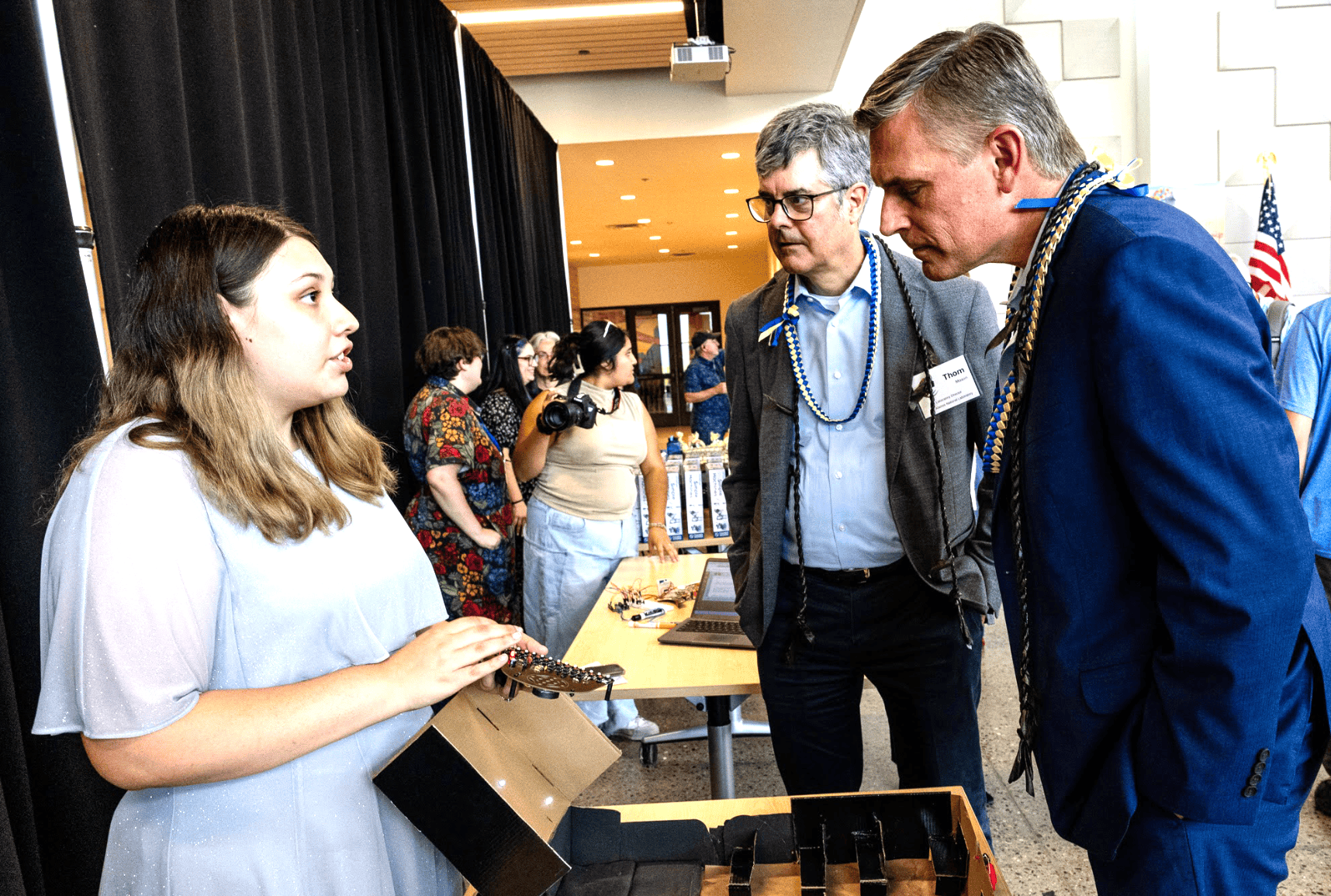
 A Music House: Student Aryl L. Villa of Silver City demonstrates the electronic grand piano in her Santa Fe Opera House model to LANL Director Thom Mason and U.S. Sen. Martin Heinrich. Photo by David Moore/LANL
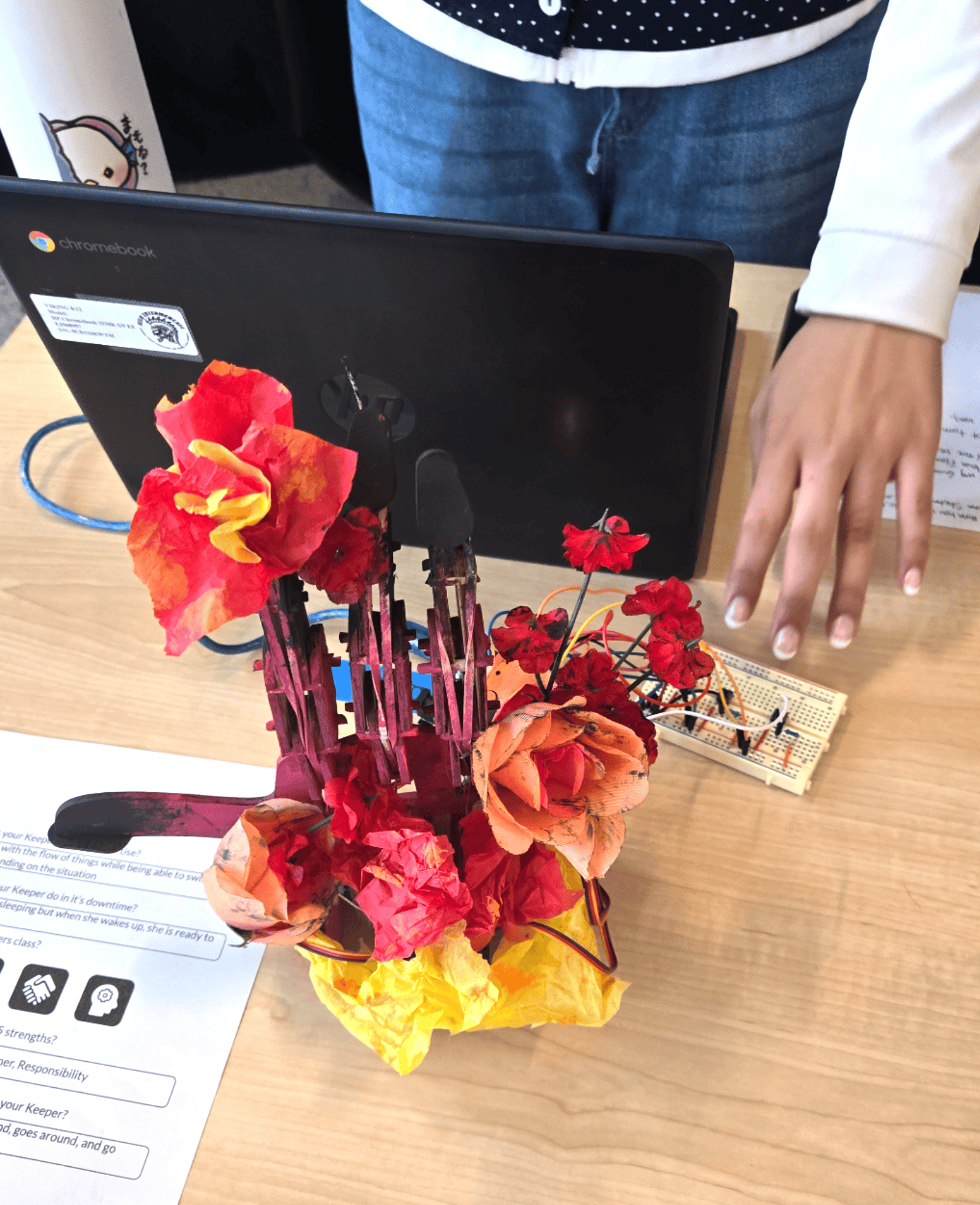 Robotic Hand Meet Your Creator: A robotic hand was created and decorated by 8th grader Hina Sherhata, of Hilo, HI with floral motifs inspired by the legends and volcanic landscapes of the Big Island. Photo by Mark MacInnes/ladailypost.com
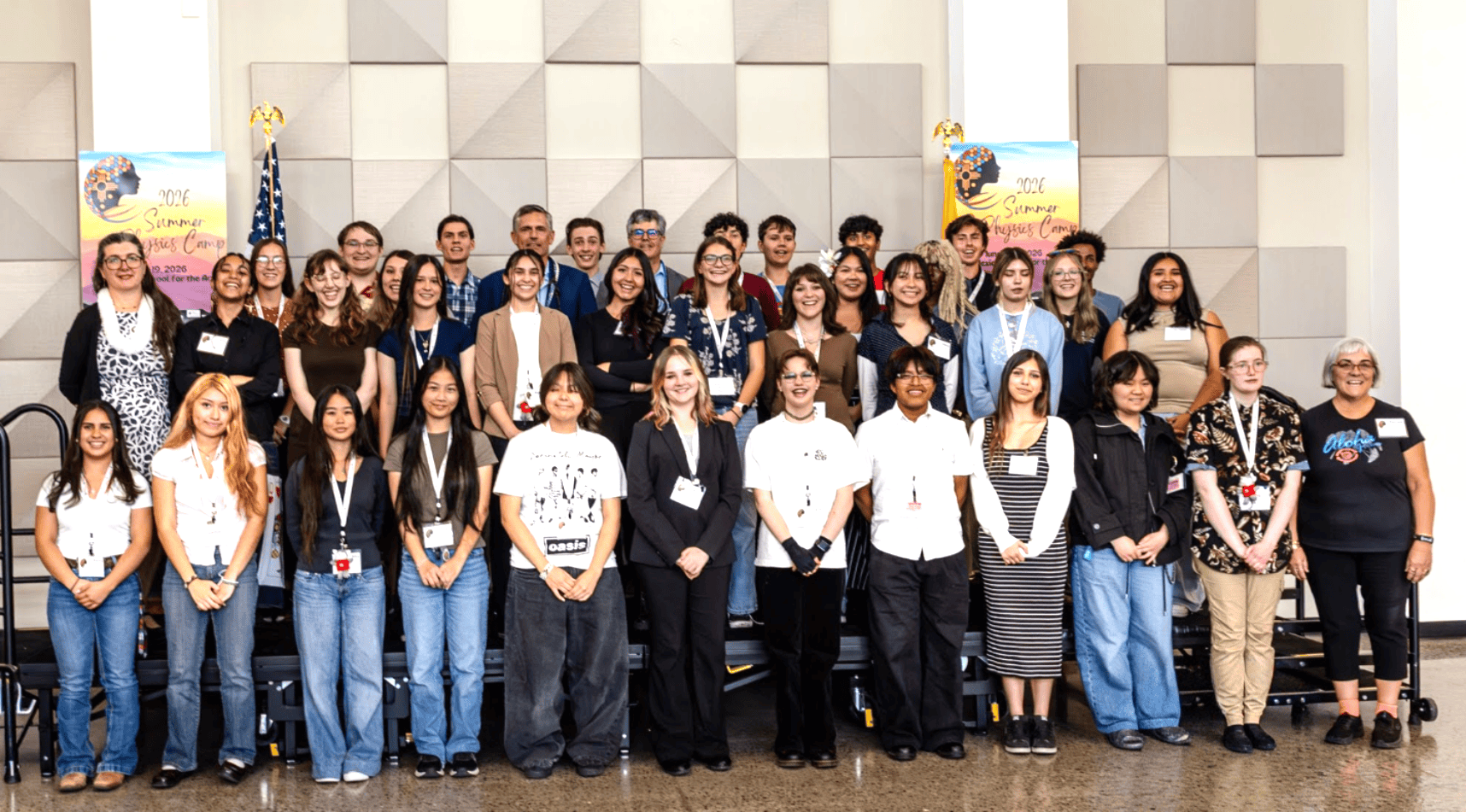 Group Shot: Students, mentors, and invited guests celebrate the conclusion of the 10th Annual Summer Physics Camp in Santa Fe. Photo by David Moore/ LANL
By MARK MACINNES
Los Alamos Daily Post
At the 2026 exhibition day for Los Alamos National Laboratory (LANL) Summer Physics Camp, in session June 8-18, students stood beside their completed robotic hands and miniature solar powered houses. Around three dozen students eagerly awaited questions from distinguished visitors on the final day of the 10th Annual Summer Physics Camp in Santa Fe. Students’ nerves quickly disappeared as they began explaining the engineering and goals behind projects they had designed and built during the free two-week program.
One robotic hand created by Hina Shehata, a student from Hawai’i decorated with colorful floral motifs reflected legends from her home on the Big Island. The four fingers were each powered by independent motors and actuator cables, operated via a controller panel. The system was student programmed via laptop software. She explained that the flower decorations represented offerings to Hawaiian gods in supplication to the powerful volcanic landscape of her home.
Another student transformed a model solar-powered house into a miniature version of the Santa Fe Opera House; complete with an electronic grand piano whose illuminated keyboard played musical notes. She explained to VIPs in attendance that the delicate and extensive soldering required for the circuitry came naturally after her prior experience with wood-burning arts.
U.S. Sen. Martin Heinrich and LANL Director Thom Mason spent much of the afternoon talking directly with students about their exhibit projects. Both were especially impressed by students’ sense of creativity and persistence and recalled their own youthful experiences building electrical devices. Sen. Heinrich is the son of an electric utility lineman, who guided him with electrical DIY projects, while Dr. Mason acquired electrical skills by assembling HeathKit devices in his childhood.
The camp marked its 10th anniversary this year under the leadership of LANL’s Dr. Anna Llobet. Her description of the program’s philosophy captured what was evident throughout the exhibition hall.
“We taught the students to embrace the struggle,” Dr. Llobet said, “because that’s what we as scientists do every day.”
She added that the camp encourages students to remain curious, ask questions and support each other to solve problems.
More than 100 volunteer scientists and engineers functioned as assistants and mentors from both Los Alamos and Sandia National Laboratories along with advisors from the Hawai’ian Hilo school districts. All contributed their time to this year’s program.
The 2026 theme, “Invisible Worlds: Physics Beyond What Our Eyes Can See” introduced students to electricity, optics, chemistry, bioengineering, computer programming, and scientific investigations spanning invisible realms from microscopic to astrophysics. Students represented 12 New Mexico counties, joined this year for the first time by five students from eastern Hawaiʻi middle and high school districts. Several students said they especially enjoyed working with camp mates from across New Mexico while experiencing Santa Fe and northern New Mexico for the first time.
Speaking directly to the students, Mason asked how many had completed their projects successfully on the first attempt. Only one hand went up. He reminisced that “as an experimental physicist, it never works the first time.” Every failed experiment he explained reveals another problem to solve. Success comes not from avoiding failures but from learning to work through them.
He reminded students that scientific discovery is rarely the work of an isolated genius. “Science is a team sport,” he said, noting that collaboration and sharing ideas are central to research at the national laboratories.
Mason also revealed one measure of the camp’s long-term success. About 30 former participants have gone on to internships at Los Alamos National Laboratory, while two former campers now hold permanent positions there.
Sen. Heinrich is one of just a few U.S. senators with STEM training. He encouraged students to imagine themselves pursuing whatever field inspires them most.
“You’re going to see more scientific and engineering changes than any generation in the history of humanity,” he said.
The greatest success of Summer Physics Camp was visible in the confidence with which students described their work, answered questions, and reflected on the challenges they had overcome. Over the two-week program, they learned more than just physics. They experienced curiosity, perseverance, and teamwork—the same qualities practiced every day by the scientists and engineers who guided them.
As the students gathered for a group photograph with mentors, laboratory leaders and Sen. Heinrich, the celebration marked not only the conclusion of another successful Summer Physics Camp but also a decade of inspiring New Mexico’s next generation of scientific explorers.