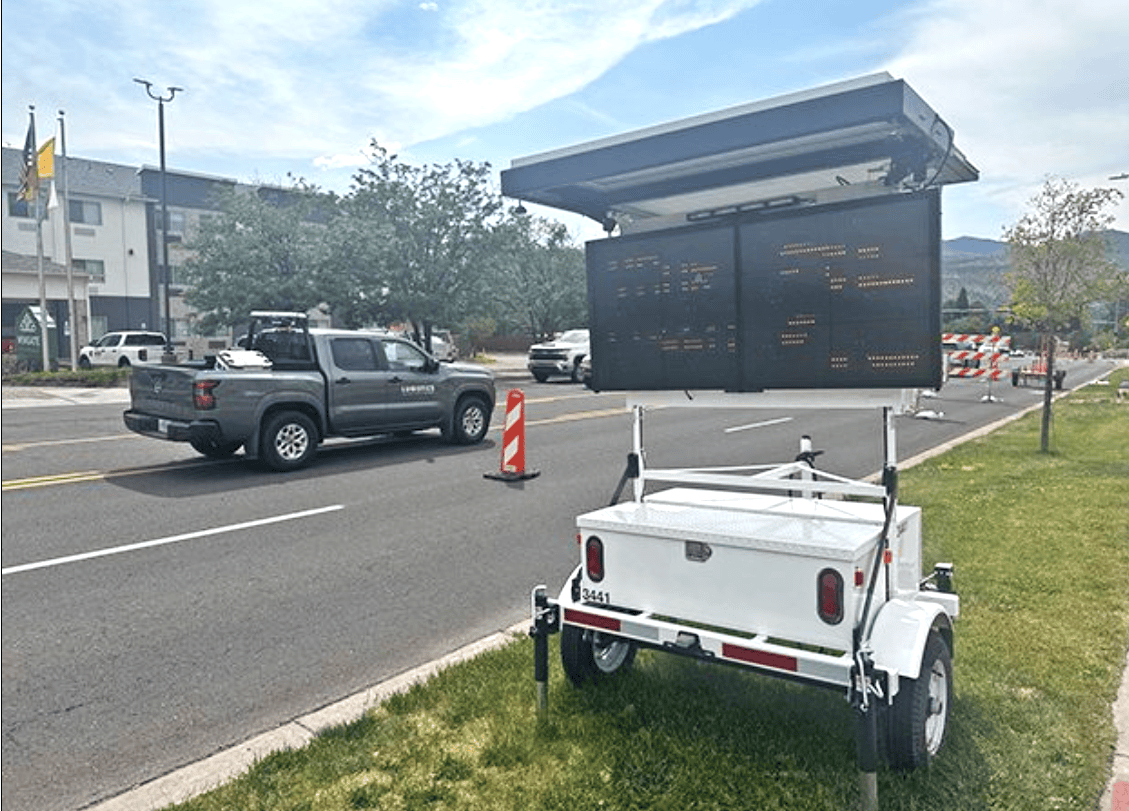
 An electronic sign announces vehicles’ speed on Trinity Drive. During the June 30 meeting, Los Alamos County Council approved the purchase of five speed cameras to further deter speeding and improve traffic safety. The cameras cost $2.1 million. Photo by Kirsten Laskey/ladailypost.com
By KIRSTEN LASKEY
Los Alamos Daily Post
kirsten@ladailypost.com
In a 5-2 vote, Los Alamos County Council approved an approximate $2.1 million services agreement for five speed enforcement cameras during its regular meeting June 30.
Councilors David Reagor and Beverly Neal-Clinton were opposed.
“I don’t think it really addresses the issue because we have lots of other issues involved in accidents or all of them have other causes and it’s very expensive, so I won’t be able to support this,” Reagor said.
Neal-Clinton said she felt the speed cameras impeded on people’s freedoms, which she could not support.
Councilor Suzie Havemann, who made the motion to approve the services agreement, said, “I personally, and people I talk with, want to see people slow down and want people to change their behavior about their driving habits and this is one tool. It’s not going to solve everything … but I think taking steps is better than not taking steps. I, for one, feel the benefits outweigh the costs when it comes to speed cameras and trying to modify behavior that is safer for everyone in the community …”
During his presentation to Council, Police Chief Dino Sgambellone said the five cameras would be placed at fixed locations around Los Alamos. Their exact location would be based on documented safety needs.
He outlined some of the criteria in his presentation:
- Traffic volumes;
- Vehicle speeds and speed trends;
- Crash history and severity;
- School zones and pedestrian activity;
- Citizen complaints and community concerns; and
- Traffic engineering analysis.
The goal for the cameras, Sgambellone said, is to deter speeding and traffic accidents. He added that state law mandates what the revenue from speed enforcement programs can be used for and locally the funds would be used for traffic safety initiatives.
Sgambellone said once the services agreement is official, it is expected that the cameras be installed and operational in six months from the effective date.
He emphasized that the speed cameras are “just trying to improve roadway safety while maintaining the public’s trust and confidence.”
Speed cameras are not the only things monitoring vehicles; council also learned more about the County’s Automated License Plate Recognition (ALPR) program during the June 30 meeting.
Sgambellone explained that the ALPR was introduced in 2023 as part of the County’s commitment to public safety and responsible technology use. They are used exclusively for law enforcement. The data is secure and accessible only to trained staff, he added.
Furthermore, New Mexico Senate Bill 40, which is effective this month, strictly limits ALPR data use, bans sharing for certain activities and requires regular reporting.
Sgambellone said ALPR’s core commitment is to:
- Enhance public safety while protecting civil liberties;
- Clear guardrails for data collection, usage and storage; and
- Comply with state mandated reporting and local system audits.
While the Supreme Court hasn’t yet ruled on a case specifically involving ALPRs, law enforcement and the lower courts heavily rely on the Supreme Court’s longstanding doctrines on the Fourth Amendment to support warrantless use of ALPR technology, Sgambellone said.
He added that the Supreme Court established in the case Katz v. U.S. 1967 that “what a person knowingly exposes to the public …. is not subject to Fourth Amendment protection.”
Therefore, because license plates are required by law to be clearly visible on public roads, drivers have no reasonable expectation for privacy regarding them.
Additionally, Sgambellone said ALPR offers people safety benefits such as the amber/silver, Brittany and turquoise alerts.
Regrading civil liberties, “the new state law, which addresses reporting and accountability and when I say reporting, it’s reporting things like our audit, our internal audit process and whether or not there were any misuses of the system, and the law discusses potential penalties for the agencies up to and including not being able to utilize the technology,” he said. “There are data retention limits, again, state mandated reporting system audits, data sharing limitations, the data is not shared with any agency that we don’t want to – we own the data. The data is never sold; and we only share data with agencies that we are allowed as prescribed by law.”
“Data and evidence collected by law enforcement through these devices is intended to help solve crime, reduce threats, improve training and promote transparency and accountability,” Sgambellone continued. “We own and control all data collected on these devices. We protect that data by investing in and remaining committed to world-class information security and privacy and we safeguard that privacy, human rights and dignity of individuals with tools such as access control and redaction.”
There are various cameras around the County, he said. Some are managed by the police department and others are not. Data collected from security cameras are retained for 128 days while traffic operation cameras’ data is retained for 28 days and My Drive, which livestreams various roadways, has its data retained for 28 days.
Regarding ALPR’s data retention, Sgambellone said any data that is not needed for evidence, or an investigation is purged automatically. As far as sharing with third parties, the data is distributed by invite-only. Access to the data is limited to authorized agencies to support cases and no copies of the data are made.
“This data helps us to accelerate investigations, find missing persons, better protect communities we serve by locating, identifying vehicles faster and more accurately … it’s estimated that over 75 percent of all crime involves a vehicle so it’s not surveillance for surveillance’s sake when designed responsibly, which this system is, (and) provides safety with accountability,” Sgambellone said.
Havemann wondered how ALPRs can be protected from any bad actors in the police department.
A lot goes into that answer, Sgambellone said. The department’s hiring practices, its culture, guiding principles, mission statement, accountability measures are in place to prevent any bad actors.
Another measure is the “audit logs and there’s two ways to do that – one, you just randomly check cases and determine if the information that was entered makes sense … and the other way is to specifically identify data or queries …,” he said.
Sgambellone added that since the program was initiated in 2023, there haven’t been any misuse investigations or any complaints received by the department.
Havemann asked if the Department of Homeland Security could demand the data for possible deportations.
State law prohibits that, Sgambellone said. The only way Homeland Security could get the data is through a search warrant and he said he has never heard of that happening.
Councilor Theresa Cull asked if the data collected was subject to the Inspection of Public Records Act (IPRA).
County Attorney Alvin Leaphart said APLR is not subject to IPRA; it is confidential and not considered a public record.
Cull also wondered what APLR is capturing.
Los Alamos Police Cmdr. Christopher Ross said the camera takes a general picture of the car and the license plate. It mostly captures images from the rear or side of the vehicle.
“…it’s not looking for facial recognition; it’s just looking for the vehicle or the plate,” he said.
Those who spoke during public comment expressed concern and skepticism toward the APLR program. Some said they were worried that APLR would be used for surveillance and tracking purposes and could lead to false arrests. Others questioned why the public is just now hearing about this program when it was approved in 2023.
One speaker commented that the way data was collected could be dangerous and APLR faces widespread backlash across the country.