Card commemorating St. Pio of Pietrelcina. Courtesy/Sherrry Hardage
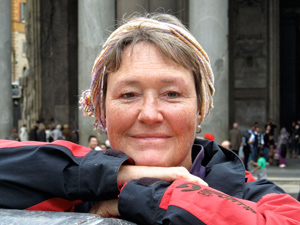 Solo Traveler: When Travel Teaches
Home again after a three-month trip to Europe, I missed the daily activity of exploring a new location, taking pictures of interesting stuff and then writing about it. Still, it was great to reconnect with old friends for chats about my travels.
A friend, Anna, asked if I’d learned anything over such a long trip. What a question! Of course I had learned about various artists, history, and culture, but what had struck me most strongly was that standing in a place you’ve only ever heard about can make you understand things you never even considered.
What I learned about art in Spain is how much El Greco from the 16th century influenced modern impressionism in the twentieth century. His work, and interest in his life, had almost disappeared by the time the 20th century rolled around. For a variety of reasons interest revived, and his impressionistic painting strokes were seen in new light. He consequently influenced a couple of generations of painters.
I had viewed his work in high school, thanks to my Spanish teacher’s extensive collection of art slides, but standing in front of his large paintings in the Prado meant seeing, for the first time, the astounding similarity of his work to modern impressionists. It made me curious, it made me look up information, and it made me travel to Toledo just to see his museum.
In Rome, I read a short blurb next to an ancient sculpture that set off another connection.
The text described the wife of an emperor who was deified after her death and a temple was built to honor her. The ancient Romans deified people? I thought their pantheon of gods was solid and immutable. No, they kept adding new ones when exceptional people died and priests decided they deserved God-status.
Isn’t that what the Catholic Church does today, in slightly different form? They sanctify people, who in life were deemed to have accomplished miracles, saved people’s lives, and who, in death, still miraculously heal.
Padre Pio, who died in 1968, was a rather eccentric priest from Pietrelcina who was known to go into trances during Mass. He is said to have appeared in other locations during his trances, sometimes half way round the world.
He also suffered terribly from the Stigmata, with almost constant bleeding from the holes in his hands and feet. His following, during life, was extensive. People packed his church when he was giving Mass, as much to receive Mass from so unusual a man, as out of curiosity to see if he might fall into a trance and writhe on the floor. The day he died, the Stigmata disappeared and his lifeless body showed no signs of wounds or scarring. He was sanctified in 2000.
When I told Anna about making that historical connection, she said, “Why do you think they call them Roman Catholics?”
Duh.
Editor’s note: Sherry Hardage lives in Los Alamos and has been traveling solo in the Americas, Europe, and Asia since she retired from Honeywell in 2009. She is a photographer, writer, and guide who organizes tours of Chiapas, Mexico through her website: www.mexadventures.com