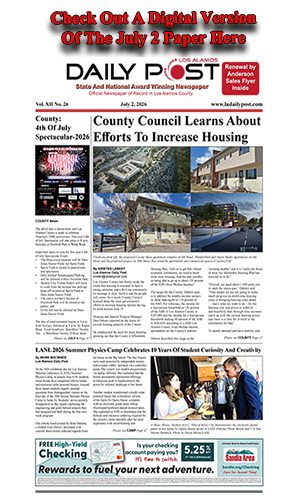
Los Alamos Site Manager of the Manhattan Project National Historical Park Charlie Strickfaden provides an update on the park during the Oct. 10 County Council meeting. Photo by Kirsten Laskey/ladailypost.com
Staff Report
Work is progressing on the Manhattan Project National Historical Park (MPNHP), the Los Alamos County Council learned during its regular meeting Oct. 10. The park’s Site Manager Charlie Strickfaden gave a short presentation to the Council about the park.
In his presentation, Strickfaden identified the draft version of the park’s purpose: “Managed in partnership by the Department of Energy and the National Park Service, Manhattan Project National Historical Park preserves and interprets the nationally significant historic sites, stories, and legacies associated with the top-secret race to develop an atomic weapon during World War II, and provides access to these sites consistent with the mission of the Department of Energy.”
The park actually spreads out over three states: Washington, Tennessee and New Mexico. Strickfaden said the park’s organization follows a model similar to other partnership national park units. He noted in addition to multiple states, there are multiple agencies involved. Additionally, there is no National Park Service land or property ownership. Strickfaden added there are multiple partnerships with local governments, private landowners and nonprofit organizations.
In Los Alamos, Strickfaden said there are currently nine properties in the park. These include:
- Pajarito Site (TA-18) – Pond Cabin, Battleship Bunker, Slotin Building
- V-Site (TA-16) – two buildings
- Gun Site (TA-8) – four buildings
He added there are eight properties that are “park eligible.” These are:
- TD-Site (TA-22) – Quonset Hut • K-Site (TA-11) – Betatron and Cloud Chamber Buildings and Control Bunker
- L-Site (TA-12/-67) – Firing Pit
- Q-Site (TA-14) – Shop and Darkroom Building
- S-Site (TA-16) – HE Magazine
- Two-Mile Mesa Site (TA-6) – Concrete Bowl
Looking to the future, Strickfaden said there are a number of objectives. These include:
- Expanded ranger-led programs and additional National Park Service staff
- Interpretive displays and educational programs that go beyond the standard telling of Manhattan Project history – displacement of local populations – worker experiences of local communities – human costs and environmental consequences
- Support preservation/restoration work of historic properties
- Artifact, photograph, document, and oral history inventories
- Support efforts by the DOE to enhance public access