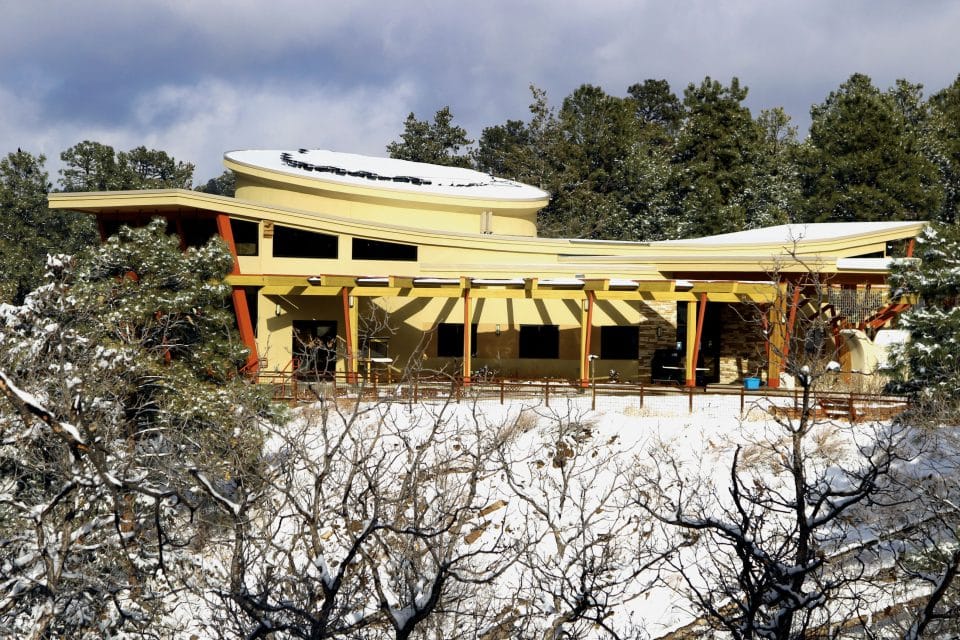
 The Los Alamos Nature Center following Tuesday night’s snowfall. Photo by Jenn Bartram/ladailypost.com
By KIRSTEN LASKEY
Los Alamos Daily Post
kirsten@ladailypost.com
Los Alamos is working hard to be green. During a virtual talk hosted by the Pajarito Environmental Education Center (PEEC) Thursday night, Los Alamos County Resiliency Energy and Sustainability (LARES) Task Force Vice Chair Robert Gibson shared highlights of the task force’s recommendations to achieve net zero greenhouse gas emissions in Los Alamos County.
The task force will present its recommendations Feb. 22 to Los Alamos County Council.
Gibson explained that the Council approved the formation of the task force last year and charged it with looking at reducing greenhouse emissions.
“We as a community contribute around 200,000 metric tons per year of carbon dioxide equivalent into the atmosphere and we would like to get that down to a much lower level,” he said.
Highlights of the report include:
A general recommendation is to establish a goal of net zero greenhouse gas emissions as soon as possible. To achieve this goal, Gibson said the exact amount of carbon dioxide emitted each year in Los Alamos needs to be known. A more detailed emissions study is needed to establish reduction targets, he said, adding that a climate change action plan needs to be developed, as well as a way to track how the County is doing. This should be presented in an annual report given to the County Council, Gibson said.
In terms of natural gas reduction, Gibson said the Board of Public Utilities already has a plan to phase out natural gas by 2070, and that this is a tall order because every building in Los Alamos is hooked up to natural gas. The task force would like to reduce natural gas usage by at least 2 percent every year. This can start with new construction, Gibson said, adding a date should be set to stop natural gas hookups. For existing buildings, things such as insulation, heat pumps, solar heaters and induction stoves can all help lower natural gas usage. Plus, he said energy audits could be made available through the Department of Public Utilities.
Regarding electricity, Gibson explained that the demand for electricity is expected to increase with the introduction of electric cars and increasingly electrified heat. To satisfy the demand, he said more carbon-free power sources such as solar and wind should be considered. Additionally, Gibson said that LARES recommends that the County only purchase market power that is generated by carbon-free sources. Since wind and solar energy is intermittent, the County will need a strategy to address that with storage, he said.
As far as transportation, taking public transportation needs to be encouraged as well as carpooling, Gibson said. The County is encouraged to acquire more electric cars for its fleet. A no idling policy also should be created to reduce unnecessary emissions.
Regarding water, increased management of the County’s water is necessary as well as managing stormwater runoff. Natural areas should continue to be carefully managed, too, he said.
Other suggestions include investigating whether the DPU can offer loans for homeowners to perform energy efficient retrofits. These loans would be repaid through the homeowners’ utility bills. Additionally, Planning and Zoning could consider approving commercial developments outside of the downtown areas to cut down on emissions caused by driving around town.
Several speakers showed that saving the environment offers other benefits, too, including saving money and improving people’s health.
Katie Leonard, who helped spearhead the creation of LARES and is a member of the County’s Zero Waste Team, offered advice on how to effectively reduce, reuse and recycle.
“I would be willing to bet that most of you have at least one reusable mug or water bottle in your kitchen,” Leonard said. “Pandemic notwithstanding, how many times have you gone to a coffee shop and thought, ‘Ah! I should have brought my reusable mug’ … creating a habit takes time and commitment.”
“If you bring regularly a reusable grocery bag to the grocery store, congratulations, you have created a habit. Now we need to do this for lots of things,” she added.
Leonard emphasized the importance of reducing and reusing. Recycling should be the last option.
“Try repairing and refurbishing items before tossing them out,” she said. “Ripped jeans can be patched and old clothes can be cut into rags. I challenge you to use only one roll of paper towels per year.” Regift things, too, is environmentally beneficial. Leonard said the Internet is a great way to find people who will gladly take your stuff.
If an item needs to be recycled, it should be done right. Leonard said that it is key for containers to be empty, clean and dry.
“When in doubt, throw it out,” she said.
Corrugated cardboard is “recycling gold” while Styrofoam is not recyclable in Los Alamos. Leonard added that despite material having the recycling logo on it, that it doesn’t mean it can be placed in a blue bin.
“A great resource to find out whether an item can be recycled is a free app call Recycle Coach,” she said.
It can be downloaded here.
“Being environmentally conscious is as simple as turning off lights and electronics or lowering the thermostat one or two degrees in the winter or up a few degrees in the summer,” Leonard said. “While waiting for water to heat or cool, fill a bowl with the access water to be used for something else.”
“These things save resources, reduce pollution, and they save you money, too,” Leonard said.
One of the most beneficial changes you can make is reducing food waste, Zero Waste Team member Sue Barns said.
“Food plays a major role in the climate,” she said.
“Food production really accounts for a big chunk of our global emissions – 24 percent or so -about the same or more than electric production and transportation,” Barns said. “Why is that? Because we produce so much food to feed our now 8 billion people and because agriculture has many sources of greenhouse gas emissions associated with it. These include land disturbance, deforestation, pollution from fertilizer and pesticides, processing transport and sale of food and the infamous methane release, so there are lots of sources from lots of food production and all of that adds up to lots of emissions.”
“Studies show that reducing food waste and having a plant-rich diet are at the top of the list for helping reduce emissions,” she added.
As far as food waste stats, Barns said that globally, over a third of all food is wasted. The U.S. is one of the biggest offenders.
Los Alamos is not exempt. Barns reported that in 2019 in Los Alamos, residents sent more than 1.6 million pounds of food to the landfill. Furthermore, studies show 70 percent of the food thrown out was edible. She added residents alone send 1.5 tons of edible food to the landfill every day. At the landfill, food waste makes methane, a greenhouse gas that is 28 times more potent than carbon dioxide at trapping heat and accelerating climate change.
This has already cost Los Alamos; Barns said in 2018 the County spent over $1 million to install a methane capture system at the landfill.
The good news is food waste can be reduced and Barns advised that it can be as simple as planning meals for the week, shopping the refrigerator before shopping at the store, making a list, avoid grocery shopping when hungry and not falling for the buy-one-get-one-free marketing ploy. Nonperishable food can be donated to food pantries or composted. She added savethefood.com has great tips.
“Our food system impacts almost every aspect of our environment, of our civilization and our lives in very big ways,” Barns said. “We use half of all our habitable land on earth for food production and when we waste food or grow food unsustainably, we waste that land. Most of our fresh water goes to growing food and as a result food waste alone weighs 25 percent of our drinking water. When we grow food unsustainably or in the wrong places, we kill plants and animals leaving the species to decline into extinction. Food waste and unhealthy eating costs individual states and nations trillions of dollars every year and all of this is going to get worst as our population expand beyond 9 billion by mid-century unless we change what we do around food.”
Council Chair Randall Ryti spoke about what is being done on the international stage regarding climate change. He attended, as a member of the Coalition of Sustainable Communities NM Delegation, the 2021 United Climate Change Conference (COP26) in Glasgow, Scotland.
“While at times sobering, Ryti said, “there was a real sense of urgency at the conference, there also was optimism.”
“In general people wondered what the experience is like, if you come back feeling hopeful or not and I think you do feel hopeful,” he said. “There’s a lot of good information about what’s going on. There’s more certainty in the modeling and in the science and there is a big commitment … from nations and states down to individual cities…”