 Courtesy/New Mexico Historic Women Marker Initiative
New Mexico Historic Women Marker Initiative:
Storytellers have flourished into a cottage industry in Cochiti. Women in this northernmost Keresan village have played a central role in keeping figurative ceramics alive and innovating the craft to meet the demands of the market.
By the late twentieth century, Pueblo figurative sculpture began to be valued as art, partly due to the popularity of Storytellers. Storytellers are now widely collected, appearing in major museums and private collections throughout the world. Moreover, Storytellers reflect values that continue to characterize Pueblo society, including the importance of oral tradition, generational ties, and community.
Figurative ceramics—animal, bird, and human figurines—have historically thrived at Cochiti. As the tourism market grew with the coming of the railroad in the 1880s, Cochiti women crafted and sold human and animal figures to outsiders. During this time period, collectors and dealers referred to these figures by the Spanish word mono (monkey, silly fool, mere doll) and did not regard them highly.
Many of these figures caricatured outsiders; scholars have speculated on their role as a form of social commentary on the changing demographics of late-nineteenth and early-twentieth century New Mexico. Use of the term mono to refer to all types of figures continued until the late 1960s, and thereafter the term Storyteller came into widespread use. Storyteller is now used in much the same way that the term mono was used to refer to freestanding pottery figures in general.
Between 1920 and 1960, figures of women holding one or two children were the most popular at Cochiti. Scholars refer to these figures as Singing Mothers or Madonnas and recognize them as the precursor to the Storyteller.
Read the Full article on Cochiti Women
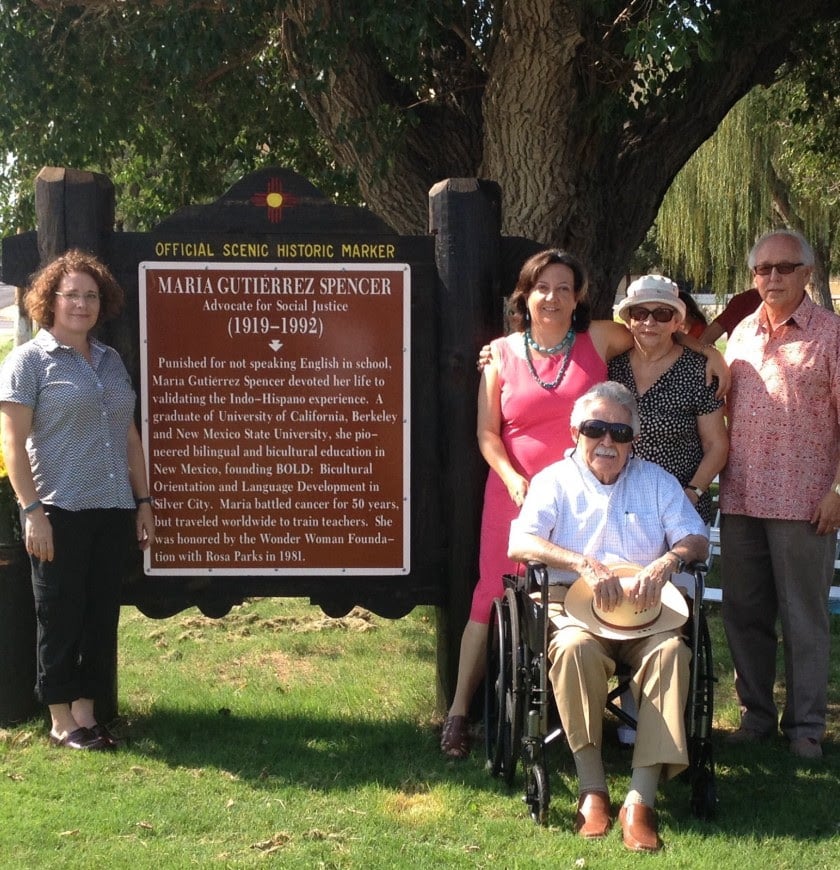
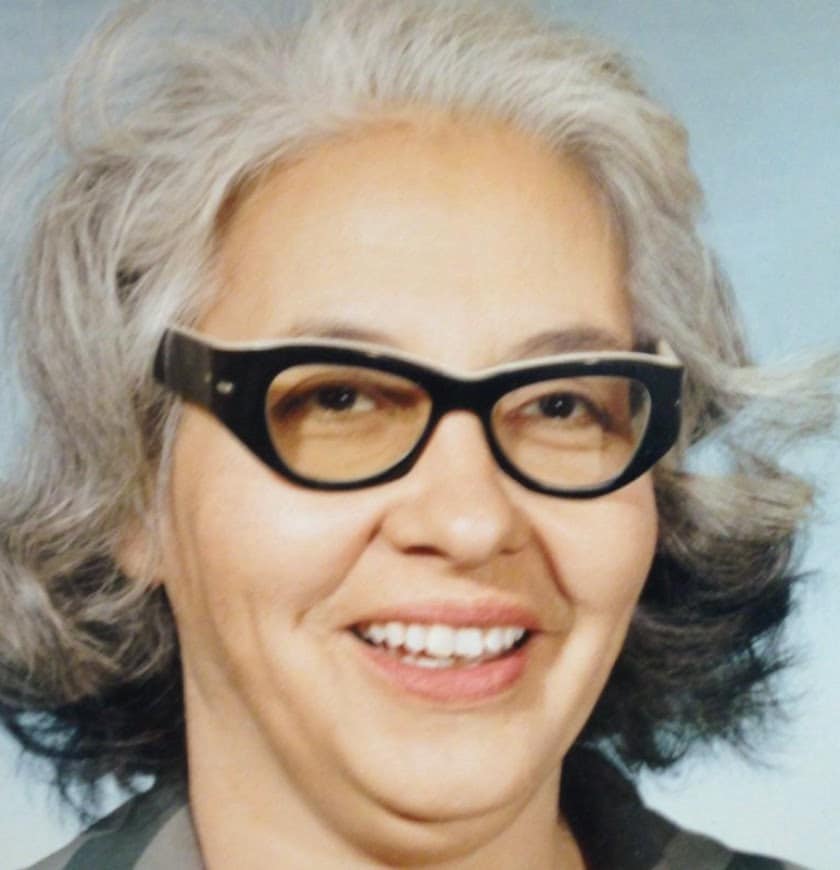 Maria Gutierrez Spencer
County: Dona Anna
Category: Education
María Gutiérrez Spencer seems to have found her calling at age five on her very first day of school: Spencer, who spoke only Spanish, could not follow the English instructions her teacher was giving her, and she was sent to the principal’s office. She would go on to become a lifeline advocate for bilingual education and help pioneer the field in New Mexico schools.
Spencer was born Dec. 17, 1919 in Las Cruces, NM. Her parents were Jesus Borunda Gutiérrez and Aurora Valdéz. She spent her childhood in Las Cruces and excelled at school. As graduation neared, she asked her father, “If I graduate as valedictorian, will you send me to Berkeley?” According to her daughter, Laura Gutiérrez Spencer, Spencer asked this question when her father was reading the paper and she knew he wasn’t paying attention – and he said yes. Though she graduated salutatorian, not valedictorian, from Las Cruces High School in 1933, her father stuck to his word. She went first to Riverside Junior College to become acclimated, then enrolled at Berkeley.
Spencer excelled in her education, majoring in Spanish and Latin American history. She was the first woman to be a Teaching Assistant in both the History and Political Science Departments.
After her graduation in 1941, she worked briefly as a translator in New York, then returned to California and her first teaching assignment, at Riverside Polytechnic High School, was not an easy one. She often took away chains and other weapons from the students – at least once even removing a knife that a girl had concealed in her hairdo. Nonetheless, as summarized by the Las Cruces Sun News in a November 14, 1984 article, she “with patience and empathy, turned their suspicion to trust and eventually mutual affection.”
Read Maria Gutierrez Spencer’s Full Article Here
 Courtesy/New Mexico Historic Women Marker Initiative
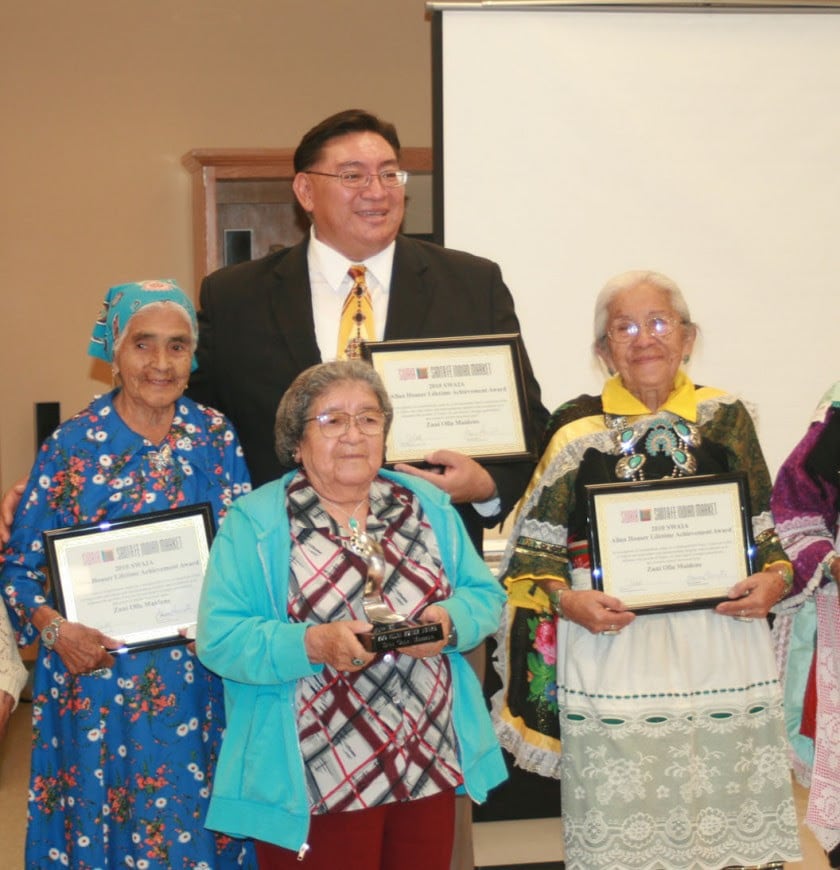
Zuni Olla Maidens
County: McKinley
Category: Arts
Zuni Olla Maidens are one of the most renowned dance groups in New Mexico. The members, all women, dance with fragile water jars, or ollas, balanced on the top of their heads.
These women play an important role in Zuni, acting as cultural ambassadors for the community portraying and preserving cultural traditions for future generations.
Dressed in traditional costumes—colorful dresses and turquoise jewelry that Zuni jewelers are known for—the Zuni Olla Maidens sing songs of their own composition in the Zuni language as well as those written by male community members. In addition, they utilize hand held instruments including drums, rattles, and another wooden instrument that mimics the sound of frogs.
The largest of the New Mexico’s nineteen Pueblos, Zuni is relatively isolated. It lies about 150 miles west of Albuquerque and a distance away from the other Pueblo villages that primarily sit along the Rio Grande valley. This isolation limited Zuni contact with the Spanish during the colonial era, and resulted in the pueblo’s current status as one of the most culturally conservative of all the pueblos. Mistaken for the fabled Seven Cities of Gold by the Spanish after an expedition led by Friar Marcos de Niza descended on the pueblo in 1539, Zuni underwent a second wave of Spanish intrusion when Francisco Vasquez de Coronado arrived the following year.