By ZHEN HUANG
Los Alamos
It was a shock to me that Dr. Tom Shankland left his last thoughts in the high-altitude atmosphere that will circulate around the globe forever, then all the cherished moments over 10 years ago I spent in the Physics Building at LANL where Tom was my next-door officemate, popped up in my memories.
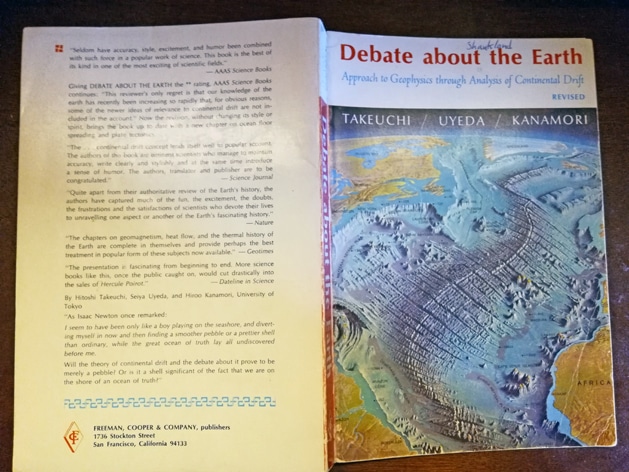
In my personal library holdings, there are several books I have inherited from Tom when he gave away his lifetime treasures on the hallway floor for “recycling”. Among them, “Debate about the Earth” has become one of my top picks when my thoughts are in need of a refreshment.
As an atmospheric scientist, the reason I am particularly interested in reading this book is because of Alfredo Wegener, a German Meteorologist and a pioneer scientist in Arctic Climate Research. In China, every school kid knows the fascinating story about Wegener who “accidentally” discovered the Theory of Continental Drift while he lay in a hospital bed looking at a world map on the wall. We know that Wegener had to drop off his scientific discovery work because of the outbreak of World War I. He had to join the army to fight the war and got injured twice during the wartime. He used his long sick leave looking into what he discovered in detail and improved his Theory of Continental Drift. However, as a layman in geology, I don‘t know much about the interesting half century long debate behind Weneger‘s fascinating discovery story. It was Tom who introduced me to this fascinating geological world.
In my cherished memories, I enjoyed conversations with Tom who not only explored in depth his areas of scientific expertise as a geologist but also had profound visions in multidisciplinary research and development of frontier sciences. One of the topics we chatted most was about the Lithosphere-Atmosphere-Ionosphere Coupling (LAIC) and associated Earthquake precursor detection.
The LAIC Earthquake precursor theory is also a debated topic since it was proposed as early as in the mid-1960‘s. The debate about the Theory of Continental Drift has been resolved because of the discovery of evidence in deep sea fossils and the advancement of theoretical models of the earth tectonics. The debate about the LAIC Earthquake precursor theory still goes on after a half of century because of lack of concrete theory to understand the LAIC mechanism, and lack of adequate satellite data coverages in spatial and temporal scales to detect seismic signals in the high-altitude atmosphere.
During the two years of time when Tom and I were next door officemates, the debate about the LAIC Earthquake precursor theory was heated up because of the catastrophic 2011 Tohoku earthquake. I remember Tom would forward to me those related articles he found interesting right at their appearance. He also introduced me to an emailing list for a group of interested scientists around the world to debate the issue and exchange research and development on this subject.
At the time, most geologists were skeptical of the LAIC Earthquake precursor theory. I remember Tom was amazed to see the movie I forwarded to him that showed propagation of seismic signals in the ionosphere during the 2011 Tohoku earthquake that had some precursor trace. I remember I asked Tom about his opinion as a geologist. He explained to me what his point was from a perspective of the earth‘s electric conductivity and emphasized that he was skeptical but open minded and would love to see breakthroughs from different perspectives. I was impressed by his critical thinking and open mind toward a debated scientific topic.
In my cherished memories, I also enjoyed the time spent with Tom for his curiosity that was a reflection of the genetic character of a scientist and his sense of humor that was pre-programmed with his scientific inspiration and discovery spirits.
I remember in those stormy winter days when my office room got overly hot Tom‘s room could get extremely cold, but no facility management seemed bother to solve such a “serious discrimination issue” as Tom technically defined. One time when we were joking about how we could drill holes to get air mixed through the dividing wall to solve the issue on our own, Tom noticed my office had a huge world topography map that occupied most of the dividing wall, then he pointed to the Mid-Atlantic Ridge and suggested we should have a “deep sea drilling team” to do the job. It was the fossil evidence from the Deep-Sea Drilling Project, a joint international effort from 1970‘s to 1980‘s, that finally verified the Theory of Continental Drift. See how scientifically inspired Tom‘s sense of humor was.
I remember one summer, a high school student came to do the custodial jobs in our building, who was a talented young artist. She used the poster board in the hallway for her wall art paintings. It was such a joy to witness how a blank poster paper gradually grew cheerful clouds, rainbows, and wildflowers, lovely little animals playing in forests and streams, and Uncle Tom‘s little cabins built up overnight. Everyone in our building appreciated the fresh entertainment the summer student brought to us, but I think no one was as close as Tom got into it.
The wall painting art was like a huge coloring book page that the young artist had partially sketched from time to time. My office door was right across the poster board and I found that Tom often came to add coloring here and there while checking out its progress. Tom actually served as an art work coordinator, if not a co-authored artist.
As Einstein said, “After a certain high level of technical skill is achieved, science and art tend to coalesce in esthetics, plasticity, and form. The greatest scientists are always artists as well”. Tom was such a senior level scientist by profession, as well as a young from heart artist by configuration, both share the same distinctive nature of curiosity in discovering the colorful world.
In my cherished memories, Tom‘s profound scientific vision, his critical thinking and open mind, his curious nature, and his humorous character have impressed me, as well as inspired me.
The book “Debate about the Earth” has become a very special one for me since that life event when I was given the opportunity to make a Weneger‘s “accidental” discovery. While waking up from a hospital bed at the darkest time of my life a couple of years ago, the first thing I noticed was the curtain that had a scenery painting of ocean, beach, and bright morning sunrise, an alternative of the world map Wegener got to see. It reminded me of that Isaac Newton‘s quote,
“I seem to have been only like a boy playing on the seashore, and diverting myself in now and then finding a smoother pebble or a prettier shell than ordinary, while the great ocean of truth lay all undiscovered before me.” that instantly brightened my spirits.
This very quote is cited in the concluding remarks of the very book “Debate about the Earth” I have inherited from Tom, and has become a must read every time I pick up the book.
I felt really sorry that Tom‘s life stopped at the high altitude atmosphere because he should have been given the opportunity as Wegener had been while he was recovering in a hospital so that Tom could discover a new perspective to challenge the Theory of Continental Drift or to wrap up the debate about the LAIC Earthquake precursor theory.
Meanwhile, I felt a bit fortunate because in the high-altitude atmosphere we have got Tom as a reliable Detection Satellite circling the globe with his ultimate missions to watch over our earth on an all-weather year-round setting. What could be his missions?
Probably, Tom wanted to keep an eye on any anomalous traces in the upper atmosphere in person, so that seismic signals could be effectively retrieved as precursors to advance our capability to reduce the devastating damage that earthquakes caused worldwide.
Probably, Tom wanted to have a personal communication with Wegener who constructed the first meteorological station in Greenland where he launched weather balloons to make high altitude atmospheric observations, so that he could get insights to develop new equipment to launch for data collection to combat climate crisis that has been escalating in an unprecedented pace.
But most likely, Dr. Tom Shankland, in the name of a Los Alamos Scientist, wanted to watch over Los Alamos in a full-spectrum scope and a best line-of-sight to make sure no operations would be carried out that could lead to mass destruction of the world he loved so much and devoted his entire life to towards a brighter future…