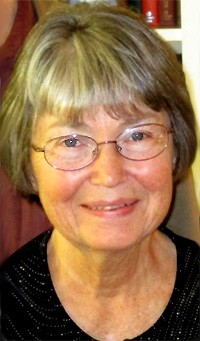
 By NELLY MAUDE CASE
Los Alamos
Our phone rang late this afternoon with the official word that Los Alamos County will move from “Ready” to “Set” status at 8 a.m. tomorrow morning in regard to the Cerro Pelado wildfire, located now about seven miles to the southwest of us in the Jemez Mountains.
If and when we get the “Go” signal, we will have no option but to jump in our cars and evacuate as soon as possible, via the main road down the mountain and away from the Los Alamos National Lab—descendant of the Manhattan Project, where the atomic bomb was developed during World War II.
For someone who lived virtually her entire life up until retirement east of the Mississippi and north of the Mason–Dixon Line, the unrelenting high winds and smoky skies of the past few weeks have been frightening enough.
All the same, evacuations have already begun in the area of the Calf Canyon/Hermits Peak Fire within the Santa Fe National Forest, which has reportedly become the largest wildfire in New Mexico’s history.
Unnerving as it is to see those smoke plumes, too, towering above the Sangre de Cristo Mountains, I can’t help but wonder what effect both fires may have on our daughter Susannah’s wedding, set to take place in Santa Fe just two weeks from today.
Many members of the groom’s family, in addition to the happy couple and most of the bridal party, are scheduled to fly in from the Northeast for a full weekend of activities. Those include, of course, the wedding reception, which was booked and paid for nearly a year ago at Meow Wolf Santa Fe—billed as the “Original Immersive Art Adventure.” At the least, will it be possible to hold the wedding ceremony outdoors as planned? At the worst, will the whole shebang have to be cancelled and rescheduled for some future date? At this point, the what–ifs are endless.
Shortly after we moved to Los Alamos six years ago, Stephen insisted we follow the standard local recommendation (following seriously destructive wildfires here in 2000 and 2011) to prepare one suitcase each for the eventuality of evacuation, whatever the cause might be. I didn’t really take the exercise seriously at the time and basically filled a carry–on size bag with clothing that wasn’t exactly central to my wardrobe, plus a toothbrush, toothpaste, deodorant, etc. Recently the Los Alamos Daily Post online and the LA Senior Center, among others, have provided detailed lists of truly essential items to take along, including prescription meds, bottled water, etc., as well as planning where to seek refuge “down the hill.” In response to my current sense of panic, a number of my Los Alamos friends, many of whom have lived through previous evacuations, also strongly advised that I “try not to worry” but instead focus on determining exactly what items I could or could not live without, if our house was lost. Thus, for the last few days I’ve been going through closets, filling boxes, and packing my car.
Sorting through a lifetime
We had to downsize considerably when we sold our house in northern New York State and retired to a townhouse in Los Alamos in 2016. In 2018 my sister and I cleared out and sold what had been our family home in southwestern Ohio since 1956. But never before have I had to winnow things down to what would fit in a Toyota Corolla. Even then, this unsettling process is nothing like what the millions of Ukrainian refugees have gone through, often leaving behind not only countless personal belongings but family members determined to stay and defend their homeland. Compared to that type of heartbreaking experience, my task has been at most sobering but in some cases even enriching.
What have I chosen to take with me when the call telling us to “Go” comes in?
1. two carry–on size suitcases of clothes I would willingly wear
2. eight large family photo albums and one box of framed photos
3. two smaller boxes of personal mementos spanning most of my life
4. a copy of the last book I wrote, My Heart Goes Home, which recounts my parents’ complex romance from the 1920s through World War II
5. the manuscripts of stories our son dictated to me and illustrated at age five during the two semesters we taught English at the Foreign Languages University in Xi’an, China
6. my violin, viola, and organ shoes (but no musical scores).
What is it I most want to preserve through these “rescued” possessions?
The essence of family, stretching back as far as my paternal great grandmother, who emigrated from Wales in the 1840s, and hopefully well forward through documentation of our own children’s lives up to now and their ambitions, both personal and professional.
One thing I found among a collection of keepsakes that I hadn’t really examined for many years was a pretend “cat of nine tails.” It originated as a prop for a production of the Gilbert and Sullivan operetta HMS Pinafore that I directed in the spring of 1974 at the Oak Hill School for the Blind in Hartford, CT, where I taught music full time for one school year. What a flood of memories that discovery brought back!
Another surprise—and the real impetus for this bit of writing—was a treasure trove of letters, post cards, drawings, and photographs dating from 1959–64 which came from the German pen pal I had been paired up with, thanks to the ingenuity of our beloved fifth grade teacher at Cherry Hill Elementary School, Mrs. Amelia Child. I well remember having corresponded with young Helga Mattes, who lived in Stuttgart, West Germany, but had no consciousness of having saved her letters for over six decades.
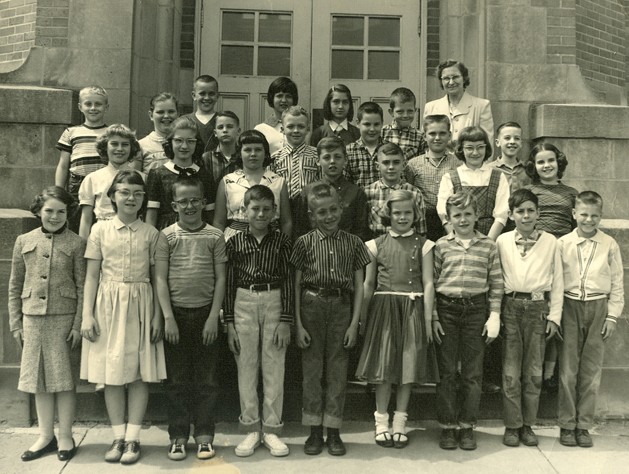 Official photo of my fifth grade class, September 1958 in Washington Court House, Ohio. Courtesy photo
Perhaps even more unexpected was the recognition upon reading Helga’s letters (what else is there to do while we wait for the county to tell us to flee?) of the many points of commonality as well as contrast between our lives, and in particular the singular global events we lived through on either side of the Atlantic during that time. With the benefit of hindsight, I’m also suddenly aware of how much more grown up and more broadly educated Helga was, even though she was but one year older than I was. She often apologized for any mistakes she might be making in her written English, which she had been
studying for only two years. Yet, typical of public education in the United States, it would be another four years from the start of our correspondence before I had the opportunity to study any foreign language in school.
The very first statement to catch my attention appeared in Helga’s letter of February 12, 1959: “I have read in the newspaper that there is a flood in Ohio. I hope the flood is not in your town.” As a matter of fact, conditions in my hometown, Washington Court House, were typical of much of the state.
According to one source, “Rains of three to six inches fell on snow covered frozen ground, producing the most destructive flooding in Ohio since March 1913. All streams reached flood stage from January 21 to 24, killing 16 people, forcing 49,000 from their homes, and causing extensive damage to homes, businesses, roads, and bridges.”
I can’t recall exactly how long school was closed. but in my own neighborhood flood waters filled Eyman Park and the area where the only swimming pools in town were located and overran the railroad tracks beside an adjacent lumber company. (See the photos of the flood, which had appeared in the Washington Court House Record–Herald newspaper of January 21, 1959.) Much the same was true of businesses on Dayton Avenue, one of the main arteries in and out of town, and the continuation of the railroad past our school at the foot of Cherry Hill. Nowadays one thinks immediately of the “once in a century” flooding that seems to occur more and more frequently across the country, as well as the vulnerability of large coastal cities like New York to inundation and the rising sea level everywhere caused by global warming. Yet so many people who could help do something about it have failed to take the threat seriously.
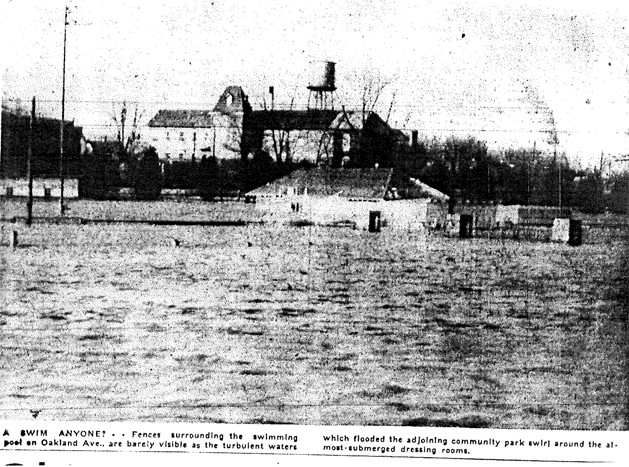 Washington C. H Record–Herald photo of the flooded community park and swimming pool at the high point, January 21, 1959. Courtesy photo
Coinciding with the mid–winter Ohio flood was the birth of my cousin, Kimberly Case, on January 20, 1959 in Cincinnati. I had acted as flower girl at her parents’ wedding in 1956 and had eagerly awaited the blessed event, as had her grandparents Robert and Marjorie Case (my paternal aunt and uncle) who also lived in Washington Court House. Presumably, Kim’s grandmother was already in Cincinnati when (as my cousin herself recently described it) “My grandfather was one of the last to cross the bridge to come meet me before the flood closed the Three C highway south.”
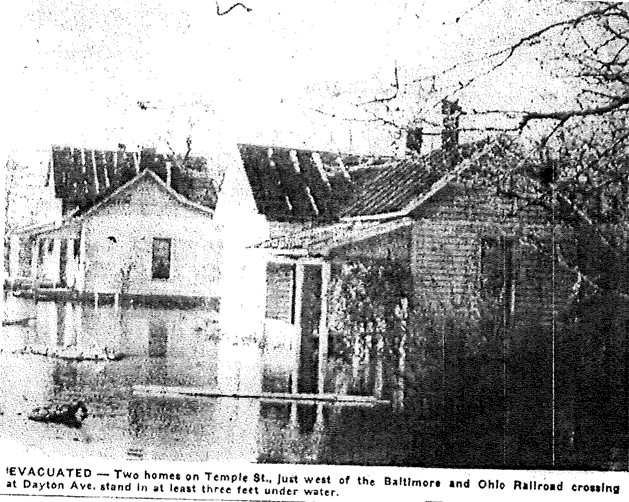 Washington C. H Record–Herald photo of some flooded homes at the high point, Jan. 21, 1959. Courtesy photo
A third highly memorable event that month, that in some sense helps tie together for me not only Ohio’s natural disaster and Kim’s birth but also the current situation here in Los Alamos, was the destruction by fire of Grace Methodist Church in downtown Washington Court House—the very church where the newborn’s parents had been married three years earlier. As related in one historical account, “The Grace Church Society was dealt a staggering blow…when the stately old stone building was destroyed by a spectacular fire early in the morning of January 14, 1959. Starting from a new malfunctioning
$5,000 furnace, the beautiful edifice was virtually consumed in one hour, while 75 firemen from eight fire departments battled the blaze and prevented it from spreading to nearby residences.”
Somehow my 78–year–old maternal grandfather, Karl Kay who lived a block away from our family, got news of the fire at its height, called to tell us what was happening, and took off in his car to take photos of it. Though we lived on the western edge of town, we could see the flames from our bedroom windows, and for weeks after that, I would wake up in the middle of the night feeling fearful.
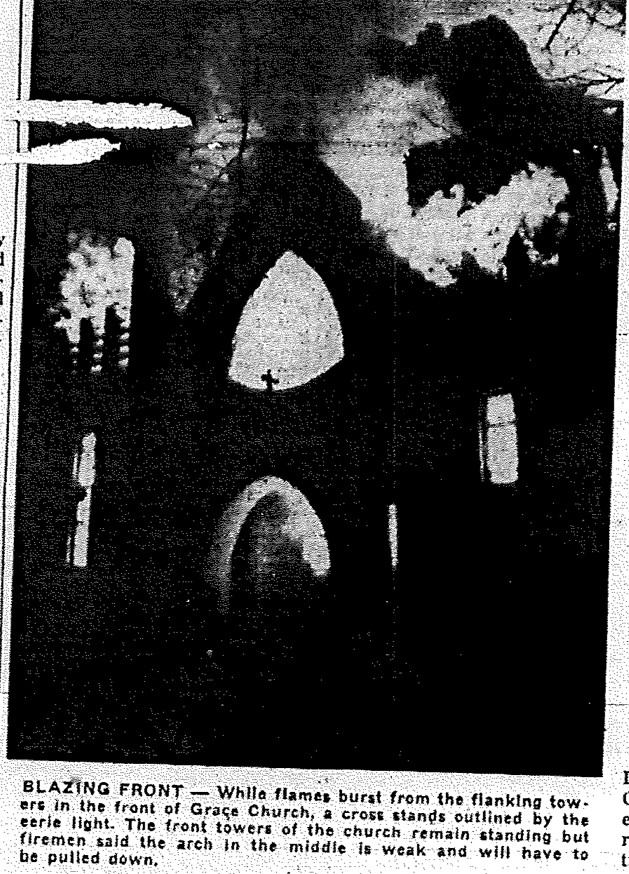 Washington C. H Record–Herald photo of the fire at Grace Methodist Church, Jan. 14, 1959. Courtesy photo