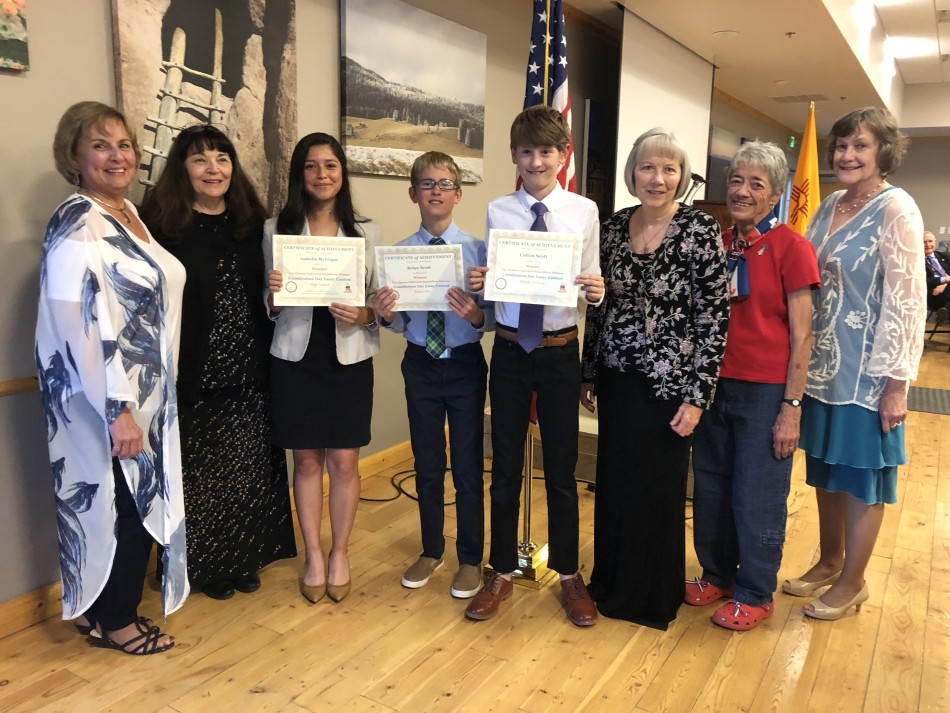
 Members of the LAFRW stand with the three students who won the 2022 Constitution Day Essay Contest. From left to right, Trish Granich, Dianne Coane, Isabella McTeigue, Brian Scott, Colton Scott, Mary Wilhoit, Cathy Walters and Jennifer McKerley. Courtesy/RPLA
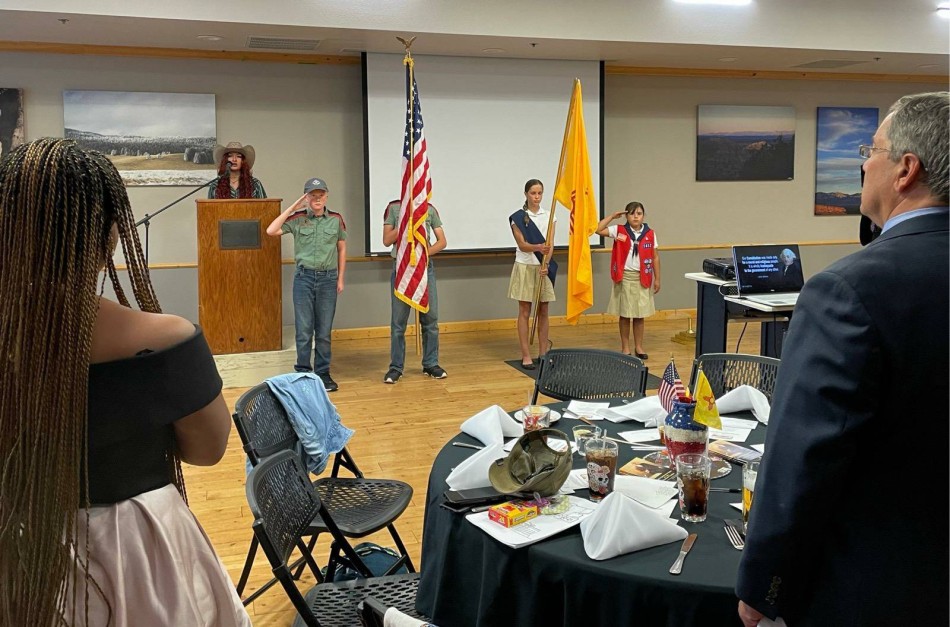 Aspen Jaramillo (at the podium) sings ‘The Star Spangled Banner’ and Trail Life members, Kit Randleman and Riley Christensen, and American Heritage girls, Teagan Christensen and Jayden Muck, perform the flag presentations at the RPLA dinner Saturday at Cottonwood on the Greens. Courtesy/RPLA
RPLA News:
The Republican Party of Los Alamos County (RPLA) hosted the annual Constitution Day Dinner Saturday, Oct. 1 at Cottonwood on the Greens.
The winners of the 2022 Constitution Day Essay Contest were presented with checks by the Los Alamos Federated Republican Women (LAFRW), the sponsors of the annual contest. The students read their essays on how the system of federalism has succeeded in supporting the Founding Fathers’ goals of balancing order with liberty. After the students read their essays, local, state and national Republican candidates and candidate representatives spoke.
Ian Parish spoke for Alexis Martinez Johnson, candidate for U.S. Congress, and stressed that as an environmental engineering professional, Johnson will promote environmental stewardship, not environmental alarmism, which has closed the timber industry in northern New Mexico while creating fire hazards. Johnson believes that we should take an “all of the above” approach to energy and that oil and gas can be part of a comprehensive climate solution. Johnson will work to restore order to the now out-of-control border, restore our failing economy, and stop Joe Biden from sending well-paying New Mexico jobs overseas.
Jeff Byrd said that he is running for the office of New Mexico Commissioner of Public Lands to ensure that schools and teachers have the funding they need to educate children. The State Land Office oversees more than 9 million surface acres and 13 million mineral acres, and the revenue from the leases funds the public schools. Byrd is a strong supporter of ensuring that the New Mexico oil and gas industry is able to thrive. As State Land Commissioner, Byrd wants to put to work his extensive experience in renewable energy, oil and gas, ranching, and electricity regulation.
Tim Bullock is running for Los Alamos Magistrate Judge. His goals are to protect the ideals of truth and justice with unwavering vigilance, to hold people accountable with compassion and to always be faithful in following the law and Constitutions of New Mexico and the United States. He has 17 years of experience in state and federal courts and has practiced before the Colorado Court of Appeals, the Colorado Supreme Court and the Tenth Circuit Court of Appeals where he has presented oral argument. He has experience in helping victims of personal injury, bad faith insurance, consumer law and bankruptcy.
Bill Redmond spoke on behalf of Jeremy Gay, Republican candidate for Attorney General, whose top priorities are to work closely with police, prosecutors, victims, and public defenders to repair and improve the current dysfunctional criminal justice system; to ensure that border patrol is fully funded and integrated into a regional and national effort that will stop illegal border crossings, human trafficking, and drug cartels that use the border as an unlocked door into communities. Another top priority is to restore transparency to the office of the Attorney General as New Mexico’s top law enforcement office.
Sharon Dry, Republican candidate for the Los Alamos County Council, is a Los Alamos native who reared her children here. Her goals as a Council member are to increase transparency, accountability and fiscal responsibility and to focus on providing efficient delivery of a mix of low cost, reliable power/utilities to all residents. She is concerned about the community’s struggle to maintain the businesses that provide goods and services, which are vital to quality of life. She believes that the County government needs to be an ally to promote local business success, not be an additional barrier to it.
Gary Stradling, a Republican candidate for the Los Alamos County Council, spoke about the issues he will address as a Council member. “Los Alamos County has a severely distorted economy because of the failure of the county to keep up with housing demand. We have tolerated this for decades, but it is now a crisis because of the recent and projected explosion of LANL hiring. The solution is to transfer lands from DOE and build sufficient housing to meet the demand, including the many non-LANL people this county needs to become economically healthy. I have the experience and skills to take on a challenge of this magnitude. This is a very difficult and long term challenge, and we must begin now.”
Keynote speaker, Harry Montoya, Republican candidate for New Mexico State Treasurer, delivered a heartfelt talk about the need for change in New Mexico. “The progressive liberal Democrats’ failed policies provide no vision for New Mexicans. We need a change in leadership in November.” Montoya said, “The treasurer is in charge of the state bank. Once elected, my commitment is to ensure that your tax dollars to the State of New Mexico are legally spent, in accordance with our state’s Constitution. My pledge as your State Treasurer would be to ensure trust, accountability, transparency and the highest ethical standards for all of state government while making the best use of taxpayer funds.”
Annie St. Hilaire and David Vandenberg informed the gathering about the Federalist Society. Founded in 1982, the Federalist Society for Law and Public Policy Studies is committed to the principles that the state exists to preserve freedom, that the separation of governmental powers is central to our Constitution, and that it is emphatically the province and duty of the judiciary to say what the law is, not what it should be.
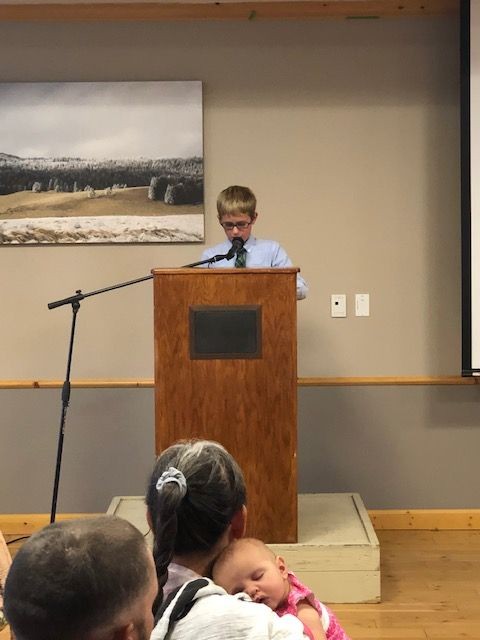 Brian Scott, a sixth grader at Barranca Elementary, reads his winning essay for Grades 4-6. He received a $100 check from the LAFRW. Courtesy/RPLA
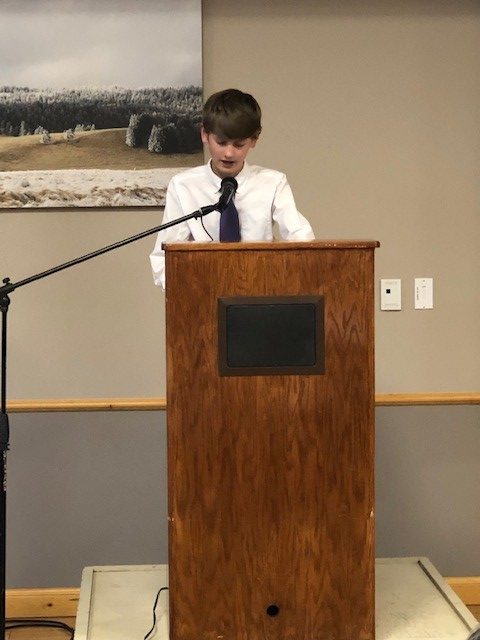 Colton Scott, an eighth grader at Los Alamos Middle School, reads the winning essay that won him a $200 check. Courtesy/RPLA
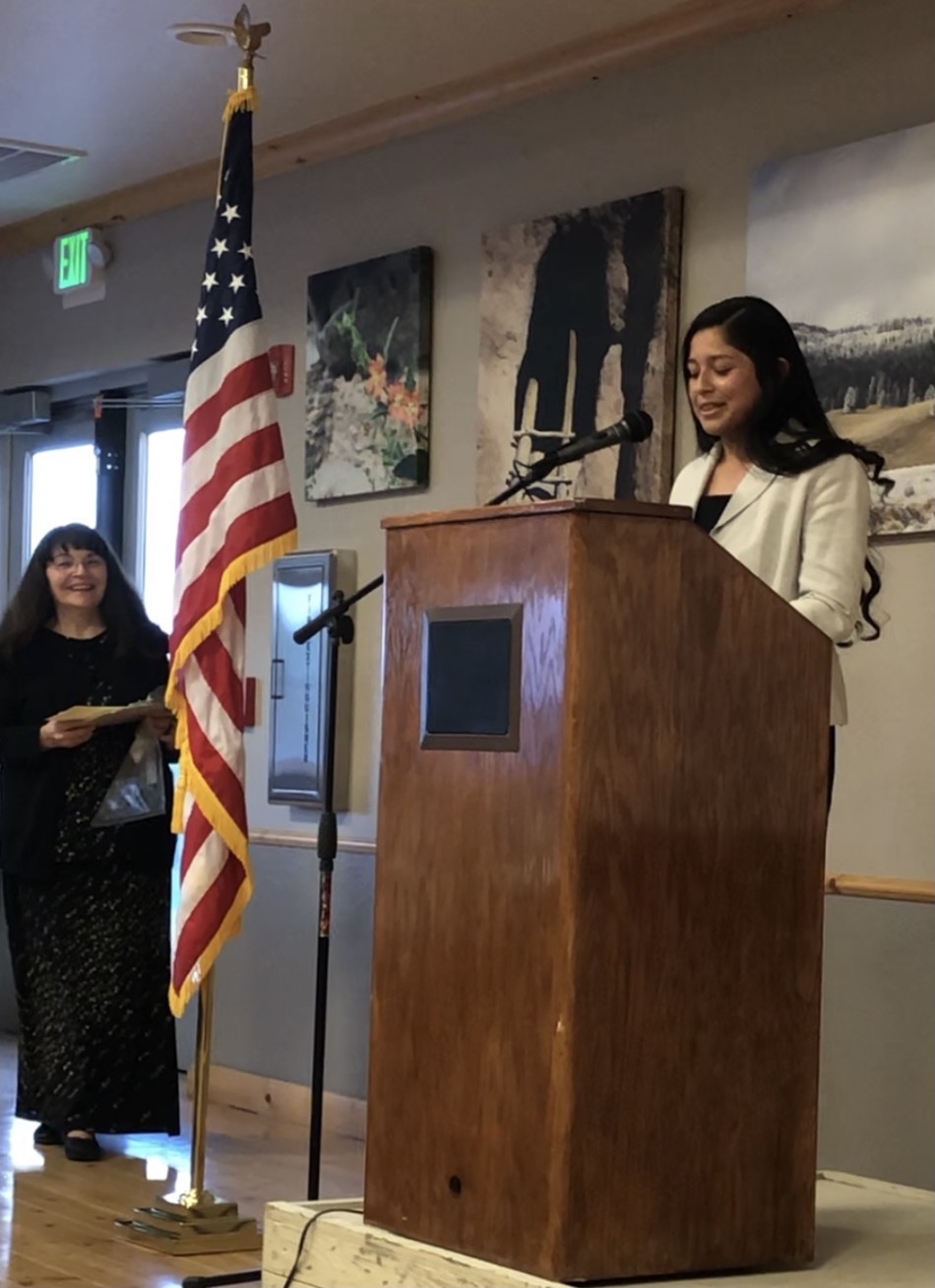 High School student Isabella McTeigue reads her winning essay, ‘The Excellence of Federalism’ and receives a check for $300 from Dianne Coane, President of the Los Alamos Federated Republican Women. Courtesy/RPLA
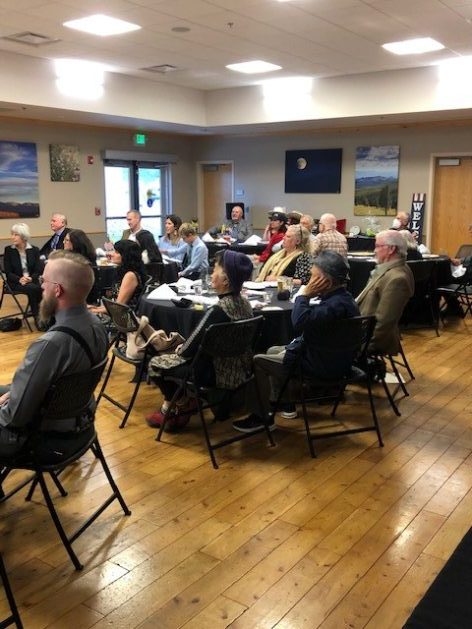 Attendees at the Constitution Day Dinner at Cottonwood on the Greens listen as students read their winning essays. Courtesy/RPLA
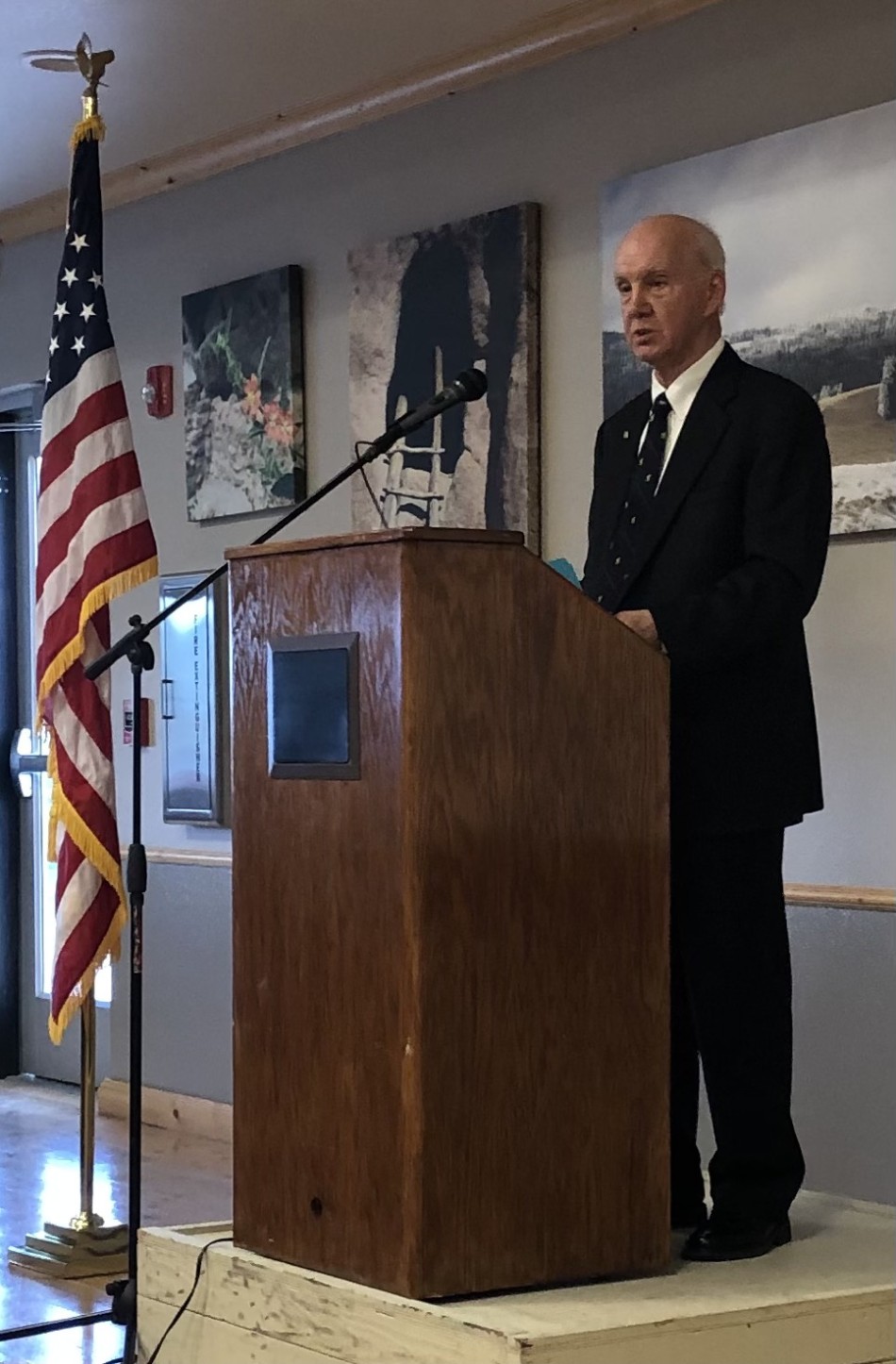 Bill McKerley, Chair of the Republican Party of Los Alamos, kicks off the annual Constitution Day Dinner at Cottonwood on the Greens. Courtesy/RPLA
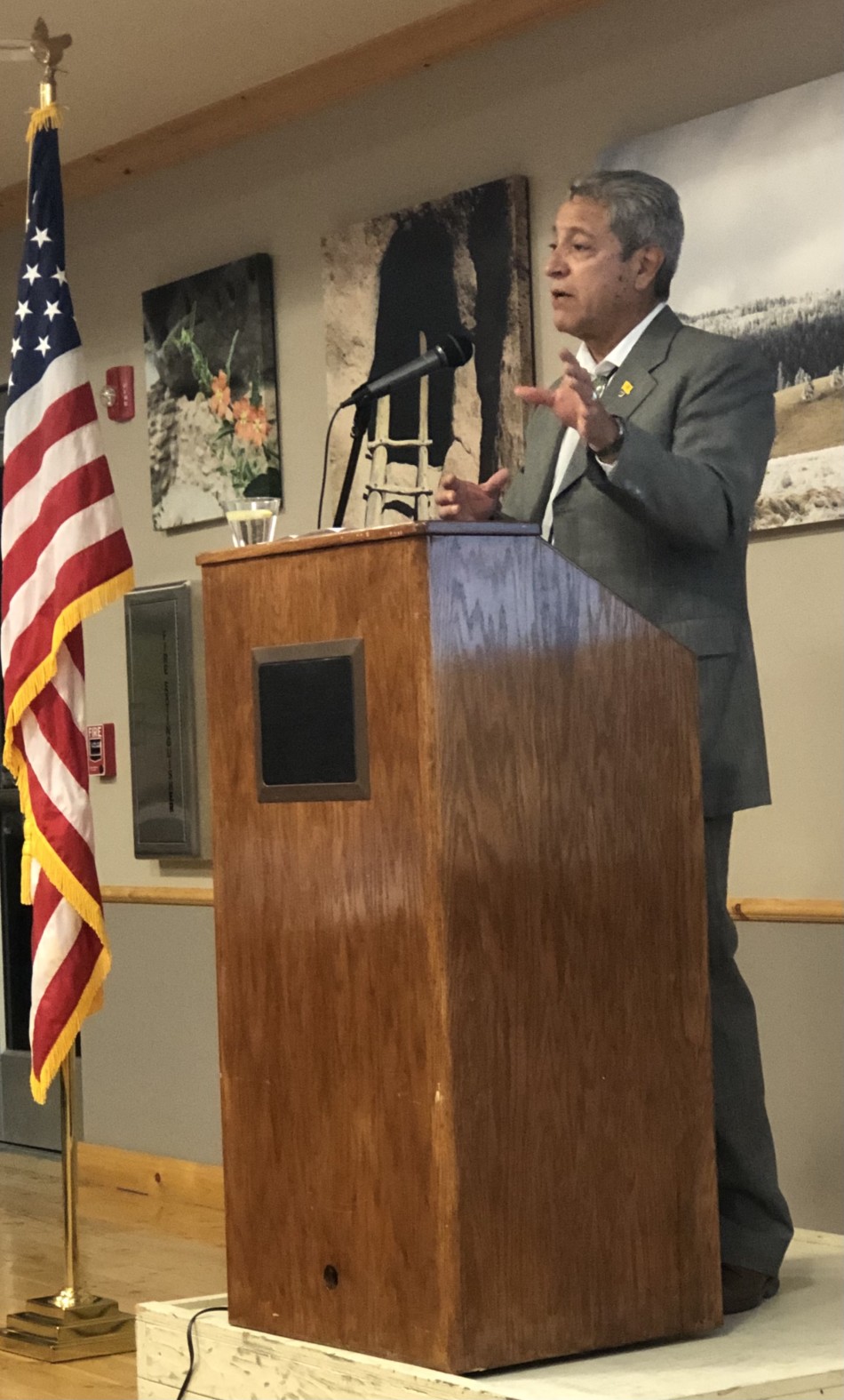 Harry Montoya, candidate for New Mexico State Treasurer, delivers the keynote address at the RPLA Constitution Day Dinner at Cottonwood on the Greens. Courtesy/RPLA
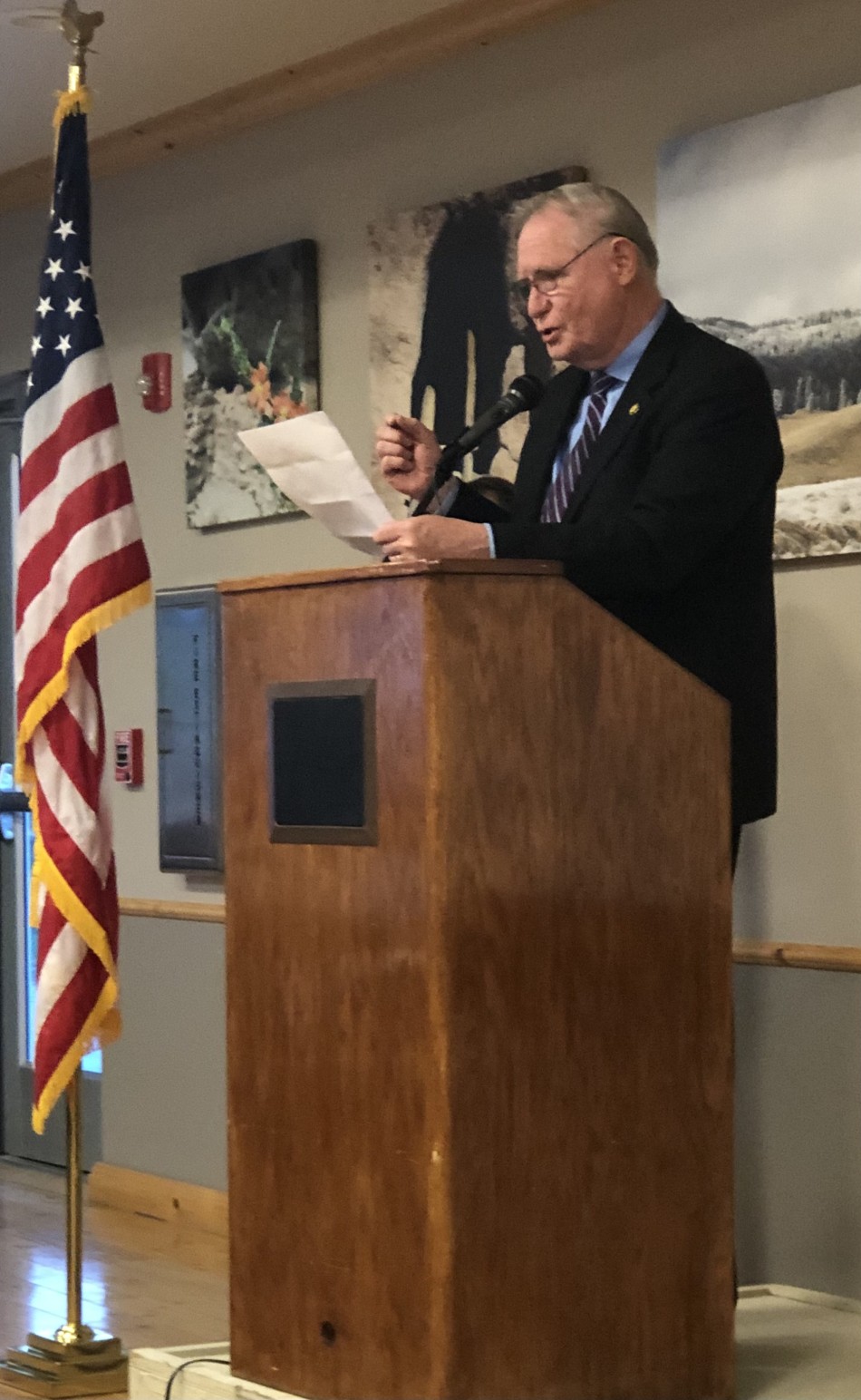 Congressman Bill Redmond speaks on behalf of Jeremy Gay, Republican candidate for Attorney General, at the Constitution Day Dinner at Cottonwood on the Greens. Courtesy/RPLA
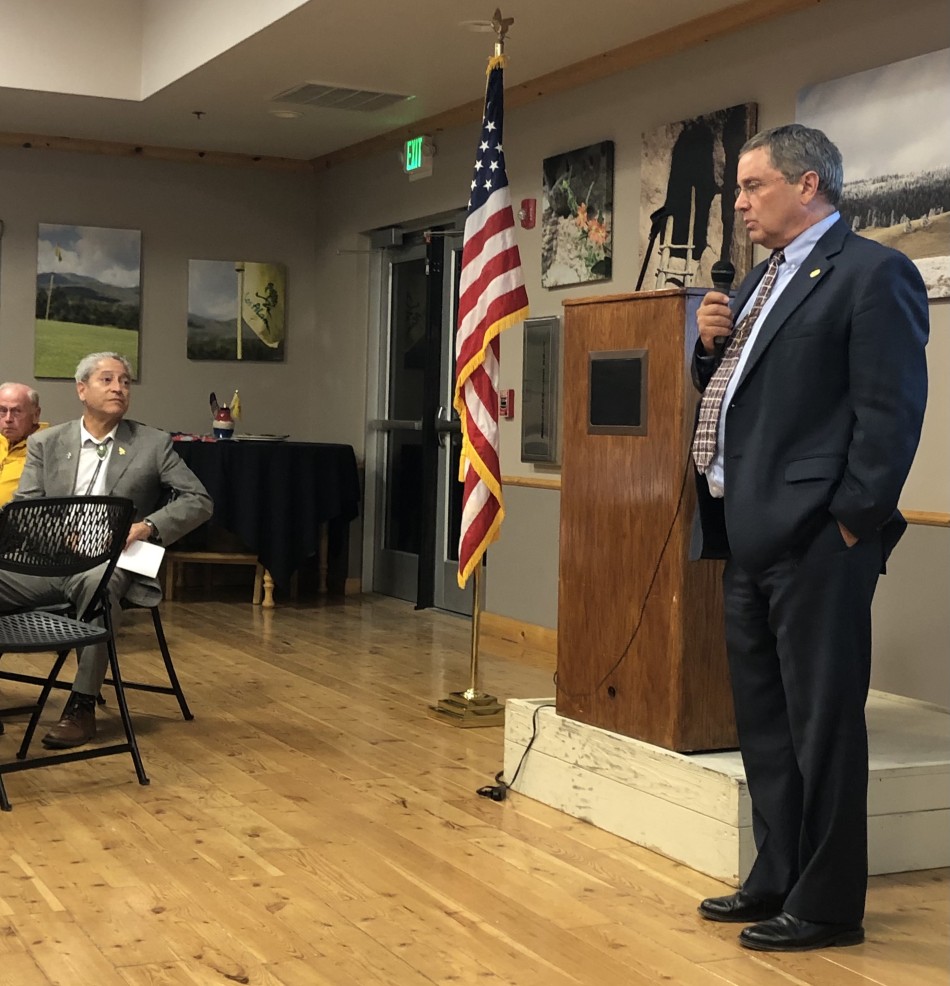 Los Alamos County Council member, David Reagor, introduces Harry Montoya, candidate for New Mexico State Treasurer and the keynote speaker, at the RPLA dinner, Oct. 1, at Cottonwood on the Greens. Courtesy/RPLA
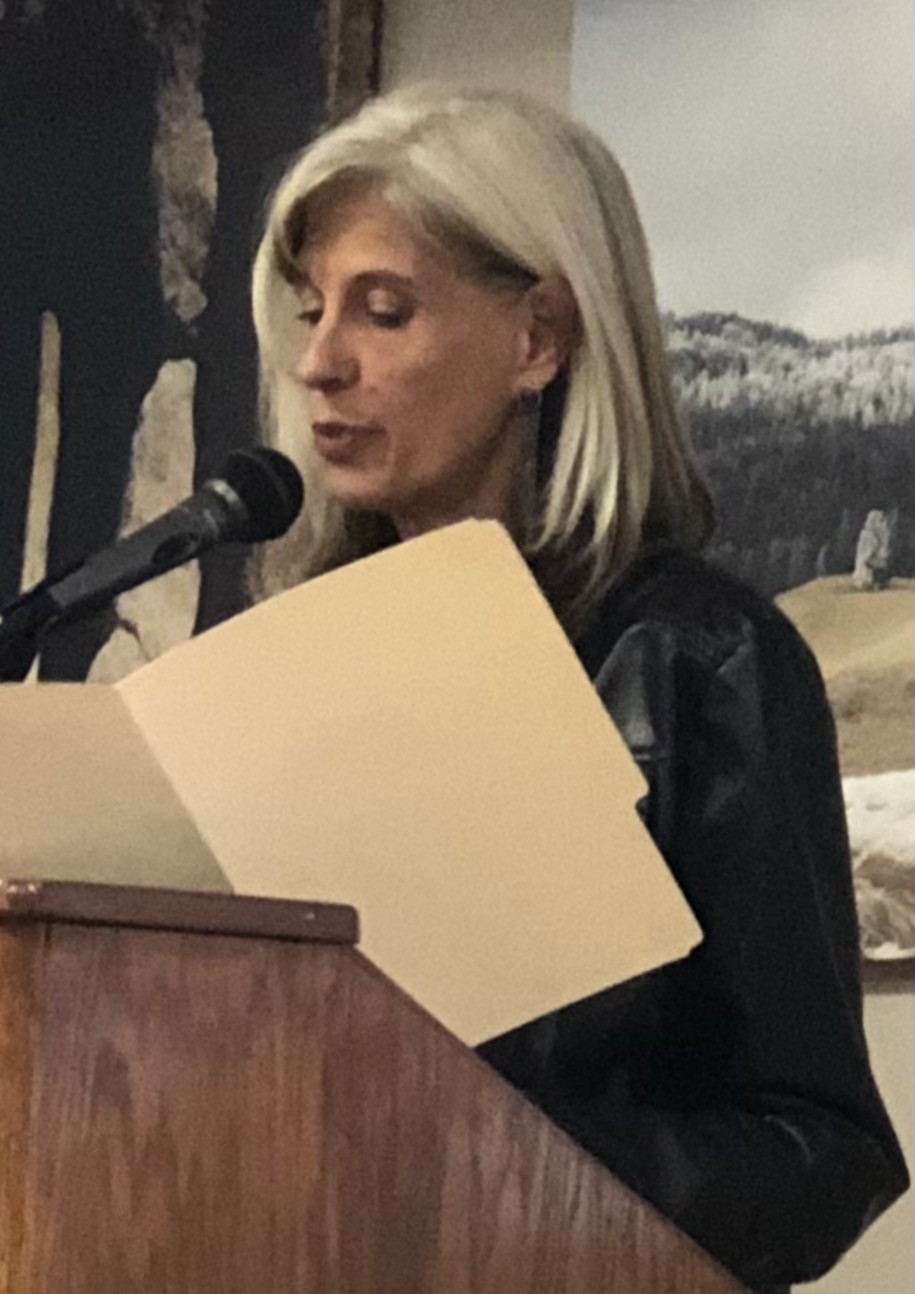 Sharon Dry, Republican candidate for the Los Alamos County Council, speaks about her reasons for running for office. Courtesy/RPLA
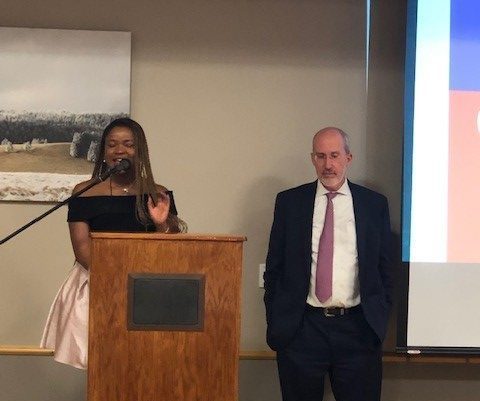 Annie St. Hilaire and David Vandenberg speak about the Federalist Society at the Constitution Day Dinner at Cottonwood on the Greens. Courtesy/RPLA
 After enjoying a delicious pasta buffet, attendees at the Constitution Day Dinner at Cottonwood on the Greens listen to Harry Montoya, candidate for New Mexico State Treasurer. Courtesy/RPLA
Constitution Day winning essay by Isabella McTeigue:
The Excellence of Federalism In The United States Constitution
The first three words of the United States Constitution, “We the people,” are the foundation of the concept of people holding power about decisions that affect them. The United States Constitution establishes a balance of power between the state governments and the national government in a governing system known as Federalism. To ensure order and liberty, the Framers of the U.S. Constitution sought these goals: to avoid tyranny by applying the separation of powers, to encourage participation in politics by implementing a representative voting system, and to provide states the right to pass laws through a system of legislation.
In order to avoid tyranny from a centralized government, Framers of the U.S. Constitution established the separation of powers. The young United States recalled that King George III had punished the 13 colonies, ultimately by dissolving them. The U.S. Constitution establishes under Article 1, Sections 1-3, that power be divided across three branches of government: Legislative, Executive, and Judicial. This balance of power is being challenged today through overuse of Executive Orders yet the Legislative and Judicial branches provide a check on those actions, thereby, avoiding oppressive governmental power.
The U.S. Constitution ensures that the people participate in meaningful political decisions. One of the weaknesses of the Articles of Confederation, which preceded the Constitution, was that each state, regardless of its size, had only one vote in Congress. Article 2, Section 1, of the Constitution establishes a system of electors, that we refer to as the Electoral College. Each state is represented by two Senators and a number of Representatives based on the population in the State. In U.S. history, five presidential elections have resulted in a candidate winning the election by the Electoral College yet not by the popular vote. Currently, the Legislature is considering changes to the Electoral College because some voters think the system is undemocratic. Our voting system, however, promotes that people in states with low populations participate in elections and are not overrun by states with large populations. The Electoral College encourages participation from the diversity of voters in each of the states.
To provide for states to pass their own laws, the U.S. Constitution applies the separation of powers so that the national government and state governments share governing responsibility. Alexander Hamilton acknowledged that the United States of America was a “diverse country” through ideology, landscape, and beliefs. The early colonies experienced the rejection of their proposed legislation by the Crown, therefore their local needs were unmet. The Tenth Amendment of the Constitution sets forth that powers not specifically delegated to the national government are “reserved for the States.” The specific powers that the U.S. Constitution delegates to the national government include military, mail, and money. State powers include to provide education, create local governments, and conduct elections. In the past year, Alabama, Arizona, Florida, Georgia, Kentucky, and Oklahoma passed election interference laws, to deter voter fraud and make the voting process more secure for the citizens. The U.S. Constitution promotes the powers of the states in order to ensure our liberty. State participation is promoted by requiring ¾ of the states to ratify Amendments to the Constitution. The 26th Amendment upholds that citizens 18 and older “shall not be denied the right to vote,” which I shall exercise in the general election.
The system of federalism as set forth in the Constitution has succeeded in avoiding tyranny, encouraging participation in politics, and allowing states to pass laws. The U.S. Constitution was created to protect the rights of the people. This ingenious document demonstrates excellence in providing structure to the government and balancing order with liberty. The authority of the Constitution must be restored in our Country as we reflect on how it has provided us, the American people, with liberty through the excellent system we know as Federalism.
Constitution Day winning essay by Colton Scott:
After years of oppressive rule under King George III, the Framers were very concerned about the possibility of tyranny if the national government were too strong. Their solution to this problem was to give the national government just enough power for it to be effective while also giving states enough power to solve local issues. The system they created is known as federalism, a plan to share power between national and state governments. Federalism has achieved the Founder’s goals of preventing tyranny from the national government and securing the rights of states by clearly defining national and state powers, and providing states with the freedom to pass their own laws.
Federalism was used by the Founding Fathers to stop the national government from becoming too powerful. The constitution clearly defines all power given to the national government such as regulating interstate commerce, declaring war, collecting debts and more. The states have powers such as controlling education, implementing welfare, and protecting people from local threats. The 10th Amendment says all power not specified is “reserved” to the individual states. Over the years even though the national government’s power has grown past our Founders’ expectations, the system they laid out has proven it can maintain the balance between giving states freedom and limiting the national government’s power.
Another way federalism achieves the Framer’s goals is by giving states the right to make their own laws. Federalism allows local governments to pass laws for their people based on their state’s specific needs, which is what the Framers envisioned for our country. They wanted the people to control their own laws locally. For example, each state gets to regulate their own education system, so students in New Mexico learn New Mexico history, but students in Texas study Texas history.
Another example is the state of California passing a law to legalize marijuana, and other states following suit, while still others have decided to keep it illegal, all based on the states’ individual needs. Laws passed by states serve as an experiment before being adopted nationwide. For example in 1912 Massachusetts implemented a minimum wage, and in 1933 the national government implemented one nationwide. This shows federalism working just as intended.
In conclusion, federalism prevents tyranny by making all state and national powers explicit, and it also allows states to meet their people’s individual needs as they pass their own laws. The Framers laid a groundwork that has stood the test of time.
Bibliography
https://www.pbs.org/tpt/constitution-usa-peter-sagal/federalism/\
https://www.law.cornell.edu/wex/minimum_wage
Constitution Day winning essay by Brian Scott:
After the Framers’ experience with the Articles of Confederation, they knew that they needed a stronger federal government, but they wanted the states to remain powerful and not be controlled by an overpowering federal government. The Framers came up with a system known as federalism which would share powers between state and national governments. The constitution gave specific powers to the states and different powers to the national government in an attempt to maintain balance between them.
There are many benefits to federalism. For example, it allows states some autonomy while still providing a strong and effective national government. The Constitution gave states the power to create their own laws. Some of these laws test new ideas that can eventually spread throughout the nation.
For example, Wyoming passed a law in 1869 that allowed all women over 21 to vote. After that, several other western states passed similar laws allowing women to vote. Their experiment showed that women’s suffrage was a good thing. Eventually, the ideas from these local laws were added to the constitution in 1919 in the 19th amendment. This shows that federalism is good because it allows states to influence the federal government with their laws.
Another example of why federalism is good is because sometimes the federal government can intervene and fix bad state laws. For example, in the early 1900s, some southern states passed “Jim Crow” laws like poll taxes, literacy tests, and racial segregation. This limited black people’s right to vote which had been given to them in the 13th amendment. In this case, the state law experiments went wrong. Eventually the national government stepped in to stop discrimination against black citizens by passing the Voting Rights Act of 1965.
These examples show why Federalism is such a great system of government. The first example showed how Wyoming’s experiment influenced the national government in a positive way. The next example showed how the Federal government prevented the states from passing laws that took away Black people’s rights. The balance the Framers created between the states and the federal government has helped our nation thrive.