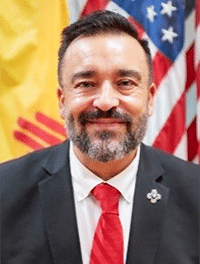
NMPED Secretary Arsenio Romero
NMPED News:
SANTA FE — In light of continued poor performance at far too many New Mexico public schools, Public Education Secretary Arsenio Romero communicated to school leadership that new accountability measures will be put in place to ensure schools are fully utilizing the billions of appropriated state dollars and implementing evidence-based learning strategies.
School designations, which are determined by student academic proficiency and graduation rates, show a troubling trend. The number of schools with a “Traditional” designation, meaning no additional supports are mandated, fell from 440 schools in 2021-22 to 219 in 2022-23. Similarly, the number of schools, requiring targeted support and improvement rose from 113 to 368 in the same time span. While the data for the 2022-2023 school year showed a 4 percent statewide increase in reading, it also showed a slight decrease in math proficiency. Overall, the statewide reading proficiency is at 38 percent and math is even lower, at 24 percent.
In the letter to district leadership, Secretary Romero wrote, “Like many New Mexicans, I am deeply alarmed by the high number of low-performing schools and what that means for the state, the children who are being educated here, and our future. Far too many of our schools are underperforming and PED will hold leadership at those districts accountable,” Secretary Romero wrote in a letter to superintendents. “Students statewide have low reading and math proficiencies. This is unacceptable. It is time for accountability: for the Public Education Department, for the school districts (including superintendents, boards and schools), charter schools, teachers’ unions, and families. In short, everyone associated with public education is responsible for student achievement. We owe this to our state’s most precious resource: our children.”
There are, however, some bright spots in the data. Reading scores reflected increases from last year in all student subgroups, including English language learners, students with disabilities, economically disadvantaged students, and Native American students. Especially encouraging was Native American student performance in reading, rising 5 percent above 2022 results. For both ELA and math results, statewide student proficiency rates were steady across subgroups, meaning no wide fluctuations. This indicates improvements across the board in ELA and no major drops in math for any particular student population.
The 2023 scores revealed outstanding student performance and improvement in certain school districts and regions throughout the state. That data makes it clear that effective school leadership that fully utilizes the tools available from the state like additional education hours and fully implementing structured literacy yields real results. Some very bright spots included double digit gains in reading in Pojoaque at 26 percent and 13 percent gains in math in Vaughn.
“While some progress has been made, we cannot ignore the persistent low student achievement results and achievement gaps that continue to plague New Mexico’s public schools decade after decade. It is time to break free from the status quo and demand excellence from everyone who works within the state’s education system,” Secretary Romero wrote. “Gov. Lujan Grisham and New Mexico legislators have invested billions of dollars in the state’s education system since 2019 – levels never before seen in history – but historic academic gains have not followed. Statewide, barely a third of students are proficient in reading and less than a quarter are proficient in math, and these results are worse for students from low-income families and with disabilities, English learners, and Native American students. That must change.”
Going forward, there will be a renewed push for increased accountability for schools, charters and districts.
“We can no longer afford to overlook underperforming schools or allow subpar educational experiences to persist,” Secretary Romero wrote. “In this model, we will enforce accountability at the district level to ensure that those that do not provide their students with an effective education implement programs and policies that are proven to produce positive results. That shift will allow the state to create a renewed culture of high expectations, collaboration, and innovation that will propel our students toward success.”
PED will seek the Legislature’s support for additional accountability measures in the upcoming legislative session.
The letter sent by Secretary Romero to district leadership attached here.