Friends of Bosque del Apache News:
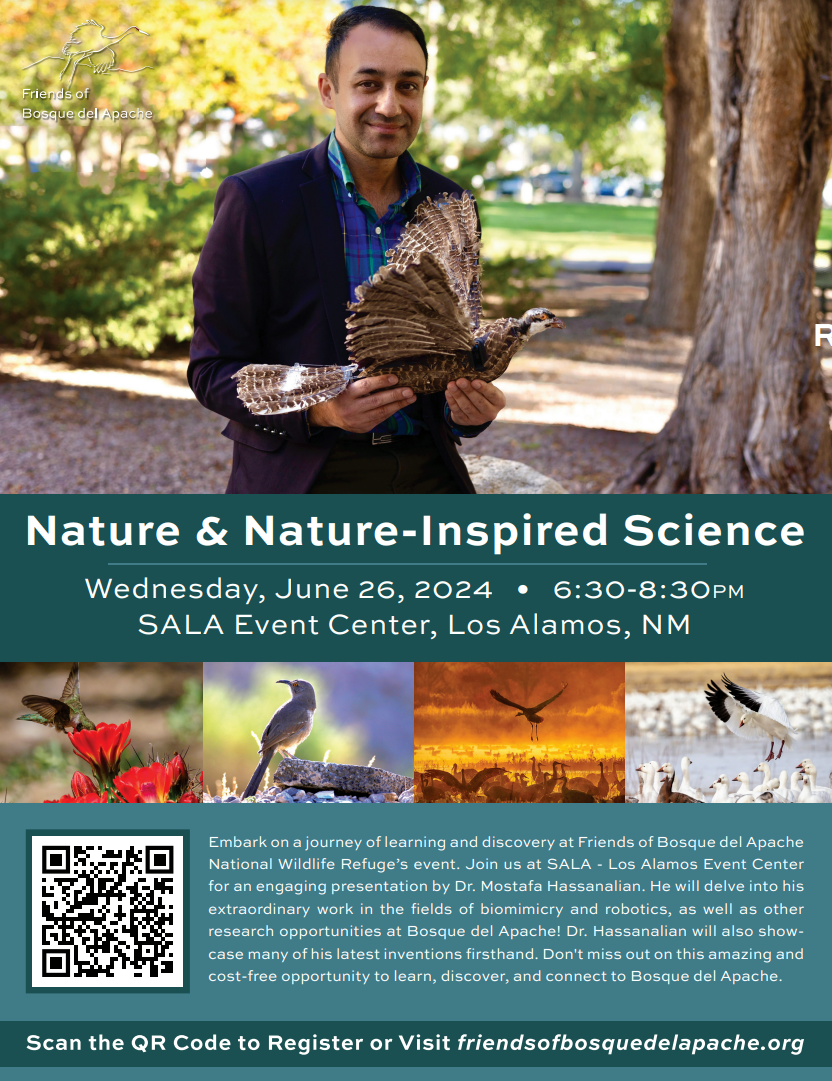
The community is invited to join Friends of Bosque del Apache on Wednesday, June 26 from 6:30-8:30 p.m. at SALA Events Center in Los Alamos. Come learn about the many things there are to see and do year-round at Bosque del Apache National Wildlife Refuge, a “Refuge for All Seasons”!
We’ll also highlight several exciting research projects occurring at the refuge and the important partnership between Friends and New Mexico Tech in Socorro. During the last hour, Dr. Mostafa Hassanalian will share his inspiring work in the fields of biomimicry, robotics and beyond, as well as the research topic opportunities at Bosque del Apache. He’ll have many of his recent inventions with him to share with you.
- 6:30-7 p.m. – Reception with appetizers in the main SALA lobby
- 7-7:25 p.m. – Short presentation about the refuge and Friends
- 7:25-8:30 p.m. – Presentation by Dr. Mostafa Hassanalian followed by demos and Q&A
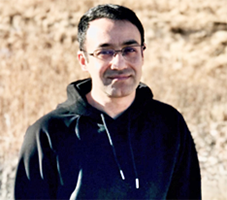 Dr. Hassanalian points of discussion:
During millions of years of evolution, nature has developed processes, objects, materials, and functions to increase efficiency. Through biomimicry and inspiration from this natural treasure trove, engineers and biologists have become interested in learning from biological insights. Sometimes looking at nature provides us the best answers for the development and optimization of different types of systems, including aerospace systems. Nature always has effective solutions for many complex tasks in aerospace industries, such as drag reduction techniques, locomotion, navigation, control, sensing and aircraft design. The growing science of biomimicry focuses on what engineers can learn: quite a lot about efficient solutions for aerospace and engineering systems, which nature has spent millions of years refining. Today, there is a growing need for flying drones with diverse capabilities for both civilian and military applications.
There is also a significant interest in the development of novel drones, which can autonomously fly in different environments and locations and can perform various missions. In the past decade, the broad spectrum of applications of these drones has received a great deal of attention, which led to the invention of a large variety of drones of different sizes and weights. Depending on the flight missions of the drones, the size and type of installed equipment are different. Considerable advantages afforded by the drones have led to a myriad of studies focusing on the optimization and enhancement of the drone’s performances. According to the mentioned characteristics, drones benefit from the potential to carry out a variety of operations, including reconnaissance, patrolling, protection, transportation of loads and aerology. They can carry various sensors: visual, acoustic, chemical and biological. Drones often vary widely in their configurations, depending on the platform and mission.
Drones can perform both outdoor and indoor missions in very challenging environments. The applications of drones can be categorized in different ways. It can be based on the type of missions (military/civil), type of the flight zones (outdoor/indoor) and type of the environments (underwater/on the water/ground/air/space).
About Dr. Mostafa Hassanalian, Ph.D.
Dr. Mostafa Hassanalian is an Associate Professor in the Department of Mechanical Engineering and Dean’s Research Scholar at New Mexico Tech. He earned his Ph.D. and Master of Science in Mechanical Engineering from New Mexico State University in July 2018 and December 2016, respectively. His main research interests are in the fields of autonomous systems, bioinspiration and biomimetics, and drones. Dr. Hassanalian serves as PI and Co-PI of $6.5M projects from NSF, NASA, NIOSH-CDC, Alpha Foundation, Sceye Inc., etc. He has authored over 200 peer-reviewed journal and conference publications. In October 2021, 2022, and 2023 he was recognized as one of the Top 2% of Cited Scientists Worldwide. In October 2021, he also received United Nation-USA SDG Advocate Award from UNA Project Rocky Mountain Region. Some segments of his group’s drone research have garnered global media attention, reaching an audience of 6 billion people. Coverage includes features in prominent outlets such as The New York Times, National Geographic, New York Post, The Washington Post, Reuters, EuroNews and more.
Dr. Hassanalian is presently advising 15 graduate students, consisting of 7 Ph.D. and 8 M.S. students. Additionally, he has successfully guided 14 graduates in the past, including 1 Ph.D. recipient and 13 M.S. graduates. He serves as a board member of Friends of Bosque del Apache, faculty advisor for various student chapters at New Mexico Tech, including the American Institute of Aeronautics and Astronautics (AIAA), Society of Allied Weight Engineers (SAWE), Vex Robotics, NASA Minds, and Lunabotics. Additionally, he oversees the K-12 Drone Program at New Mexico Tech.
About Deb Caldwell
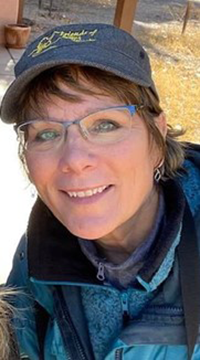
Deb Caldwell has served since July 2015 as the Executive Director for Friends of Bosque del Apache National Wildlife Refuge. A native New Mexican, Caldwell returned “home” in 2010. She grew up loving the outdoors, wildlife, and Bosque del Apache. That passion has grown over the years and Caldwell has recently become an avid birdwatcher. She considers her current position to be her ultimate dream job.
To her current job, Caldwell brings her previous work experience: Executive Director of Socorro County Chamber of Commerce; leadership and teamwork consultant for the Federal Drug Administration in Washington, DC; 25 years at IBM Corporation in San Jose, Calif. as a technical writer and manager; and program director in a social services agency in Tucson, Ariz. Caldwell holds an M.A. degree in Counseling Psychology from Santa Clara University (in Santa Clara, Calif.) and B.A. in English Composition from New Mexico State University.