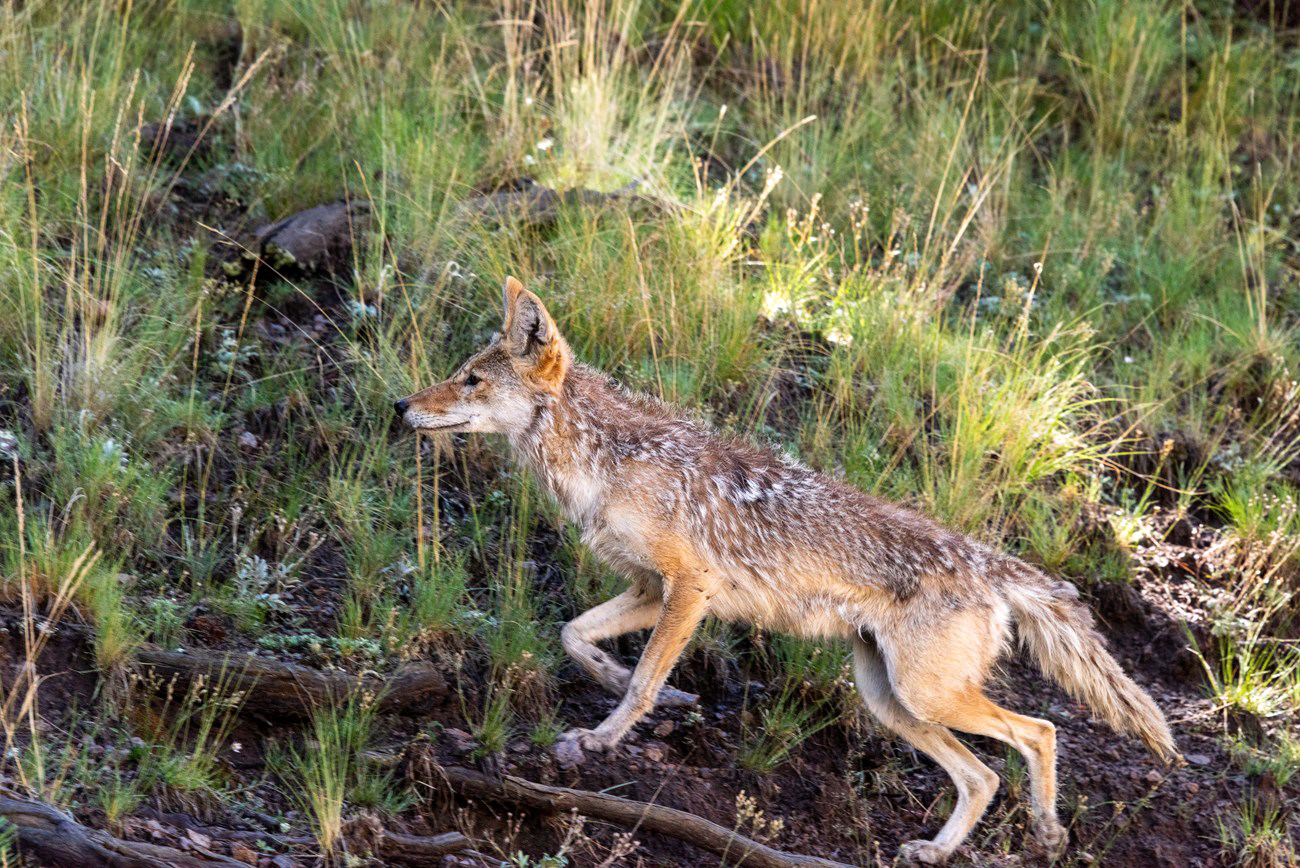
 Daily Postcard: A coyote hunts along a grassy slope at Valle Caldera National Preserve. Coyotes are intelligent and adaptable. They can be found throughout North and Central America, thriving in major urban areas as well as in remote wilderness. This adaptability helped coyotes resist widespread efforts early in the 1900s to exterminate them in the West. The coyote is a common predator at Valles Caldera, often seen traveling through the park’s montane grasslands. Often mistaken for a wolf, the coyote is about one-third of a wolf’s size with a slighter build. Its coat colors range from tan to buff, sometimes gray, and with some orange on its tail and ears. Males are slightly larger than females. During the 1900s, coyotes across the West partially filled the niche left vacant after wolves were largely exterminated. Following the eradication of wolves in Yellowstone, for example, coyotes formed packs or family groups of up to seven animals. This social organization is characteristic of coyotes living in areas free from human hunting. With the reintroduction of wolves, Yellowstone coyotes returned to a more typical social organization—pairs with pups. At Valles Caldera, packs of five to seven coyotes can sometimes be seen hunting cooperatively, particular during elk calving season. During the remainder of the year, it is more common to see coyotes traveling solo or in small groups of two to three animals. Coyotes, also known as ‘song dogs’, communicate with each other by a variety of long-range vocalizations. You may hear groups or lone animals howling, especially during dawn and dusk periods. Photo by Corey Lycopolus/NPS