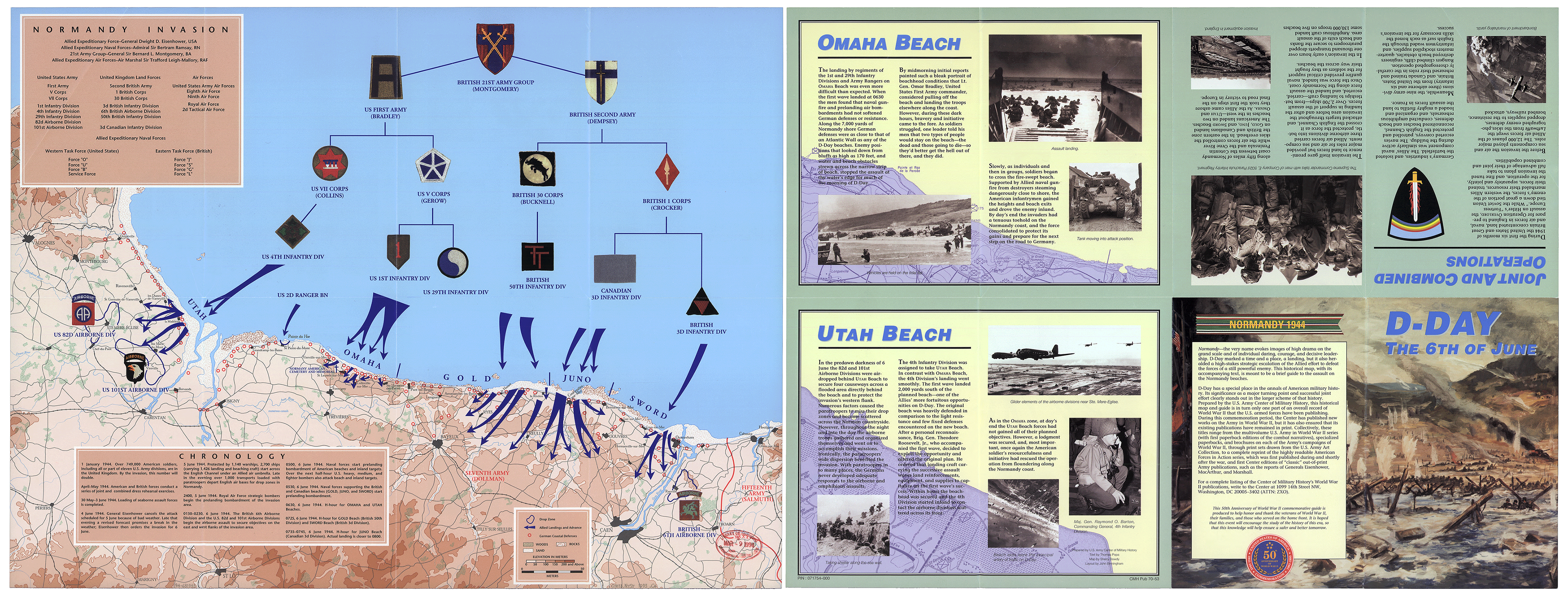
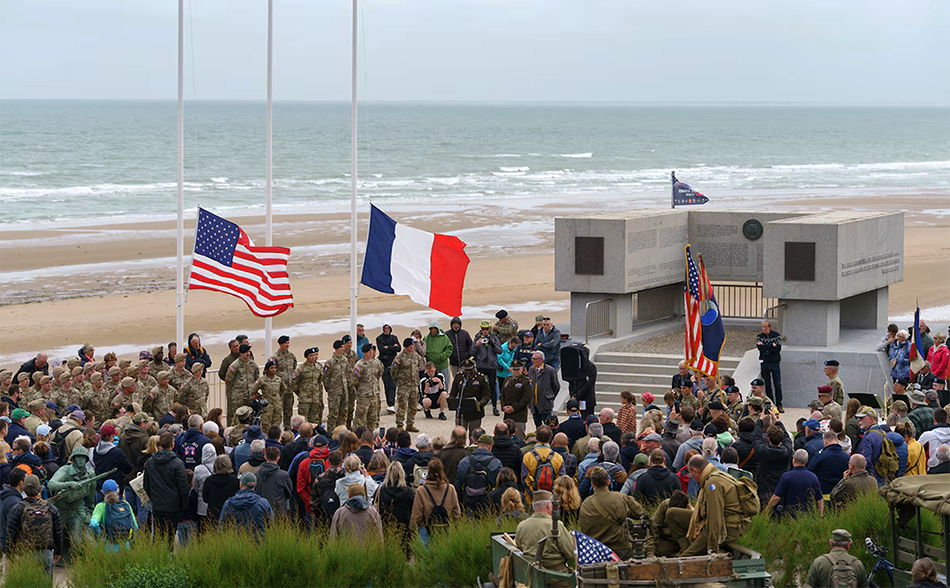
 Commemorating the events of June 6, 1944, the largest amphibious invasion in history, which the world now knows as D-Day. Courtesy/defense.gov
D-Day 2024:
They stormed the beaches and saved the world.
The roughly 160,000 Allied troops who landed in Nazi-occupied France on June 6, 1944, not only successfully executed the largest air, land and sea invasion in history, they did so amid daunting obstacles, terrible bloodshed and stakes that couldn’t have been higher.
“We will accept nothing less than full Victory!” their commander, Gen. Dwight D. Eisenhower, told them. And victory, in this battle, was far from certain in the first hours of that first day.
JUNE 6, 1944, THE EARLY HOURS
Midnight
After years of planning and months of training, the Allies launch their invasion of northwest Europe, Operation Overlord. Royal Air Force bombers begin a strategic bombardment of the invasion area, a roughly 50-mile stretch of beaches in Normandy, France.
1:30-2:30 a.m.
The British 6th Airborne Division and the U.S. 82nd Airborne Division and 101st Airborne Division begin the airborne assault behind enemy lines to secure objectives on the east and west flanks of the invasion area. Thick cloud cover hindered the air insertion, and some of the airborne troops were badly scattered.
More than 23,000 Allied airborne troops total landed in Normandy on D-Day, by parachute or glider.
5 a.m.
Naval forces start a prelanding bombardment of the beaches where U.S. infantry units are to land, codenamed Utah and Omaha, and inland targets. U.S. heavy, medium and fighter bombers also attack beach and inland targets over the next half-hour.
About 11,600 Allied aircraft total supported the D-Day landings.
5:30 a.m.
Naval forces start a prelanding bombardment of the beaches where British and Canadian infantry units are to land, codenamed Gold, Juno and Sword.
In total, the invasion armada comprised about 7,000 vessels, about 80% of which were British. More than 16% were from the U.S.; the rest were from France, Holland, Norway and Poland.
6:30 a.m.
H-Hour for Omaha and Utah Beaches: U.S. soldiers assigned to the 4th Infantry Division began storming Utah Beach while U.S. regiments of the 1st and 29th Infantry divisions and Army Rangers assaulted Omaha Beach.
The first wave at Utah landed about 2,000 yards south of the planned beach, which ended up being fortuitous because the intended beach was more heavily defended. In contrast, troops at Omaha, the most heavily defended and restricted of the beaches, with cliffs and steep bluffs, faced an even more difficult situation than initially expected.
About 73,000 U.S. troops total landed in Normandy on D-Day, including those at both beaches and airborne troops.
7:10 a.m.
U.S. Army Rangers begin scaling the 100-foot cliffs at Pointe du Hoc, with the objective of seizing German artillery pieces that could have fired on the American landing troops at Omaha and Utah beaches.
7:25 a.m.
H-hour for Gold Beach, where the British 50th Infantry Division landed, and Sword Beach, where the British 3rd Infantry Division led the assault.
About 61,700 British troops landed in Normandy on D-Day, including airborne troops and those at both beaches.
7:35-7:45 a.m.
H-hour for Juno Beach, though the actual landing occurred closer to 8 a.m. Canada’s 3rd Division led the assault here, with British troops also participating.
About 21,400 Canadian troops landed at Juno Beach on D-Day.
By day’s end, the Allies had not achieved all their objectives, and they had suffered an estimated 10,000 killed, wounded, and missing in action: 6,603 Americans, 2,700 British and 946 Canadians. Nevertheless, Allied power had prevailed across the Normandy beachhead, and their tenuous foothold grew stronger in the following days and weeks, paving the way for victory in Europe.
Principal sources:
U.S. Army Center of Military History, D-Day: The 6th of June
U.S. European Command, D-Day: The Beaches
Source: National Archives and Records Administration
Voices of the War
Decades later, the memories of D-Day remain fresh in veterans’ minds. Watch and listen as some share their stories here.