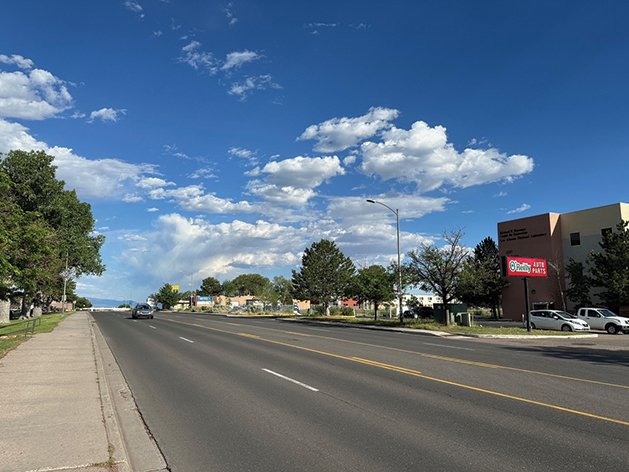
 View of the portion of Trinity Drive from Oppenheimer Drive to 15th Street that could see some improvements to better serve multiple modalities and improve safety. Photo by Kirsten Laskey/ladailypost.com
BY KIRSTEN LASKEY
Los Alamos Daily Post
kirsten@ladailypost.com
Based on feedback from the Los Alamos County Transportation Board, perhaps the best way to serve multiple modalities and improve safety along Trinity Drive, is to literally slow down.
As part of a project to study existing conditions on Trinity Drive, which is being coordinated with New Mexico Department of Transportation (NMDOT) and Los Alamos County, the County hired engineering consulting firm, Wilson and Company to study existing conditions on Trinity Drive, particularly along the corridor from Oppenheimer Drive to 15th Street and recommend alternative options for the road. Conrad Ley, a representative from the consultanting firm, presented a status of its work during the June 6 Transportation Board meeting.
Regarding existing conditions, Ley said there are two different “typical sections” in the corridor – four-lanes that are 11-feet wide and a continuous left turn lane that runs from Oppenheimer to 20th Street and the same configuration but no continuous left turn from 15th Street to Knecht Street as well as turn bays.
As far as what can be spotted moving along Trinity Drive, while vehicles are the main mode of transportation, pedestrians are also frequent followed by bicyclists.
Regarding crash history, it was reported during the Transportation Board meeting that between 2014-2020 there were 54 accidents on the corridor, which were mainly side-swipes and rear-ends. A “hot spot” is at Knecht Street.
Ley said in all the design options being weighed, lowering the speed limit wasn’t included in any of them.
What is being considered is improving visibility for bicyclists and pedestrians and ADA accessibility.
Two options that were eliminated were widening the road to add bike lanes because that would require at least 10 feet of right-of-way that the State doesn’t have and constructing roundabouts due to visibility issues. The design options that are still on the table are a road diet and two hybrid options.
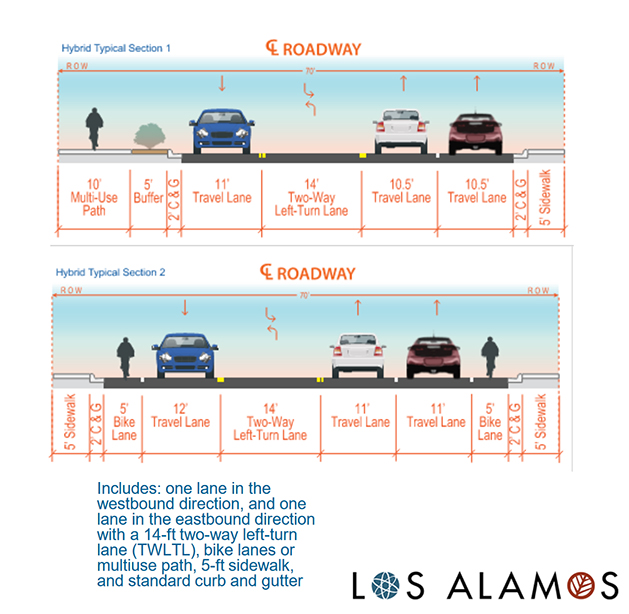 Hybrid options for Trinity Drive. Courtesy/LAC
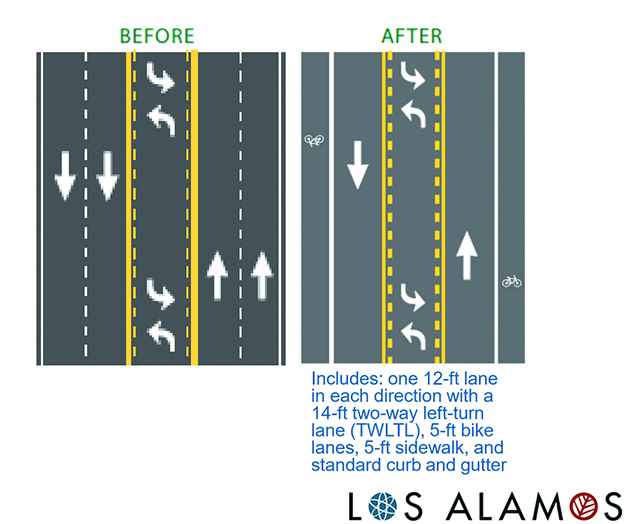 The road diet option for Trinity Drive. Courtesy/LAC
While lowering the speed limit was not in the design plans, board member Michael Altherr said he felt it should be.
“I understand that N.M. 502 is a state highway and that there are certain restrictions to that, but I don’t understand why we need to maintain a 35 mph speed limit along that corridor,” he said. “It is an accident waiting to happen.”
He noted anyone on the road while a Summer Friday Night Concert is in full swing will see kids running along the sidewalk and the community is fortunate no serious catastrophe has occurred.
“I think reducing the speed limit through that section would be optimal,” he said.
Reducing the speed limit, Ley said, would be difficult because of the road configuration – there isn’t any horizontal or vertical curves. It was further noted that just because the speed limit is lowered doesn’t mean people would drive slower unless enforcement was ramped up. However, he did mention traffic calming measures could be utilized. Altherr noted that perhaps the question that should be considered is: What is the right thing for the community, not necessarily the commuters trying to get out of town as fast as possible?
In connection to lowering the speed limit, board member Joshua Muck wondered if a traffic light at 20th Street should be considered as a tool to control traffic speeds.
“…is it feasible in terms of slowing down traffic, if you put in another stop light over on 20th … stop lights also help mitigate speed … it gives another safe crossing …,” he said.
Public Works Director Juan Rael said there are certain requirements that need to be met for a traffic light. First, he said, a traffic study needs to be done and certain warrants need to be met. When Marriott was considering building a hotel on the property off 20th Street, Los Alamos County began to plan for installing a traffic light, but those plans stopped when the hotel was scrapped. Depending on what does get built on the property, another traffic study should be done, Rael said.
A 2016 roadside safety audit started this project, which began in February. According to Public Works Engineering Project Manager Justin Gibson, the audit included several key findings, which are:
- sidewalks and ramps at intersections do not meet current public right-of-way accessibility guidelines,
- perceived lack of adequate crossing gaps for vehicles and pedestrians (cited multiple locations),
- Atomic City Transit stops in through travel lane on Trinity Drive,
- Possible under estimation of vehicle, pedestrian and bicycle traffic flows due to seasonal variation,
- Ingress/egress conflicts at driveways during peak hour,
- Pedestrian crossings at non-designated crosswalk for special events at Ashley Pond,
- Speeds too fast for the conditions,
- Bicycle usage split 50% street 50% sidewalk,
- Possible gaps in roadway and pedestrian lighting, and
- Increasing transit demand to downtown area results in increased pedestrian flows to crossings.
The audit was initiated to specifically consider pedestrian safety, mobility and operations in the study area in addition to other modes of transportation as they are inter-related. He added that the stretch of road from Oppenheimer Drive to 15th Street was selected because there are two signalized intersections at the beginning and end points which encompassed mid-block regions along Trinity Drive that focused on pedestrian movements across Trinity Drive accessing downtown and Ashley Pond.
Data acquisition and alternative analysis is ongoing, and work is being done on an environmental review. Once a design alternative is chosen, a final design is expected to be made early next year.Since Trinity Drive is a state-owned road, Gibson said that NMDOT coordinated and funded the audit and approved that the project is suitable to progress into the study and final design phases.
Furthermore, he said that NMDOT has assisted through a partnership to fund the project, participated in the road safety audit and will continue to be involved through design. Meanwhile, Los Alamos County Public Works is managing the execution of the project and coordinating with NMDOT at critical decision points.
As far as funding the project, Gibson said it has been made possible by NMDOT through award of Highway Safety Improvement Program (HSIP) funds.
The public is encouraged to provide feedback on this project. Please submit all comments by June 20, to Public Works Department at lacpw@lacnm.us