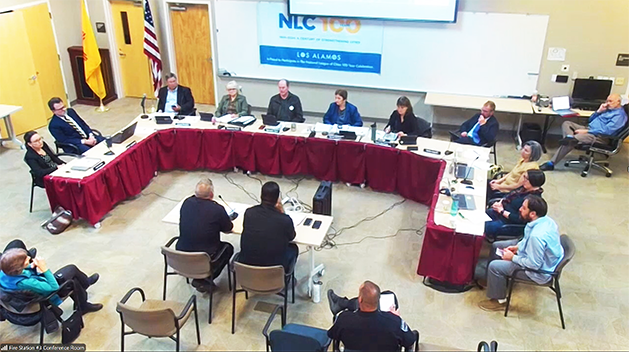
 Police Chief Dino Sgambellone, center left, and Public Safety Director Juan Rael, center right, participate in a road and traffic safety discussion at the Oct. 22 County Council meeting at the fire station in White Rock. Screenshot/LADP
By KIRSTEN LASKEY
Los Alamos Daily Post
kirsten@ladailypost.com
Los Alamos County is striving to make its roads safer. To ensure everyone’s safety, Los Alamos County Council voted unanimously to direct staff to take several actions and establish timeframes for these items.
Council made the motion during its work session Tuesday night.
The action items they directed staff to pursue include:
- Return to council with ordinances for an automated speed enforcement program and prohibition on using handheld phones while driving.
- Evaluate feasibility of speed limit changes and road design improvements related to N.M. 502.
- Engage residents and commuters and coordinate with partner municipalities, tribes, state and federal agencies and Los Alamos National Laboratory on road and traffic safety concerns.
- Develop FY26 budget proposals related to road and traffic safety identified projects and programs.
Improving traffic safety is a complex task and it will involve collaboration. As a result, Police Chief Dino Sgambellone and Public Works Director Juan Rael presented their plans.
Sgambellone identified the police department’s existing strategies. These include enforcement such as traffic citations and warnings and DUI checkpoints, education outreach through press releases, annual report data and other means and preventative engagement including programmatic initiatives, community partnerships and County department collaborations and CodeRed alerts.
As far as what the police could pursue, Sgambellone said he has researched automated speed enforcement.
“…there is evidence to support positive outcomes for speed camera enforcement,” he said, adding when he contacted law enforcement officials in Albuquerque, he was told speed cameras led to an 80 percent reduction of dangerous speeding incidents. However, Sgambellone noted that this would require a significant infrastructure investment.
Additionally, he said an ordinance would be required and a speed camera vendor would need to be acquired. Sgambellone estimated an additional six positions in the police department would be needed, too.
“If we went in this direction, I would recommend mobile and fixed,” he said, adding there would need to be a memorandum of understanding with the Department of Energy (DOE) to set up cameras on laboratory property.
Another strategy would be a local ordinance to ban the use of hand-held cell phones. Sgambellone noted that there is a ban on texting while driving but not one for holding a phone.
“There are many studies that show the use of a cellphone while driving increases the risk of an accident … every mile per hour that you decrease speed has a favorable impact on the seriousness of the accident,” he said. “So, if we could get a significant reduction, I think we would see a serious reduction in severity. Similarly, every mile per hour over the speed limit has the opposite effect.”
Regarding wildlife and traffic concerns, Sgambellone reported there were 62 crashes involving wildlife last year and so far in 2024, there have been 48. They mostly occur on Diamond Drive and usually involve deer. While he couldn’t pinpoint any strong patterns or causes for the accidents, Sgambellone said lighting could help prevent crashes with wildlife as well as an ordinance that prohibits feeding animals.
When it comes to improving safety, Rael noted that collaboration throughout the region is needed. He noted that the New Mexico Department of Transportation (NMDOT) owns N.M. 502 from Pojoaque to Diamond Drive. The state also owns N.M. 4 from the area known as the “Y”, past Bandelier National Monument, past the laboratory’s back gate all the way to U.S. 515. Plus, sections of N.M. 502 and N.M. 4 go through land owned by San Ildefonso Pueblo, DOE, Bandelier, Santa Fe County and Los Alamos County.
He added Los Alamos County officials have met with NMDOT.
“One key item we discussed is that solutions are going to take a multi-jurisdictional effort,” Rael said.
As a result, Rael and Sgambellone said they want to meet with their counterparts across the bridge to work on common issues.
“I would like to take a regional approach to our coordination efforts that include our closest neighbors San Ildefonso Pueblo and Santa Fe County,” Rael said. “We also need to continue our discussions with NMDOT and New Mexico Game and Fish. One thing I would like to highlight is that any potential traffic safety solutions we propose are in accordance with national traffic engineering standards…”
Councilor Randall Ryti wondered what efforts could produce effective results.
“I think we should be doing things that actually make a difference not just sending a message – things we can enforce,” he said.
Councilor Melanee Hand agreed, saying she felt it was important to take a regional and inter-organizational approach and look at best practices from a variety of organizations.
Councilor Suzie Havemann emphasized that what needed to change was people’s driving behaviors.
“I’ve seen too many people driving distracted … I would like to see us get to where we develop a culture of intolerance for careless and distracted driving,” she said.
Havemann said distracted driving should be handled similar to seatbelts; after a while wearing a seatbelt became normal behavior.