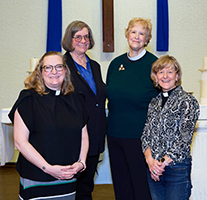
 Clergy from left, Deacon Amy Schmuck, Deacon Cynthia Biddlecomb, retired, The Rev. Mary Ann Hill and The Rev. Lynn Finnegan. Photo by Nate Limback/ladailypost.com
By The Rev. Mary Ann Hill
Rector
Trinity on the Hill Episcopal Church
Does this time of year make you feel nostalgic? All I have to do is put on a late sixties LP called The Candy Clarinet by Dixieland jazz great Pete Fountain, and I’m transported back to my grandmother’s house.
I heard a talk recently about God and time, and remember thinking, “But that’s not how it works!” From a traditional Christian perspective, there are two versions of time – chronos and kairos – names borrowed from ancient Greek philosophy.
Time as humans usually experience it is called chronos, and it is linear. God’s time – kairos – is not the same thing. Humans experience kairos as qualitative rather than quantitative. Kairos is the word used when, in English, scripture talks about “the fullness of time.” Kairos is used 86 times in the New Testament. Chronos is used 54 times. The author Madeleine L’Engle named eight of her most popular young adult novels, including A Wrinkle in Time, her “Kairos Novels.”
So, what does that have to do with Christmas? Well, really, I’m thinking about Advent. Traditionally, the season of Advent consists of the four weeks leading up to Christmas – and it does not include the Twelve Days of Christmas. Those are actually the twelve days of Christmastide beginning on December 25 and ending on Twelfth Night – January 5.
Advent is a time when, if we are paying attention, we experience kairos in a very distinctive way. We look back to the time when Christ became human and dwelt among us. We know that Christ is with us in the present through the Holy Spirit. And we look forward to that time when God will set the universe to rights, bringing heaven down to earth (eg what we experience incarnationally) and raising earth to heaven.
I find great comfort I knowing that what I look back on, whether good or bad, is always present in God’s mind. God is continually in the midst of everything, and therefore with everyone I’ve ever loved. Regarding the future, even though I don’t know what it will hold, I can trust that God is there too.
And that leaves the present. In the last verse of the Gospel of Matthew, Christ promises to be with us always. That should be comforting, although I suspect that some may feel daunted by the idea of Christ being in the midst of our messy lives. But I like to remind people that Dorothy Day pointed out that Christ chose to be born in a stable, and despite what art and Christmas cards may depict, stables are very messy places. Like our lives, stables are often full of muck and mud. That mess did not deter Christ 2000+ years ago, and it doesn’t now.
Whether you are grieving over the past, or feeling anxiety about the future, or simply overwhelmed by life at present, know that all of that time is held together by the God who loves more than we can ask or imagine.
Editor’s note: ‘All Shall Be Well’ is a column written by local women clergy including The Rev. Mary Ann Hill, Rector, Trinity on the Hill Episcopal Church (momaryannhill@gmail.com); The Rev. Lynn Finnegan, Associate Rector, The Episcopal Church of the Holy Faith, Santa Fe (rev.lynn@holyfaithchurchsf.org); Deacon Amy Schmuck, Bethlehem Evangelical Lutheran Church (deaconamy@bethluth.com); and ELCA Deacon Cynthia Biddlecomb, M.Div., retired (czoebidd@gmail.com).