 Courtesy/International Crane Foundation
International Crane Foundation News:
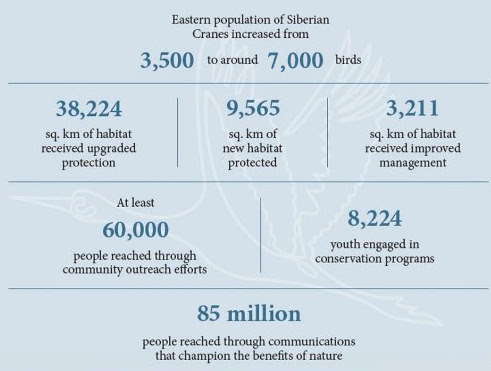
After a successful 10-year partnership for Siberian Crane Flyway Conservation, the International Crane Foundation announced the population of Siberian Cranes in the eastern flyway region has increased from less than 3,500 in 2015 to almost 7,000 cranes today.
The Foundation held closing ceremonies in China recently to celebrate the Saving Wildlife for Siberian Crane Project, with 110 representatives from government departments, protected areas, scientific research institutions, non-governmental organizations, volunteers, and communities attending the ceremony and workshop.
The project used applied research, habitat protection and restoration, community engagement and development, environmental education, and other associated activities in the breeding, staging, and wintering areas for Siberian Cranes. During the workshop, the partners shared results from the 10-year project, celebrated achievements, exchanged experiences, and planned for the future.
“The International Crane Foundation began working to save Siberian Cranes in 1979,” said Dr. Rich Beilfuss, International Crane Foundation’s President & CEO. “Collaborating with partners, we were able to identify Poyang Lake as the most important wintering area for the eastern population of Siberian Cranes. With much gratitude to the Disney Conservation Fund as well as a prior multi-year project funded by the United Nations Environment Programme/Global Environment Facility, the Foundation and our partners were able to design and implement a series of conservation projects to protect Siberian Cranes and their habitats.”
The Siberian Crane (Grus leucogeranus) is a first-class protected wild animal in China and is listed as Critically Endangered on the International Union for Conservation of Nature (IUCN) Red List. The crane faces continued threats due to climate change, habitat loss, and human interference. Prior to the Foundation’s long-term commitment, its numbers were decreasing each year. The project team first studied migration patterns and ecological needs and how the birds adapted to changes within their habitat. Then, they developed integrated programs to protect the species, the flyway, and the wetland habitats.
The flyway-level conservation approach revealed the important role of wetlands connecting wintering areas in southeastern China with the species’ breeding areas in northeastern Russia in the Yakutia Region and staging areas in Northeastern China, such as the Tumuji National Nature Reserve and Agula Wetland in Inner Mongolia, the Momoge and Xianghai National Nature Reserves in Jilin, the Yellow River Delta National Nature Reserve in Shandong, and the Huazidong National Wetland Park in Liaoning. It also highlighted the importance of building a connected and stable flyway network to ensure the successful migration of cranes.
Environmental education and raising awareness were key strategies of the conservation project. The project team developed a children’s book, “Discovering Siberian Crane,” which uses cartoon pictures to help children learn about Siberian Cranes and their habitats. The book will be donated to communities and schools throughout the Siberian Crane flyway. International Crane Foundation staff also developed a “Crane School” project in collaboration with nature reserves and schools committed to sustainable habitat management and fostering crane conservation. Elementary school-age children learned about crane conservation and how they could make an impact.
“This Closing Ceremony does not mean the end of the Siberian Crane Conservation work, but instead the start of a new journey for Siberian Crane Conservation,” said Mahendra Shrestha, International Crane Foundation’s Vice President of Asia Programs. “Together, we have proven that a species can be brought back from the brink of extinction and recovered through a long-term commitment and synergistic partnership. We will continue to work with all partners to take active actions in breeding, staging, and wintering areas to jointly safeguard the health of the Siberian Crane population and the stability and safety of their migration routes.”
As part of the week’s activities, participants witnessed the signing of a cooperation agreement between Jiangxi Poyang Lake National Nature Reserve and the International Crane Foundation for the next three years, 2025-2027, marking the official launch of a new stage of cooperation for the Poyang sub-lakes Habitat Restoration, Management and Community Development Pilot Project.
View the video: Ten Years of Collaboration to Save the Siberian Crane: (15) Ten Years of Collaboration to Save the Siberian Crane – YouTube