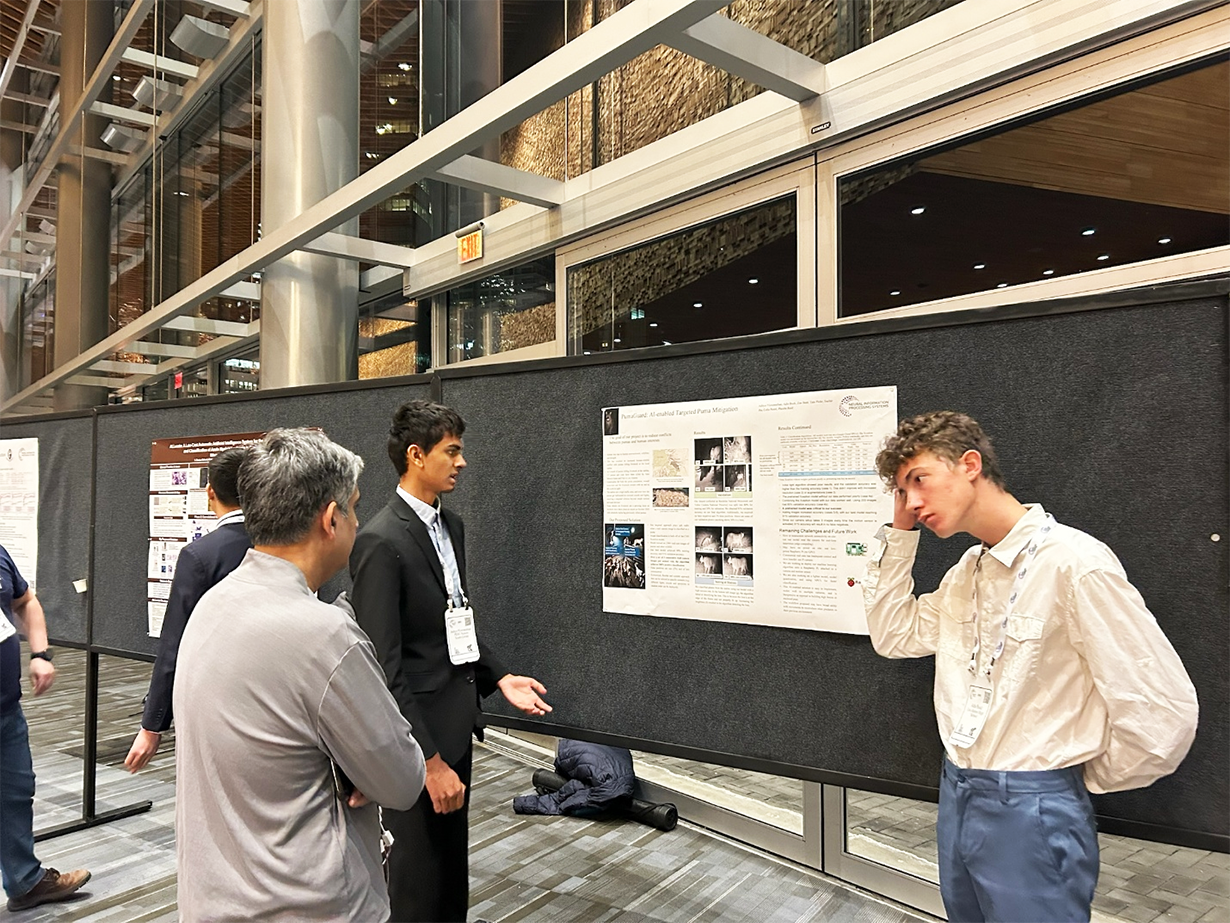
 PEEC Nature Youth Group members Aditya Viswanathan, center, and Adis Bock, right, of Los Alamos High School presenting poster at the Neurips conference, Dec. 10, 2024, in Vancouver. Photo by Hari Viswanathan
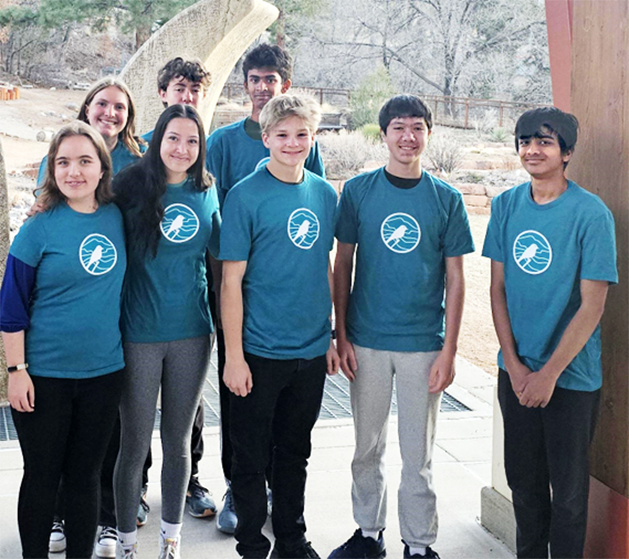 PEEC Nature Youth Group members Aditya Viswanathan, Adis Bock, Zoe Bent, Tate Plohr, Suchir Jha, Celia Pesiri, Sebastian Koglin and Phoebe Reid of LAHS. Photo by Ryan Ramaker
By ADITYA VISWANATHAN and ADIS BOCK
PEEC Nature Youth Group
The members of our Pajarito Environmental Education Center (PEEC) Nature Youth Group were awarded a prestigious prize for a project that aims to prevent predator-livestock conflicts by using Artificial Intelligence (AI).
Our group was awarded one of four awards of the high school track of NeurIPS [1], the Conference on Neural Information Processing Systems, an annual conference that brings together researchers from various fields to exchange research ideas on neural information processing. It is considered one of the most prestigious Artificial Intelligence (AI) conferences in the world.
Our project was selected from 335 global entries, placing them in the top 1% of submissions. Along with a $1,500 monetary prize, two members were given the opportunity to present at the conference on Dec. 10, 2024, in Vancouver, Canada. We traveled to Vancouver to present the work and accept the award for the team. The members of the prize-winning team include us, Aditya Viswanathan and Adis Bock, as well as Zoe Bent, Tate Plohr, Suchir Jha, Celia Pesiri, Sebastian Koglin and Phoebe Reid.
Our group was founded just a year earlier to bring together high school students, lab scientists, and local experts to address environmental challenges in the Los Alamos community. For the Neurips award, our team developed an AI system to help mitigate human-wildlife conflict in the local area. We used a combination of trail cams to take photos of passing animals, AI to determine if that animal is a mountain lion, and if so play sounds and flash lights to scare it off. Our project aimed to highlight the practical role AI could play in addressing human-wildlife interactions and environmental challenges.
The award that our group received was announced at the conference during the opening remarks in front of over 7,000 people! Afterward, we presented our poster at the opening reception along with the other three winners. There was a lot of interest in our work and we were able to explain the project to many people over the course of 3 hours.
This was a very exciting conference to attend because just last year AI contributions to STEM won Nobel Prizes in both Physics and Chemistry. Much of this Nobel Prize work was initially presented at Neurips years ago. In addition, with the rapid development of tools such as ChatGPT, generative AI tools such as DALL-E, self-driving cars, robotics, etc., it was clear this was a fast-moving field impacting many facets of everyday life.
Many talks at the conference discussed the positives and negatives of AI and how as a community, AI researchers can make sure they avoid the negatives while focusing on the positives. Many of the leading AI researchers from Google, Microsoft, Meta, Academia, and National Labs across the world attended the conference and it was exciting to attend different talks and poster sessions. Seeing thousands of researchers presenting their work was very inspiring since neither of us had been to a scientific conference before.
We are continuing to work on the deployment of our method and hopefully, we can be successful in preventing mountain lion-livestock conflicts. Our method could work for other predators as well if we retrain our neural network.
One of the other winning student projects at Neurips focused on using AI to help with rainwater harvesting in Tanzania. They also have problems with African Lions killing livestock so we discussed collaborating with their team to see if we could try our system in Tanzania. We thought this was a great example of how these conference collaborations could lead to new exciting ideas and projects going forward.
PEEC Nature Youth Group is developing exciting eco-centric programs for young adults ages 14-19+. These programs will promote PEEC’s mission of enriching local communities in and around Northern New Mexico by connecting people to our canyons, mesas, mountains and skies. The program provides leadership development opportunities for participants and adheres to PEEC’s core principles.
[1] https://blog.neurips.cc/2024/11/18/announcing-the-neurips-high-school-projects-results/