







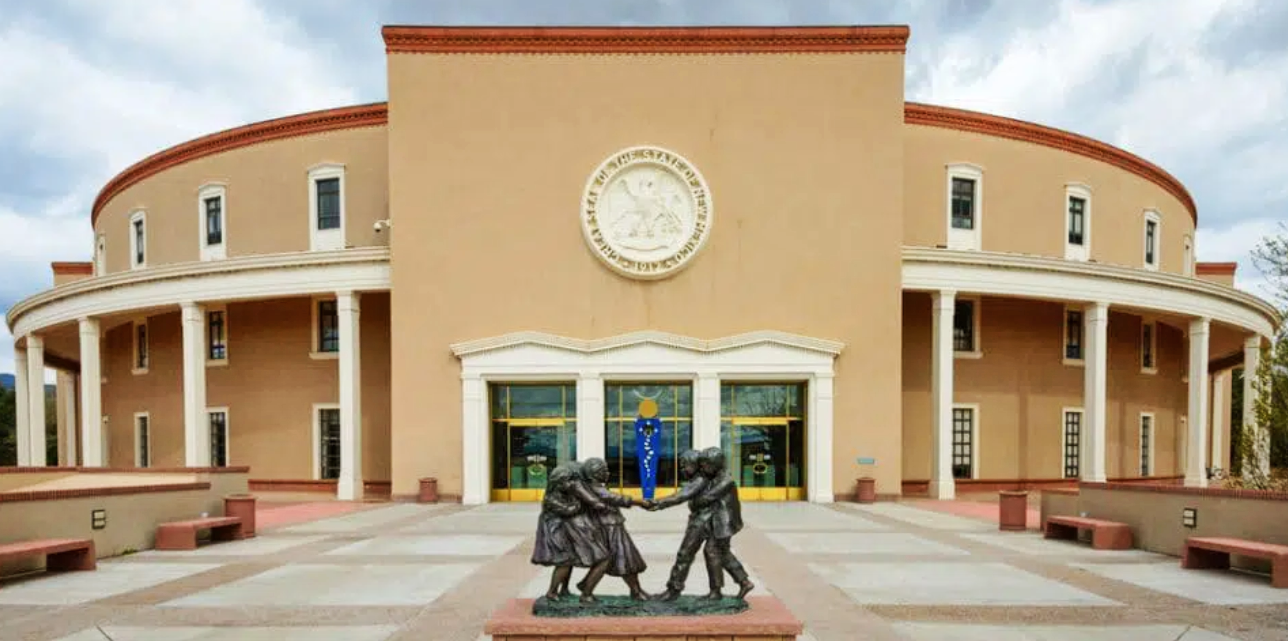
 The Roundhouse in Santa Fe. Post file photo
By RICHARD MARK GLOVER
The Santa Fe New Mexican
Bilton Werito — a member of the Counselor Chapter of the Navajo Nation, a combat veteran and a former oil field worker — stood in the high-desert sun, gazing at the sky as if hope might tumble down. He is the father of two boys. They are both sick.
“We moved to Counselor two years ago after my wife died. Since then, my sixth grader has developed headaches two or three times a week, nausea, itchiness in his throat and a skin rash around his mouth. My youngest just coughs all the time,” Werito said on a recent day.
Less than half a mile, by the way the crow flies, from the boys’ Lybrook Elementary School, two oil and natural gas facilities stand in the cleft of a mesa. One is a single storage tank; the other, much larger, includes a compression station, a nine-tank battery, and a manifold hub with a five-hose truck loader.
Back at the Roundhouse in Santa Fe, state Rep. Debra Sariñana, D-Albuquerque, hopes her House Bill 35 will make a difference to the 34,000 kids in New Mexico who, like Werito’s children, attend classes in the shadow of oil and gas infrastructure.
“Kids shouldn’t need to inhale those fumes,” said Sariñana, a former math teacher. “It’s hard to concentrate in the classroom when you have asthma or headaches.”
HB 35, titled “Children’s Health Protection Zones,” seeks to prohibit construction of new oil and gas facilities within a mile of public schools.
After its first hearing before the House Energy, Environment and Natural Resources Committee — with much debate, including which lawmaker loves children more — the measure passed on a 7-4, party-line vote Tuesday, with Democrats in favor. It has a long way to go to the finish line, with two more committee votes before it reaches the House floor. Its next stop is the House Health and Human Services Committee.
Werito testified in favor of the bill before the Energy, Environment and Natural Resources Committee last week. His two sons sat in the front row.
Sariñana pointed out several examples of oil facilities near schools in Eastern New Mexico and the San Juan Basin, including Jefferson High School in Hobbs, surrounded by 161 oil and gas wells — all within a mile of the campus.
“This legislation has been accused of afflicting harm on [the] oil and gas industry,” Rep. Miguel García, D-Albuquerque, said Tuesday, “but what it does, actually, is uphold the state constitution and protect the public health, welfare and environment by being conscientious of the impacts.”
Missi Currier, president and CEO of the New Mexico Oil and Gas Association, indicated in an email this week the group does not support HB 35.
“HB 35, while well-intentioned, poses significant challenges for our communities in the San Juan and Permian Basins,” she wrote. “The proposed regulations would impose unnecessary financial and regulatory burdens that could hinder economic growth and development in our region. Our regional industries already comply with local setbacks, comply with, and often exceed, stringent regulations, and continue to make substantial progress in reducing emissions.
“We believe that collaboration, best available science, and informed decision-making, rather than additional legislation, are the best ways to ensure the health and prosperity of our communities,” she added.
A bill similar to HB 35 was unsuccessful last year. Republican state Sen. Larry Scott of Hobbs, who previously served in the House, was not in favor of the measure and remains opposed. He wrote in an email late last month, “If you can point me to even one instance of a peer reviewed study confirming the damage done by these facilities to school kids then I am completely on board.”
But, he said, “The fact is that this evidence simply does NOT exist. The industry captures virtually all of the gas and oil that is produced because it is what we have to sell. The small volumes that escape into the atmosphere rise quickly (natural gas is much lighter than air) to become undetectable very short distances from the facility. This is a solution in search of a problem.”
Several studies in the last five years have shown emission leaks from oil and gas facilities in the Permian Basin, in particular methane, are some of the nation’s highest.
According to the Center for Biological Diversity, 47 peer-reviewed studies have been sent to lawmakers identifying leaks of volatile organic compounds and their health effects.
“It’s high time for our state leaders to recognize the health dangers of oil and gas pollution,” said Gail Evans, an attorney for the center. “They should start with not poisoning children while they’re at school.”
One peer-reviewed study in 2020 in the Counselor area titled “A Cultural, Spiritual and Health Impact Assessment,” using eight air-quality sensors, found high levels of benzene and other volatile organic compounds leaking from oil and gas facilities.
A study conducted in 2022 and 2023 by Tommy Rock of the Navajo Nation, at the time a post-doctoral research fellow at Princeton University, placed air monitors at the larger facility below Lybrook Elementary. Rock found benzene leaking above the legal limits, with spikes especially in the mornings, at over 7,000 parts per million. In comparison, the Occupational Safety and Health Administration limits exposure in most workplaces to 1 ppm during an average workday and a maximum of 5 ppm over any 15-minute period. Rock’s study was not peer reviewed.
Rep. Matthew McQueen, D-Galisteo, who chairs the Energy, Environment and Natural Resources Committee, noted the state’s inspection and monitoring system for the oil and gas industry might need more stringent enforcement.
The New Mexico Environment Department said in July it had only five enforcement staff to monitor and inspect over 55,000 licensed oil and gas facilities statewide.
“We have heard that enforcement is lacking,” McQueen said. “It could be more robust. Oil and gas need to play by the rules. We appreciate what they do but we are not going to turn a blind eye.”


























