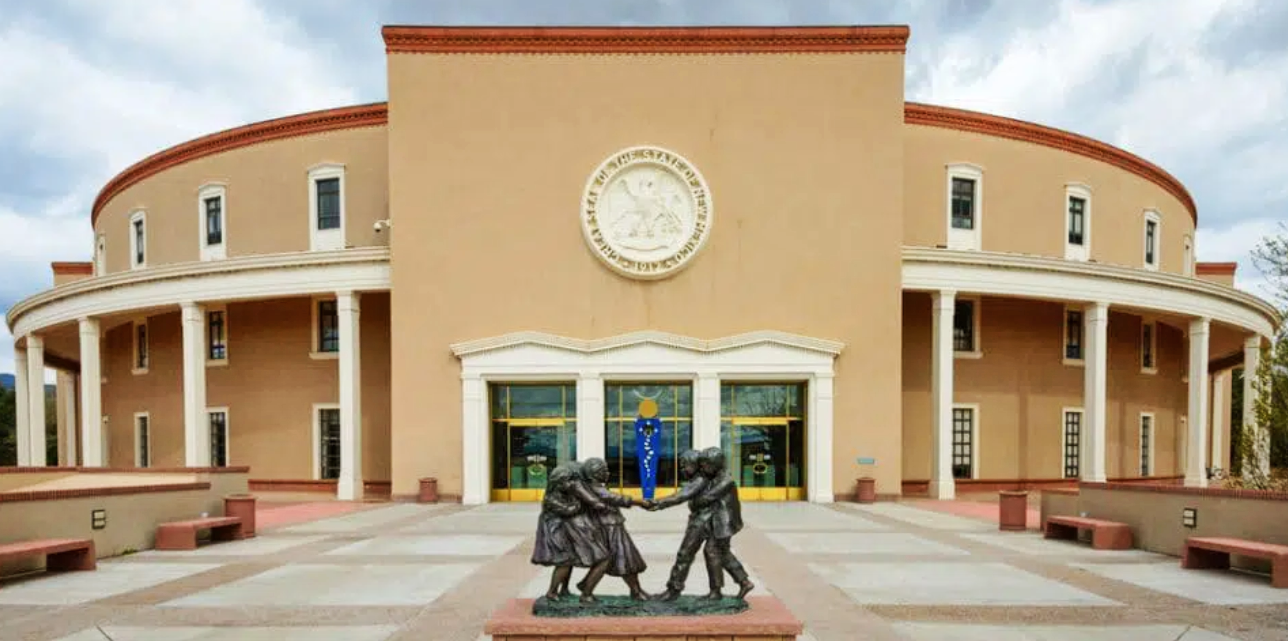
 Roundhouse in Santa Fe. Post file photo
By CORMAC DODD
The Santa Fe New Mexican
Members of New Mexico’s state-regulated cannabis industry have long raised concerns about the rollout of sales for recreational use: the volume of dispensary licenses, taxes and the lack of enforcement of a still-thriving illegal market.
Duke Rodriguez, CEO of New Mexico cannabis giant Ultra Health, said it was possible key legislation addressing some of these issues could land on the governor’s desk before the session ends this week, but he was not particularly optimistic.
“It’s my understanding that nothing has crossed the finish line,” Rodriguez said earlier this week. “So, while our wishlist was very short, if one or three of these things cross, at best, it might be a pleasant surprise.”
Rodriguez has seen at least one wish granted: The Senate on Tuesday approved a bill that would give police powers to the state Regulation and Licensing Department in an attempt to crack down on the illicit market; it now heads to Gov. Michelle Lujan Grisham for her signature.
The police powers bill was one of two proposed cannabis-related measures that have gained traction as the end of the session comes into focus. Another deals with intoxicating hemp.
Ben Lewinger, executive director of the New Mexico Cannabis Chamber of Commerce, believes this is the most significant session for the industry since 2022, when the state legalized recreational cannabis.
The so-called “cannabis cops” bill and the legislation dealing with delta-8 THC have the potential to reshape the billion-dollar cannabis industry in the Land of Enchantment.
It remains unclear, however, whether a bill that would do away with a planned escalation in cannabis excise taxes, championed by members of the industry, is going to become wrapped into the Legislature’s tax package for the session.
“I’m mixed on the session overall. I think there were some missed opportunities,” said Matt Kennicott, who leads a group called The Plug, which supports small cannabis businesses in New Mexico.
Enforcement bureau
House Bill 10, which is co-sponsored by House Speaker Javier Martínez, D-Albuquerque, and already has Lujan Grisham’s backing, has been one of the closely watched cannabis bills.
It would allow the Regulation and Licensing Department, which houses the Cannabis Control Division, to employ certified law enforcement agents in a new enforcement bureau, primarily to investigate potential violations of the state’s cannabis law. The agents would be granted the same powers as other law enforcement officers in New Mexico.
Under HB 10, the enforcement bureau would have the ability to seize illegal weed and make arrests. The Regulation and Licensing Department currently has no authority to conduct criminal investigations; that is up to law enforcement.
The measure passed the Senate 25-1 on Tuesday after receiving similarly wide support in the House.
The Cannabis Chamber of Commerce, with a membership of about 200 license-holders, strongly supports the bill. Retailers say the underground market continues to have a negative impact on New Mexico’s licensed manufacturers and distributors.
Kennicott said The Plug is neutral on the measure, noting law enforcement already has the authority to regulate the illegal trade.
“I would argue that that authority and that ability is still there,” Kennicott said. “I am not sure why we even need House Bill 10. But what I’m hoping is that, if it does pass, implementation goes smoothly and, as an industry, we’re able to have some input on the implementation of that legislation.”
Rodriguez said HB 10 was the lowest of his priorities.
Intoxicating hemp
The largely unregulated market for hemp products containing the psychoactive chemical THC has fueled concerns in New Mexico and across the nation. Products such as gummies and other edibles containing the often synthetic hemp-derived THC are sold legally in gas stations and smoke shops in many states, including New Mexico, thanks to a federal farm bill loophole.
House Bill 346 — introduced by Andrea Romero, D-Santa Fe, and Derrick Lente, D-Sandia Pueblo — would impose a prohibition on synthetic cannabinoids and semisynthetic cannabinoids, by banning possession, marketing and sales of delta-8, delta-10 and THC-O acetate in New Mexico.
Intoxicating hemp derivatives known as delta-8 THC and delta-10 THC have become popular, Politico reported this year, with some hemp companies finding it is possible to get enough delta-9 THC in a beverage or edible product to have psychoactive effects without breaking the guidelines of a 2018 law.
HB 346 passed the House on a 54-7 vote March 13 and is awaiting a hearing in the Senate Judiciary Committee. It was unclear Tuesday afternoon what bills would be heard in the committee the rest of the week, leaving uncertainty about whether HB 346 would pass the full Senate before the session comes to a close.
“With just a couple days left, each day that goes by I’m less optimistic,” Lewinger said. “But it does solve the issue of having intoxicating hemp-derived THC substance readily available … [without] the same testing protocols we have in the cannabis industry.”
HB 346 amends the Hemp Manufacturing Act to give the state Environment Department authority over hemp products. Currently, the Environment Department only regulates products manufactured in New Mexico.
Environment Department spokesperson Drew Goretzka wrote in an email the agency supports the legislation.
“We look forward to ensuring that finished hemp products are appropriately labeled to ensure consumers know what they are putting into their bodies,” Goretzka said. “And that synthetic cannabinoid products, made using harmful chemicals and other ingredients, are not available in New Mexico.”
Romero said Tuesday she was not sure when the bill would get to the Senate floor but said she is “still hopeful.”
“Psychoactive substances that are being cultivated in the state that are at all associated with THC need to be regulated by the Cannabis Control Division. Right now, for this hemp derivative, this THC derivative that is semisynthetic or synthetic, we don’t have any reliable testing to understand what’s in it,” Romero said. “It’s completely unregulated.”
Halting tax hike
Senate Bill 89, sponsored by Sen. Katy Duhigg, D-Albuquerque, would eliminate statutory increases in the cannabis excise tax rate, instead maintaining the current 12% cannabis excise tax “in perpetuity,” according to a Legislative Finance Committee analysis.
Current law provides for the cannabis excise tax to increase by 1% per year in fiscal years 2026 through 2030 for a total final rate of 18%.
Duhigg’s bill has not gotten a hearing during the session, but Lewinger and others were holding out hope the legislation would be rolled into a tax package.
By reducing the cannabis tax rate in future years, revenues to the state general fund would be reduced by $2.7 million to $13.4 million a year, the Legislative Finance Committee notes in an analysis of Duhigg’s bill.
Under current law, total cannabis excise tax revenues to the general fund are estimated to climb from $32.7 million in fiscal year 2024 to $41.1 million in the fiscal year 2029, the analysis states.
“I do still think that that could still go somewhere. It’s just rebranded,” Lewinger said.
Rodriguez was less optimistic.
“I’m highly doubtful any kind of cannabis tax relief is forthcoming,” he said.
Kennicott, who owns a company in Socorro called High Maintenance, said, “That’s one that we really needed this year. And I’m not sure it’s actually going to make it into the Senate’s final tax package.”