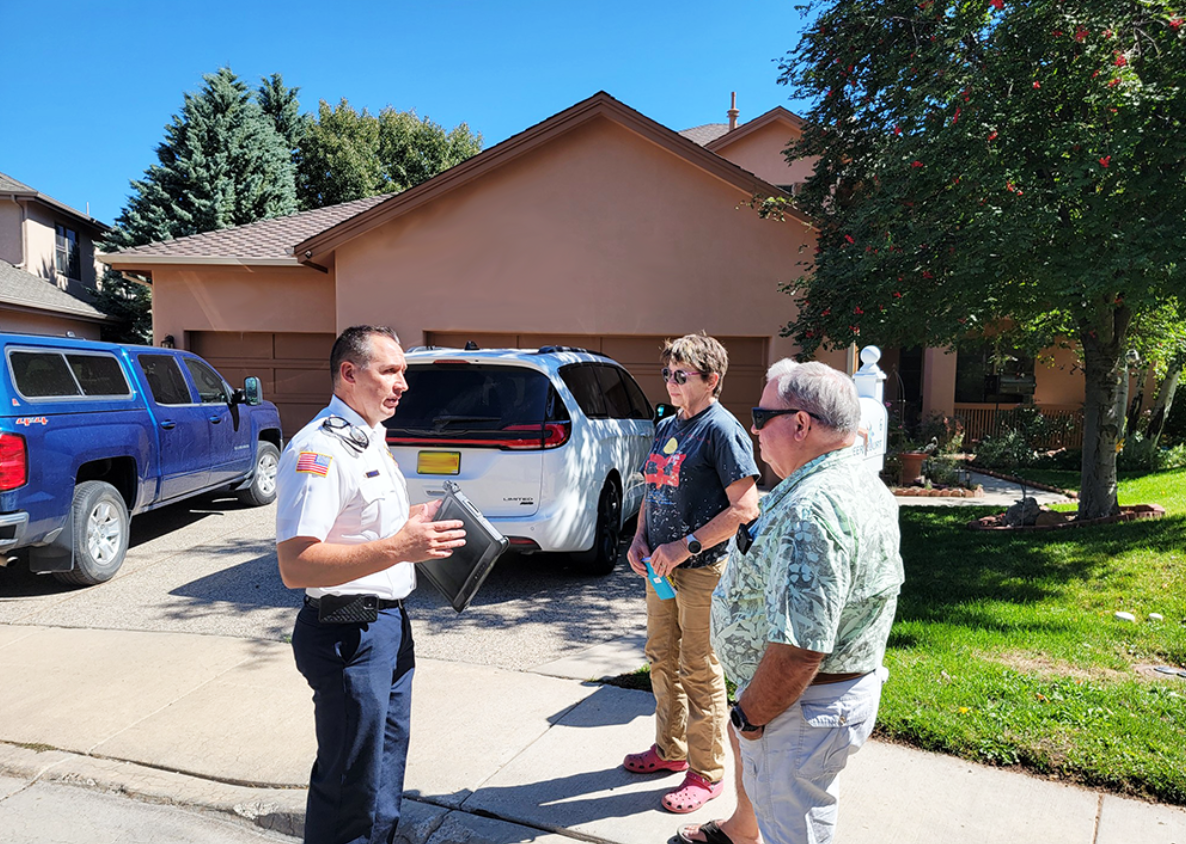
 Wildland Fire Chief Kelly Sterna speaks with homeowners Ruth and Jim Doyle as he prepares to conduct a free wildland fire home assessment last fall of their North Mesa residence. Photo by Carol A. Clark/ladailypost.com
By KIRSTEN LASKEY
Los Alamos Daily Post
kirsten@ladailypost.com
“It’s going to take everybody doing the right thing to really harden our community to wildland fire,” –Wildland Fire Chief Kelly Sterna
It is only March but the seasonal outlook for wildfires is already looking dire.
During a recent Los Alamos Local Emergency Planning Committee meeting, Los Alamos Wildland Fire Chief Kelly Sterna presented a map of the U.S. that used red to indicate regions that have or will have above normal fire potential. Come April, the map showed pretty much the entire state of New Mexico glowing scarlet.
“The problem is that when we look at the U.S. wildland fire potential outlook annually, the southwest is the first geographical area in the United States that gets into the wildland season in the early spring, March and April,” Sterna said. “However, when you look at the map, we already saw on the news this past weekend, we had a pretty significant wildland fire in Myrtle Beach, S.C. and most recently Miami Dade County, and you can see the entire southeast looks like it’s above normal potential as well. That’s really a bad combination … because that puts a stress on one of the most effective resources that we use for wildland fire, which is aviation resources. There’s only a certain amount of air resources that the whole country shares, and when we get more than one geographical area with above average potential or we get actual fire starts in those geographic areas, it’s important to recognize that there’s going to be a strain put on those resources as well as our normal fire engines, our hand crews, other resources that typically will respond to wildland fires.”
The good news is Los Alamos Fire Department and the County Emergency Management Division are offering resources to help harden the community against wildfires.
One of the main resources is the fire department’s Home Assessment program. Emergency Management Coordinator Lance Fresquez said to date, more than 500 assessments have been done.
“This is definitely making the community more resilient to wildland fire risk so if everybody takes the steps to create their defensible space around their property, it makes us a more resilient community, which we are always trying to encourage in emergency management,” he said.
Sterna emphasized that during the assessment, the fire department is not mandating; it is offering an opportunity to be educated. To schedule an assessment, email the LAFD Wildland Division at LAFD Home Assessments.
Another tool is the County’s “Ready, Set, Go” management action plan.
Fresquez explained the plan was implemented during the Cerro Pelado Fire in 2022.
Breaking down the stages, Sterna said the first one, Ready, is constant; the County is always in the Ready stage. He explained in this stage, there is a year-round opportunity to harden homes against wildfires. This can include the home assessment as well as seasonal maintenance. It is especially important, Sterna said, to create a defensible space in the 0-5 foot radius around a home.
This can be achieved by removing combustible materials, thinning tree canopies, pruning trees and shrubs, disposing of dead vegetation, watering plants and lawns. Another component of the Ready stage is an emergency kit or go-bag. Sterna recommended creating a list of items that need to go into that bag. This can improve evacuation times. Furthermore, he said people should know their evacuation route and noted that a secondary evacuation route is through Rendija Canyon.
The next stage is Set. During this stage, Sterna said it is important to be informed; sign up for the County’s emergency notifications through Code Red and look out for announcements on social media.
The final stage is Go. Sterna said Code Red will notify when it is time to evacuate, starting with those closest to the emergency.
While residents are encouraged to be proactive, Sterna said the fire department is also actively responding to wildland fire risk.
For instance, he mentioned the department’s Community Wildfire Protection Plan (CWPP).
“Our CWPP – for anybody who doesn’t know what that stands for – it means the community wildfire protection plan. That was originally authored by Craig Martin in 2006. We then updated that in 2015 and then again in 2022. We are mandated by NM State Forestry to update our CWPP at a minimum of every five years. Typically, we look at updating that a little sooner because if we’re doing any project work, fuel mitigation work, here in Los Alamos County, or we add mapping products, those all constitute good reasons to update our community wildfire protection plan,” Sterna said. “Again, we are one of the few counties in New Mexico that have had two or more updates or three versions of our community wildfire protection plan. I really like to talk to that point because this document, it’s a living document, it’s really how we understand and how we analyze what our need and our priorities as far as wildfire mitigation are in the county.”
New opportunities are always sought for how to do mitigation, Sterna added.
“Presently, we’re actually looking into robotic mastication equipment, to bring into the county do some work on our steeper slopes that we can’t really safely put people on,” he said. “So, just because we have steep slopes that’s not a reason for me to not try to mitigate that area. So, again, we are moving forward with a lot of interesting and exciting projects. We’re going to be collaborating with Los Alamos Open Space Division and their YCC – youth conservation corps – to do additional mitigation on top of our own personnel that are going to be out and about in five to seven project areas we identified in Los Alamos and White Rock.”
Those areas can be viewed on the LAFD Wildland Page.
Additionally, Sterna said the fire department utilizes its No Harm Wildfire Risk Assessment, which was developed by Anchor Point. The assessment used ground-truth data that helped create the wildland home assessment program. In 2017, Sterna said the fire department received around $450,000 through FEMA for a hazardous material grant program.
With that grant, 144 acres within the County were focused on for mitigation. The first phase, he said, was an environmental assessment and assessments for homes that bordered the project area.
With that data from the home assessments along with other data points, the no harm wildfire risk assessment was developed. Furthermore, he said, LAFD created mapping that it uses internally for structure triage or structure protection for neighborhoods.
Sterna did address insurance coverage.
“I can tell you that insurance companies will use whatever means they have to look at homes that are under their coverage umbrella … that’s why we want to give home assessment to folks, because the number one thing I tell homeowners is to take before and after pictures of any work that you do, save them to a file on your computer because if you speak to your insurance folks and they say, well, we can’t justify covering you, or you’re going to face a higher insurance premium because of this type of hazard around your home, you actually have evidence that you’ve done the work and you should get credit for that work,” he said.
This is an issue being addressed in the fire department, too. Sterna said staff in his division and the LAFD Fire Marshall’s office are going to the state legislature and talking with insurance industry professionals, the New Mexico Office of the Superintendent of Insurance, legislators and others to understand mitigations that really matter on both sides of the table.
Sterna said he hopes that in the future insurance companies recognize what fire departments are looking at for wildfire risk and can agree what the risk looks like.
He added one of the primary purposes behind the home assessments is not to get the best rate but to be insured.
There are heavy odds stacked against the community this wildfire season but there is an invaluable asset to address the risk of fire: residents have one another.
As Sterna said, the push is for neighbors to talk to each other, rally entire neighborhoods to be mitigated and then the whole community.
“It’s going to take everybody doing the right thing to really harden our community to wildland fire,” he said.