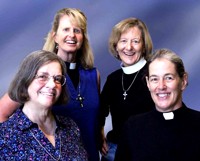
Clergy from left, Deacon Cynthia Biddlecomb, retired; Pastor Nicolé Ferry, Assistant Rector Lynn Finnegan and Pastor Deb Church. Courtesy photo
By REVEREND LYNN FINNEGAN
The Episcopal Church of the Holy Faith
Santa Fe
“Happy shall they be who take your little ones and dash them against the rock!” This brutally descriptive sentence is found … in the Bible. What? When I first encountered this language in the Book of Psalms, a collection of ancient Hebrew sacred songs and poems found in the Old Testament, I cringed. So graphic. So violent. So not what I expected to read in the Bible. This last line from Psalm 137 is so distasteful it is sometimes omitted when the psalm is read. I don’t want to omit it, though. I still cringe every time I read it, but I don’t want to omit it because it is a poignant reflection of pain, suffering and raw emotions that sometimes we Christians want to pretend don’t exist.
The verse, like so many of our Biblical quotes, must be read in context, though, not misused as an off-putting meme. Have you seen the “Scary Mary Trailer Horror”? It is a cut and paste video of Disney’s “Mary Poppins” that splices scenes, adds horror music, and catches seconds of film showing Mary Poppins looking stern and the children aghast and terrified. If you had never seen “Mary Poppins,” you would definitely want to keep your children far from Julie Andrews.
The same principle applies with this psalm. From history of the time period, we know the poem was written by a refugee, one of an entire nation of Hebrew refugees wrenched from their homes and marched into slavery by their conquerors. Many of the poet’s own people, including children, have been slaughtered. The remainder of the psalm paints the fullness of the degradation: in addition to death and destruction, the captors torment the refugees and taunt them to sing songs of their homeland.
The writer is not a monster. The poem is not an expression of joy at the death of children or a call to violence. It is an agonizing lament of unfiltered vengeance, reflecting the depths of suffering I pray I will never experience. Many have known, and many today do know, the depth of the poet’s pain, however. Perhaps many in our country feel this pain today, on this Sept. 11 anniversary of the attack on our country.
The Book of Psalms contains songs of thanksgiving, joy, unbridled happiness and praise. But it also contains words of lament and pain, anger and confusion. The writers of the psalms glorify God with words of praise and homage, but they also weep in agony and aren’t afraid to shake an angry fist at him. And this is precisely why I love that the Book of Psalms, with all its raw emotional expressions, is in our Bible. It reminds me all my emotions, no matter how shocking or offensive, are valid and welcome to God.
Editor’s note: ‘All Shall Be Well’ is a semi-monthly column written by local women clergy (pastors and deacons) including, ELCA Deacon Cynthia Biddlecomb, M.Div., retired (czoebidd@gmail.com); Nicolé Ferry, Pastor, Bethlehem Evangelical Lutheran Church (pastornicole@bethluth.com); Lynn Finnegan, Assistant Rector, The Episcopal Church of the Holy Faith, Santa Fe (rev.lynn@holyfaithchurchsf.org) and Deb Church, Pastor, White Rock Presbyterian Church (pastor@wrpchurch.com).