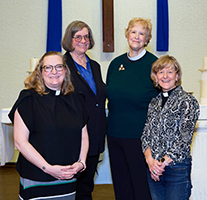
 Clergy from left, Deacon Amy Schmuck, Deacon Cynthia Biddlecomb, retired, The Rev. Mary Ann Hill and The Rev. Lynn Finnegan. Photo by Nate Limback/ladailypost.com
By The Rev. Lynn M. Finnegan
Associate Rector
The Episcopal Church of the Holy Faith
Recently, I met with a couple planning to be married in the Spring. For their ceremony, they requested the most requested wedding scripture of all time: a passage from St. Paul’s First Letter to the Corinthians. It reads:
Love is patient; love is kind; love is not envious or boastful or arrogant or rude. It does not insist on its own way; it is not irritable or resentful; it does not rejoice in wrongdoing, but rejoices in the truth. It bears all things, believes all things, hopes all things, endures all things. 1 Corinthians 13:4-7.
This is a beautiful sentiment for a betrothed couple to hear and take to heart in their relationship. St. Paul, however, whose opinion of marriage was basically “only if you have to,” would likely be bemused to know we have reduced his powerful words to a wedding day encouragement.
When Paul wrote, he did not have marriage in mind. Rather, he was admonishing a community in crisis.
Paul established a church in the city of Corinth and then left to preach elsewhere. The church he left behind was a mix of wealthy and lower class, those of Jewish descent and Greek converts.
Such a diverse community was a radical and challenging idea in the first century Middle East, but Paul encouraged them to welcome one another and worship together in unity. And it worked.
After Paul left, another Christian teacher, who encouraged elitism among the wealthier Christians, intervened. Factions formed, arguments ensued, and the church wrote to Paul for advice. Paul responded in a desperate effort to restore the teachings of Jesus, where each person is equally valued and cared for.
He doesn’t suggest they form a committee to study the problem, or lay out a visioning plan, or even encourage them to use social media to argue the righteousness of their positions. Instead, he told them they had to love one another, and that this love, modeled by Jesus, was the only thing that was going to prevent them from imploding. Their reliance on their own self-importance, their need to strut their own opinions to dismiss the value of others, well, all of that was insignificant. It all would end: death is the great equalizer. But love – love endures. If the community were to survive, each person had to let go of ego, pride, and selfishness and do whatever it would take to support one another. They had to let go of resentments and reveling in the other’s failures. They had to forgive and learn to work together.
This way of love wasn’t easy then and it isn’t easy now. The Corinth Church continued to struggle with Paul’s advice, and he would write again, reminding them sacrificial love involves humility, pain, and suffering. He doesn’t back down and teach an easier path, though, because following Christ is not an easy path. I look forward to reading the “love passage” from Corinthians in the Spring and at many weddings to come. Let’s not, however, relegate Paul’s challenging words to flowery nuptials. Love is patient, kind, not envious, boastful, or arrogant and … love takes work. Paul’s words are meant for all of us.