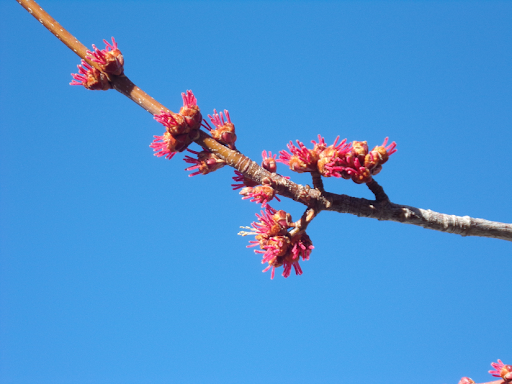
 Red colored clusters of flowers are emerging from a stem. Photo by Robert Dryja
By ROBERT DRYJA
Los Alamos
March could be called the springtime clustering month. Both plants and animals begin to appear in different kinds of clusters as the weather begins to become warmer. A flower may emerge on tree branch as part of a group that grows close together. Picture 1 shows several clusters of red-colored flowers emerging on a tree stem. Pollen bearing anthers appear as red-colored stems coming out of orange colored sepals. What looks like a single flower at a distance is actually several small flowers growing adjacent to each other, called florets. Picture 2 shows a variation. Clusters of white-colored flowers are growing along small stems. These smaller stems in turn are growing from a larger stem.
Again, several flowers are growing close together to give the impression they are part of a single flower. These clusters last only about a week. Pollination then is complete and the flowers begin to wither away, to be replaced with growing seeds.
Clustering also may occur among birds. Red-winged blackbird gather in large flocks. As many as a hundred may gather at the top of a tree. Their group chirping is remarkable to hear. The sound is continuous with the chirps blending together. A group also is remarkable while flying. The birds are about two or three feet apart and somehow know when turn direction together. A large group may divide into smaller groups and reassemble as a single large group. A flock may migrate northward or southward as part of spring or autumn. A flock alternatively may remain local, moving up or down a mountain side as part of a seasonal change. Red-winged blackbirds typically nest in marshy and stream areas but then change locations when these become frozen in winter.
Common ravens are seen in small groups of two or three birds during the summer. Two birds often fly close to one another and a third follows at a distance. Perhaps these are parents with a now mature chick staying with them. Ravens may gather in small flocks of about ten birds over the winter before disbursing in the spring. A flock of these birds at the top of a tree is remarkable to see.
Sandhill cranes can provide an even more remarkable sight and sound. The Rio Grande River flows through a canyon that is 750 feet deep and a mile wide. This results in a shape that approximates a megaphone. Ten to twenty sandhill cranes may be bugling as they fly only a couple of hundred feet about the canyon rim. Their loud bugling echoes up from the canyon bottom, hundreds of feet below. The impression is that the canes are flying down in the canyon, not above to one side.
Clusters in spring time may last for only a week or two. They can be scenic as occurs with flowers. They can have surprising affects as occurs with bugling birds.
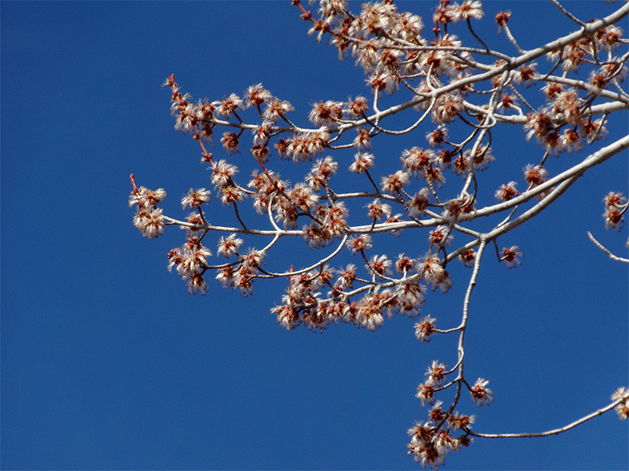 Flowers are growing along smaller stems that are growing from a larger stem. Photo by Robert Dryja
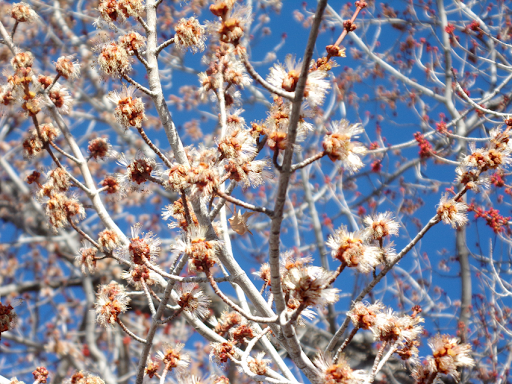 White anthers that are producing pollen stand out. Photo by Robert Dryja
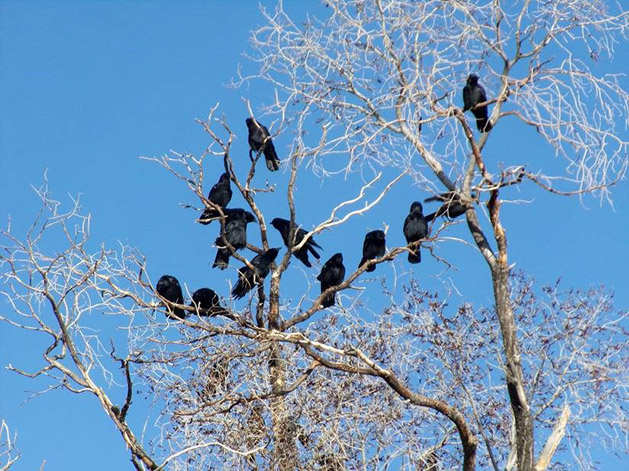 A cluster of common ravens gathers at the top of tree that has flower beginning to emerge. Photo by Robert Dryja