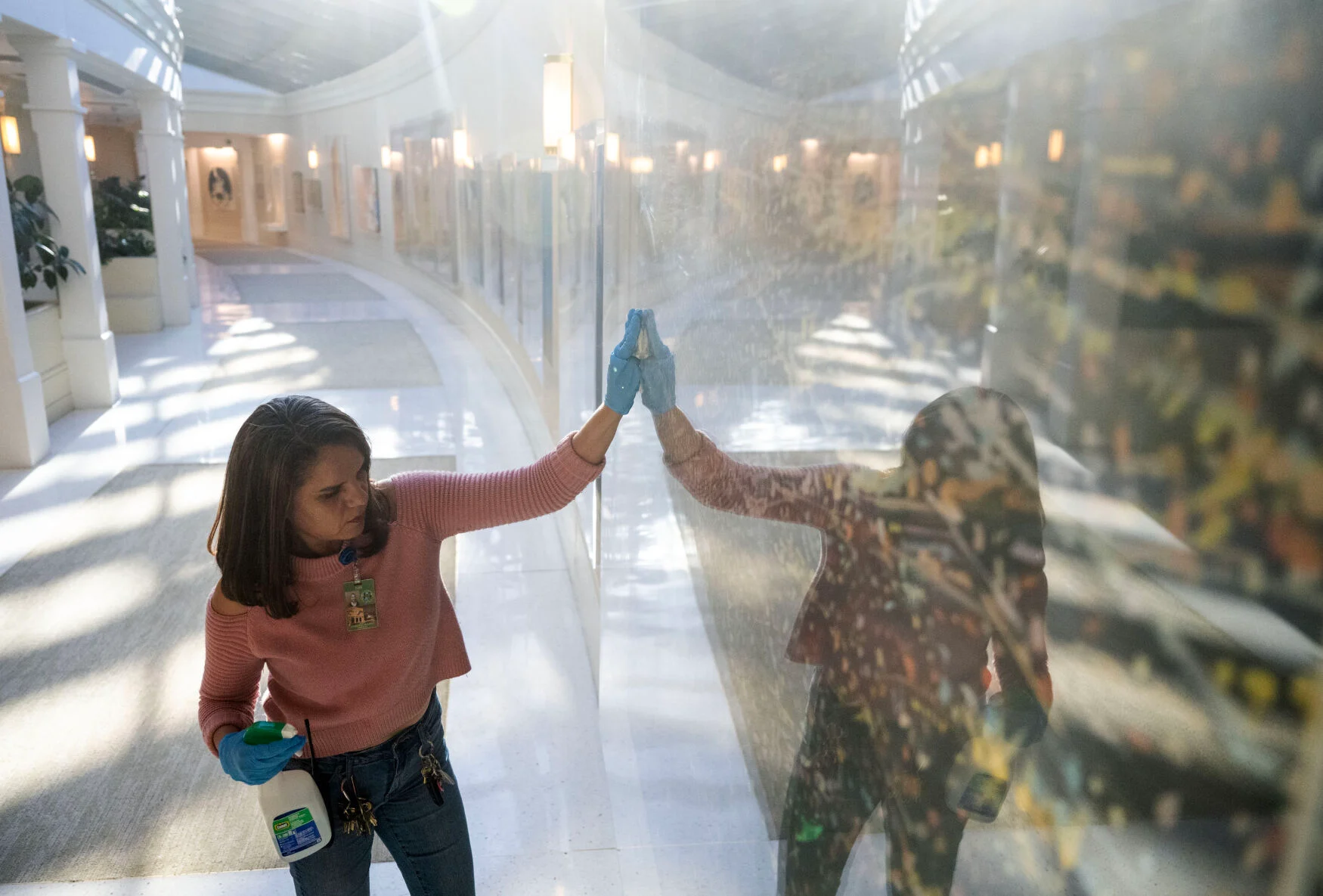
 Claudia Diaz, a custodial supervisor at the Capitol, does her rounds in the Walter K. Martinez Memorial Walkway last month. Diaz has worked in custodial services at the Roundhouse for 16 years and says she logs 25,000 steps a day during the legislative session to keep the building clean. Photo by Michael G. Seamans/The New Mexican
By DANIEL J. CHACÓN
The Santa Fe New Mexican
It takes a small army to keep the Roundhouse running like a well-oiled machine, particularly during a legislative session when thousands of people pile into the state Capitol.
While the spotlight tends to be on lawmakers and the governor during a session, the people who really run the building are more blue collar than white collar.
From custodians and carpenters to security guards and emergency medical technicians, they play vital roles at the Capitol, and it doesn’t go unrecognized.
Though they don’t typically receive individual recognition, legislative leaders routinely laud the collective group of people who work at the Roundhouse.
“A special thanks to the staff and all the folks across the building,” Sen. Michael Padilla, D-Albuquerque, said at the end of Friday’s Senate floor session.
“I’m not going to start naming the groups, but thank you so much for all of your help keeping the trains running on time, to all of the staff all over the building,” he said.
Shawna Casebier, director of the Legislative Council Service, which is the drafting and legal research agency for the Legislature but also oversees the security, care and maintenance of the Roundhouse and surrounding property, said the people who work in the building are essential.
“Our incredible team of year-round and session employees works tirelessly, often behind the scenes, to keep the Capitol safe, clean and welcoming for legislators, staff and thousands of visitors each day,” she said.
“Their dedication is integral to the operations of this 60-day session, and I am honored to work alongside such hardworking and kind individuals,” Casebier added.
Building Superintendent Raphael Baca called his 52 employees “top notch.”
“I’m just so blessed to work here because I’m working with the best of the best,” he said.
Behind the nation’s ‘cleanest capitol’
On any given day, Claudia Diaz, 51, logs anywhere between 7,000 and 9,000 steps in her custodial job at the Roundhouse.
But during a legislative session, the number climbs to up to 25,000.
“Sometimes more than 5,000 people come to the Capitol in a day,” she said in Spanish.
Diaz, who has worked in custodial services at the Capitol for more than 16 years and is now a supervisor, said the increase in traffic during a session means she and her colleagues have to step up their game, from cleaning restrooms every 15 minutes to regularly wiping door handles and other surfaces and emptying trash cans.
She and her colleagues take great pride in keeping one of the most iconic buildings in the state clean.
“Tourists say, ‘This is the cleanest capitol we’ve ever visited,’ “ she said.
While keeping the Roundhouse clean is her top priority during the day, Silva said her own housework sometimes takes a back seat, especially during a session.
“When I get home, I can barely walk,” she said.
Diaz, who speaks English but is more comfortable in her native language, said she enjoys the excitement that comes with a legislative session. But her job would be too demanding to handle if the building was buzzing with so much activity all year long, she said.
“If it was like that all year, I don’t think I’d survive,” she said, laughing.
Keeping lawmakers comfortable, on track
As the lead plant technician at the Capitol, Miguel Mora, 43, said his job is making sure everyone in the building is comfortable.
If it’s too hot or too cold or there’s a problem with the water, Mora is the go-to guy to solve the problem.
“This is where our laws are made, and keeping [lawmakers] comfortable and on track is paramount to keep government operating efficiently,” he said. “We like to think that [plant technicians play a] pretty important duty, and we have a lot of pride in our duties.”
Mora, who carries a thermometer gun everywhere he goes, constantly monitors the temperature in different parts of the building.
“Most of the time, we’re operating very minimally in occupancy; there’s not a lot of people in the building for a great deal of the year,” he said. “But for either [a 30-day or 60-day session], it’s a beehive of things going on. It’s most challenging during the session time when, obviously, people flood into the building. It’s like the circus coming to town in a sense, so we just want to make sure all of our operations are in line.”
Mora said the Roundhouse, which has four levels, recently underwent “a huge upgrade” to the heating and cooling system that has improved the temperature of the building.
“As anybody that’s been in the Capitol knows, it’s either too cold or too hot in most of the places, and we’ve done a wonderful new upgrade, so we’re hoping to minimize any issues moving forward because it’s far more efficient,” he said. “It was was a big upgrade, costly, but it’s ultimately going to keep people more comfortable.”
Mora has worked at the Roundhouse for eight years and said he’s “still learning something new about this unique building.”
“I have a very unique relationship with the building,” he said. “I really love the building. It becomes like a part of your family in a sense. … It’s just really a great place to be able to experience your daily nine-to-five. I’m never too distraught to come to work on Monday morning.”
Equipped to handle any medical emergency
Caretaker.
That’s how Daniel Coyne, 71, an emergency medical technician, describes his role at the Capitol.
“We’re equipped … to handle pretty much any kind of medical emergency,” he said.
“People have needs, and you have equipment, medication and skills that can address those needs, so you’re just taking care of people,” he said.
Coyne, who only works at the Capitol during legislative sessions, which he’s done since 2018, said he and his colleagues deal with a wide variety of medical issues, from slip-and-falls to indigestion.
“We have not yet had a childbirth, but we are equipped to handle that,” he said. “We do have obstetrical equipment on site.”
In addition to handling emergency calls in the building, including a cardiac case in the first two weeks of the session, Coyne said he and other first responders have a “discreet group of people that come in every day to have their vitals checked” on the advice of their doctors.
“We will check their blood pressure, check their blood sugar, their heart rate, their oxygenation, all of that, on a daily basis,” he said.
Coyne said he and his colleagues were the busiest at the height of the coronavirus pandemic.
“We were tasked with doing all the COVID tests in the building, so we would usually have three [emergency medical services] personnel on staff every day,” he said. “We will do COVID testing, rapid testing, now on demand.”
Coyne said strep throat is “the only thing that seems to be trending” at the onset of this year’s 60-day session.
“We’ve had a number of cases of that in the last couple of weeks,” he said. “It’s not exponentially high. I think we’ve had four cases — and indigestion. But that always seems to be high here.”
Pride in maintaining Roundhouse grounds
A.J. C de Vaca, 38, has always been a hands-on type of guy, which has come in handy in his role as the grounds crew supervisor at the Capitol.
“Our main job is landscaping,” he said.
But C de Vaca said the six-member grounds crew tackles a variety of tasks, from clearing snow to trash removal.
“We’re really like the backbone of the whole Capitol [Legislative Building Services] department,” he said. “Our job duties change throughout the year. Like right before session, [we were] moving furniture. We set up offices. Pretty much anything that needs to be done, they call us.”
C de Vaca said he first started working with the grounds crew as an intern in high school more than 20 years ago.
“When I finished school, there was an opening, and they called me for an interview,” he said. “School finished like that Wednesday, and I started full time that Monday. I’ve been here since then. It’s a good place to work.”
C de Vaca said his favorite part of the job is that it’s never dull.
“I can make a schedule for the week, and it will not go like that because there’s always something,” he said.
C de Vaca said he and his crew take pride in making sure the Capitol grounds are well maintained and look nice for residents and visitors alike.
“My guys are hard workers, and I really appreciate them,” he said. “It’s a team effort.”
Ensuring everyone’s safety and security
Kenny Chacón, 35, never goes to bed late.
As one of the security officers at the Roundhouse, Chacón said he’s always on high alert, which means getting a good night’s rest, since his job is the “safety and security” of the people in the building.
Chacón said he and his colleagues are constantly “checking the premises” to prevent any security lapses.
“The biggest thing right now is [monitoring our metal detectors], just making sure that there’s no weapons coming into the building,” he said.
While firearms are prohibited at the Capitol, he said certain knives aren’t.
“If they’re foldable knives and they’re not longer than four inches, they’re allowed in,” he said.
Chacón said members of the New Mexico State Police boost their security efforts during a session, which he said makes lawmakers and the public feel even more safe.