 By REBECCA RUTHERFORD
For the Los Alamos Daily Post
What is the dark web?
A. When you turn on Dark Mode on your web browser and everything is on a black background.
B. A special part of the web dedicated exclusively to content about the night sky.
C. A secret criminal market that is easily accessible to search for illegal things.
D. The part of the World Wide Web that is only accessible by means of special software, allowing users and website operators to remain anonymous or untraceable.
If you answered D., pat yourself on the back, you are right!
But what is it really, and what does that mean?
You can think of the internet as having three parts:
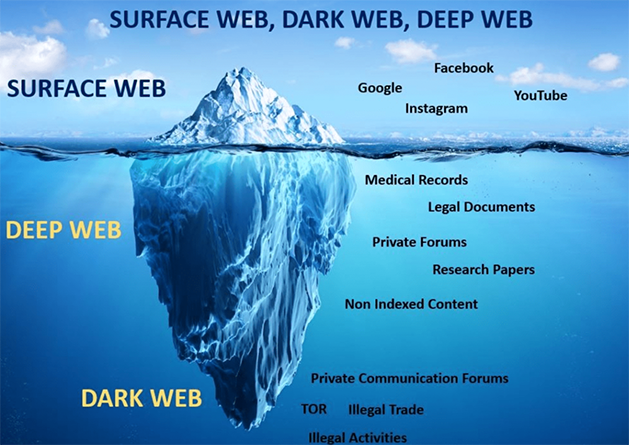 Image from medium.com article
The surface web is the part of the internet we most interact with, things like Gmail, Facebook, CNN, etc.
The deep web refers to the vast part of the internet that is not indexed by search engines, containing private resources.
The dark web is a part of the Internet that is invisible to search engines and can only be accessed by using an anonymizing browser called TOR (The Onion Router). TOR accesses the Dark Web by hiding IP addresses and browsing activity by redirecting web traffic thru a series of routers called nodes. TOR hides browsing activity and blocks tracking, making it useful for whistleblowers, journalists, and other privacy conscious individuals. Web traffic is anonymized via a special encryption technique originally developed by the US Navy. TOR is an open source, privacy platform available to anyone, except in certain countries where it is blocked. In addition to working as a web browser, TOR provides “onion services” via its “onion network” to allow anonymity for websites and servers; these websites all have a .onion domain. So that’s how users can access the dark web, but what content is on the dark web?
 Dark web meme
The dark web is not a place most users should ever venture; according to researchers 57% of dark websites host criminal related content. Many dark web sites are dangerous, and host illegal content. While the dark web itself is not illegal, illegal activities do occur on the dark web and accessing illegal content or participating in these activities can get you in trouble. There are many illegal things for sale on the dark web like credit card numbers, stolen personal data, drugs and illegal sexual content like child pornography. The dark web is also used for human trafficking. The dark web can also be used to promote terrorism and extremism. In addition to these threats, there’s also a greater likelihood of getting a malware infection.
The dark web is not a place most people will ever want or need to explore, but how can you know if your personal data is being sold on the dark web? Many security services are offered by companies such as Norton, NordVPN, McAfee, etc. that will monitor the dark web to check if your data or credentials have ended up on the dark web. If this is a concern, it’s definitely a worthwhile service to invest in.
Now that you know what the dark web is, I highly recommend you file that away and stay off the dark web. There are way too many risks for the average user, and it’s not a place you need to go. If you have concerns, invest in a dark web/identity monitoring service to keep track of your personal information. Stay safe online, and stay off the dark web!
Editor’s note: Rebecca Rutherford works in information technology at Los Alamos National Laboratory.