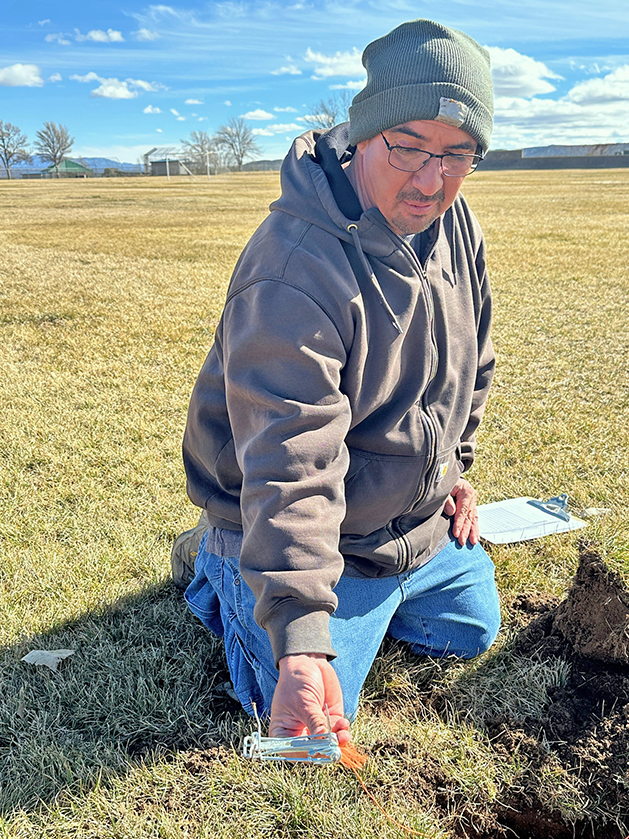
 Parks Maintenance Construction Specialist 3, Alex Archuleta shows a trap ready to capture a gopher Friday at Overlook Park. Photo by Kirsten Laskey/ladailypost.com
By KIRSTEN LASKEY
Los Alamos Daily Post
kirsten@ladailypost.com
It was a nice day Friday afternoon at Spiro Field in White Rock. The warm temperatures eliminated any lingering mounds of snow and the field was pleasantly backdropped by cloudless blue sky.
Too bad trouble is brewing beneath the park’s surface.
This trouble comes in the form of gophers. These rascals burrow and tunnel in the earth. They feed on plant roots and are territorial. According to a presentation made recently to the Parks and Recreation Board, only six to eight gophers can inhabit a single acre and they will fight and kill intruders.
They can make a burrow system 800 feet or longer that resides four to 15 inches below the surface. The small, furry, buck-toothed creatures are real diggers – a 1-year-old gopher can move 2 and a half tons of soil.
The problem is gophers’ lifestyles results in lawns, athletic fields and public parks becoming pot marked with upturned dirt and holes. This, of course, poses safety concerns for those who utilize the fields so therefore, the gophers have got to go.
The County launched a war against
the rodents.
Friday, County Parks Superintendent Wendy Parker explained their battle strategy, which is to capture and then dispose of the critters.
The effort has been ongoing, but staff have been out on the fields since mid-January. Traps are set on County-owned land, the captured animals are collected then killed by an air compression system. The most populous areas for gophers are White Rock, North Mesa and Barranca. On a typical day, 17-30 traps are set around White Rock and six to 12 gophers are caught.
According to the Parks and Recreation Board presentation, since May 2023, staff and contractors have captured 223 gophers.
To make it even more effective, Parker said a contractor is being sought to do gopher mitigation. The cost for the contractor is not yet known but the County is seeking a 7-year contract, she said. The contractor will continue to trap, which is in line with the County’s IPM policy to reduce pesticide use.
“We are trying to stick to the County policy,” she said, adding that hiring a contractor will be a big help.
“It will be a great compliment to what the staff does,” Parker said.
Parks Maintenance Construction Specialist 3, Alex Archuleta said traps are set in the morning and are usually collected around 3 p.m. Piles of fresh, upturned dirt are the telltale sign that a gopher is around. The traps are set in holes and marked with flags. When the flags are jiggling that is the sign a gopher is caught.
Assistant Parks Superintendent Emmanuel Abeyta said efforts start early in the year so parks staff can stay ahead of the various athletic schedules.
“So, we need to keep ahead of it to prevent injuries,” he said.
Abeyta added that so far, no injuries caused by gopher holes have been reported to the County.
It was further noted that the impact gophers have had on the fields remains stable; it hasn’t worsened from 2022 to 2023.
Still, Parker said it is an issue that cannot be ignored.
“You want to have time to take care of the gophers as quickly as you can,” she said.
Despite all the County’s efforts it seems that the gophers get the last laugh. As Archuleta said, their efforts merely control and maintain the gophers’ impacts on the fields; the animals will never be eradicated.
“It has been an ongoing thing,” he said. “It’s one thing that we will not get rid of.”
Still, “It is the best, most effective way,” Archuleta said.