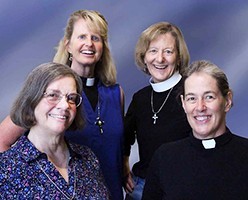
 Clergy from left, Deacon Cynthia Biddlecomb, retired; Pastor Nicolé Ferry, Assistant Rector Lynn Finnegan and Pastor Deb Church. Courtesy photo
By DEB WORLEY
Los Alamos
Over the past three months, I’ve participated in an intense class on racism in our country. It’s been demanding in terms of time, intellectual capacity, and perhaps most of all, heart capacity.
It’s painful to see more fully the historic and ongoing oppression that exists in our country, based solely on race. It’s uncomfortable to see the ingrained-ness of racism in our country. It’s overwhelming to see the pervasiveness of it. It’s painful to see the intentionality of it, on a systemic level. And it’s humbling to begin to acknowledge the ways we all participate in it.
It’s especially hard for those of us who identify as White Americans … and who believe that as individuals, we are not racist … It’s hard to acknowledge the power we have simply by virtue of being born White. It’s uncomfortable to acknowledge that we live within a society that has been purposely set up to give us who are White advantages while simultaneously disadvantaging those who are not.
So…what does this have to do with Advent? And Christmas? I’ll get there…
But for a moment, back to racism.
You can’t talk about racism without talking about power – who’s got it, and who doesn’t got it.
And fear – fear of losing power.
And domination – using domination to maintain power.
And violence and death and grief and lament.
Power. Fear. Domination. Violence. Death. Grief. Lament.
These words, sadly, describe significant pieces of the reality of our world.
Even more sadly, perhaps, these words represent human behaviors that are not new, but rather, seem to go hand-in-hand with the existence of humanity.
We see that throughout human history. We see it throughout the Bible. And we see it in the Christmas story. Yes, in the story surrounding the birth of Jesus, we see fear of losing power. And asserted domination. And as a consequence, violence, death, grief, and lament. Read Matthew 2:1-18 for more details.
The short story is that King Herod was threatened upon hearing of the newborn “King of the Jews”; and unable to eliminate that threat by killing just that one baby, he ordered the slaughter of all children under the age of two in and around Bethlehem. Understandably, that horrific act was followed by inconsolable grief and lament by those children’s parents.
Power. Fear. Domination. Control. Violence. Death. Grief. Lament.
That is the world into which Jesus was born.
And that’s the world in which we still live today.
Jesus knows what those things are; he knows the suffering of our human existence; he knows our hearts. And yet he comes to us.
He came so that the world then, and the world ever since then, could experience grace. Mercy. Justice. Peace. Hope. Love. Jesus came so that the world might experience God.
Jesus’s birth didn’t do away with the darkness of those times–nor does it do away with it now.
Nor does his birth mean we deny the reality of the pain and suffering and brokenness in the world.
Instead, we can rejoice that in the midst of our grief and sadness and surrounded by the brokenness in the world, Jesus still comes and is born among us. To be with us and show us another way of being in the world.
The darkness doesn’t go away because of his birth. We can’t pretend it doesn’t exist. We have to see it, and acknowledge it, and feel it … and know that in the midst of it, Jesus was born. And is waiting to be born again. In us. Today.
Merry Christmas!
Editor’s note: ‘All Shall Be Well’ is a semi-monthly column written by local women clergy (pastors and deacons) including, ELCA Deacon Cynthia Biddlecomb, M.Div., retired (czoebidd@gmail.com); Nicolé Ferry, Pastor, Bethlehem Evangelical Lutheran Church (pastornicole@bethluth.com); Lynn Finnegan, Assistant Rector, The Episcopal Church of the Holy Faith, Santa Fe (rev.lynn@holyfaithchurchsf.org) and Deb Church, Pastor, White Rock Presbyterian Church (pastor@wrpchurch.com).