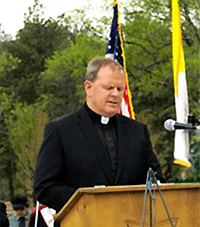
 By Fr. Glenn Jones:
Quite the celebrations of the 250th of the U.S. this year, no? Maybe you saw videos of the celebrations in New York, Washington, Mt. Rushmore … and even Japan!
Despite the naysayers and the often bitterness of critics, it’s remarkable what has been accomplished in a mere 250 years. When one considers the many centuries that empires of the past took to build, such a short time of growth is a comparative blink of the eye. And our form of government—of course imperfect as are all others, and yet so successful—has been imitated to various degrees throughout the world. And despite the critics, they should be relieved that they can still criticize freely. As we see throughout the world, many have lost, and are losing, that right. People are jailed now even for “offending” others. Talk about a slippery slope!
Socialism/communism is on the rise, too, which is an idealistic utopia rather than a realistic system: “From each according to his ability; to each according to his needs” as Mayor Mamdani quoted Marx recently. Such a system works only if everyone works toward that goal … which never happens. So it necessarily becomes a system of forced labor and forced confiscation, as we have seen countless times over the decades.
So before deciding to become a banner-waver of such a system to replace what has proven so successful in this country, one might be wise to actually live somewhere that form of government is in place before touting its imagined advantages. After all, how rare it is to find persons who have come to the U.S. from such a system who want to return. Because once a proven system is replaced, it can be awfully hard to bring back.
The mere fact that so many people clamor to come to the U.S. would seem to change most of its detractors’ minds. Lots of things seem good in theory, but the proof is in the pudding of practice. As is often noted, the U.S. is building the “wall” to keep floods of people from entering; socialist/tyrannical countries build walls to keep their own people in, re: Cuba, North Korea, the former East Germany, Soviet Union, and China under Mao. Not to even mention the wholesale slaughter of millions of “dissidents” and “hooligans” in those countries.
One of the sadder things I’ve witnessed is at Guantanamo Bay—the fences, cacti and minefields not so much to keep U.S. forces from invading Cuba, but to keep their own people from escaping to the U.S. base. We Americans can travel around the world with little difficulty, but people in such systems tend to be trapped within. Don’t want to live in the U.S., then we wish you well; there’s no law that keeps you here. But already our more socialist-leaning states are trying to enact tax “walls” to punish those who would leave them. Déjà vu all over again, in the words of Yogi Berra.
Why does this old priest write about such? Because one of the first things to go in those systems are freedom of speech and freedom of religion. In fact, freedom, period, goes by the wayside.
So…what do we want to see as we go forward to hopefully another prosperous 250 years? Well, along with freedoms, there are few things worthwhile without peace—peace of mind, peace among neighbors, and that elusive peace for the world.
St. Peter Chrysologus wrote: “Peace, dearest brethren, rescues man from servitude, provides him with the name of a free man … Peace among brethren is the will of God, the joy of Christ, the completion of holiness, the rule of justice, the teacher of truth, the guardian or morals and a praiseworthy discipline in every regard…Peace is the mother of love, the bond of concord and the manifest sign of a pure soul.” So, peace should be the goal of all, for peace brings that harmony without which we cannot live amicably with one another.
Sadly, there is so much division in our day—even to increasing acts of violence simply for having different ideas. So, returning to St. Peter Chrysologus: “God’s is the planting of peace in the root, but the uprooting ifs from the enemy; for, just a brotherly love comes from God, so hatred comes from the devil; therefore we condemn our hatred of men, for it is written: ‘He who hates his brother is a murderer.’”
We witness this murderous bent not only in spiritual ideal, but in reality. President Trump has had several noted assassination attempts; regardless of one’s opinion of him and his administration, such hatred leads to increased violence and strife. Likewise with the Charlie Kirk murder. Or Martin Luther King, Jr. Or Bobby Kennedy. Or any other of those who are murdered for their ideas and principles.
Finally, Chrysologus continues: “Now you see, dearest brethren, why we should love peace and cultivate harmony; because they beget and nurture love … [and] love comes from God, and that whoever is not with God does not possess love. …We must keep peace before all other virtues, since God is always in peace. Love peace, and all the world will be tranquil and quiet.”
If we cannot achieve peace and peaceful resolution of problems and ideas among ourselves, how can we possibly expect peace to be achieved over the world. Even the most massive edifice is built one brick at a time. While Mankind has never had worldwide peace, wouldn’t it be grand if we at least word toward it—beginning with ourselves.
“Blessed are the peacemakers, for they shall be called sons of God.” (Matthew 5:9)
“The wisdom from above is first pure, then peaceable, gentle, open to reason, full of mercy and good fruits, impartial and sincere. And a harvest of righteousness is sown in peace by those who make peace.” (James 3:17-18)
Editor’s note: Rev. Glenn Jones is the Vicar General of the Archdiocese of Santa Fe and former pastor of Immaculate Heart of Mary Catholic Church in Los Alamos.