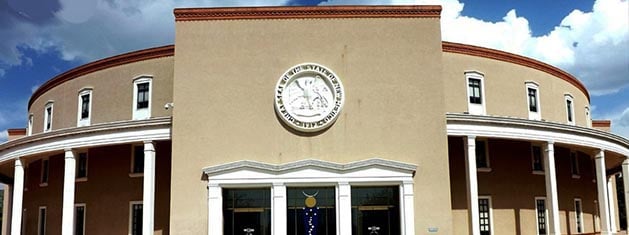
 The Roundhouse in Santa Fe. Post file photo
By ROBERT NOTT
The Santa Fe New Mexican
A bill that would change New Mexico high school graduation requirements for the first time in about 15 years is on its way to Gov. Michelle Lujan Grisham — the first nonprocedural piece of legislation in this year’s 30-day session to reach her desk.
A spokeswoman for Lujan Grisham said her office is “supportive” of House Bill 171, which means it’s likely to be signed into law and become effective for high school freshman who start in 2025.
Spokeswoman Maddy Hayden wrote in an email the Governor’s Office worked on the bill with lawmakers over the past year.
Sen. Bill Soules, D-Las Cruces, said HB 171 “adds flexibility” for high school students who want more options as they determine whether they pursue a college or career path.
Bill cosponsor Mimi Stewart, D-Albuquerque, garnered enough support to override a proposed amendment from Sen. Martin Hickey, D-Albuquerque, that would have required all high school students to take a standalone financial literacy course.
The bill includes financial literacy courses embedded in other courses such as social studies, government and economics standards, Stewart said.
Hickey and others argued a standalone financial literacy course would better prepare students with much-needed life skills to navigate the world of balanced budgets, checking accounts, investments and financial aid for college.
But the Senate voted 22-19 to oppose Hickey’s amendment.
The Senate also opposed, on a vote of 33-5, another amendment introduced by Sen. Linda Lopez, D-Albuquerque, to require students to take an ethnic studies class before they graduate.
Soules argued each extra required course takes away an elective course for students.
HB 171 keeps the total number of credits required to graduate at 24.
Lujan Grisham vetoed a similar bill last year, noting in her veto message the 2023 version “weaken[ed] graduation standards” by decreasing required units of credit to 22 from 24.
Among other proposed changes, HB 171 does away with requirements that students take dual credit and advanced placement classes and Algebra II. It does, however, include a provision that requires districts to offer Algebra II classes for students who want them.
The legislation also requires school districts to come up with two units of discretionary studies for graduates, giving districts more say in offering classes that may be more relevant to the students in their area, Soules said. The bill also requires districts to offer classes in world languages and career and technical education.
“We need to get students ready for careers right out of high schools,” said Soules, a longtime high school teacher.
Supporters of the bill have been working for years to update the state’s graduation requirements, contending the revisions are necessary to meet students’ needs in the modern world. Supporters also said the new requirements will boost the state’s graduation rate.
A recent Legislative Finance Committee progress report on high school graduation found New Mexico increased the graduation rate from 69.3% in 2014 to 76.2% in 2022.
Despite the progress, New Mexico is among the lowest ranking states in the nation in high school graduation, with students tending to drop out in ninth and 10th grades, the report said.