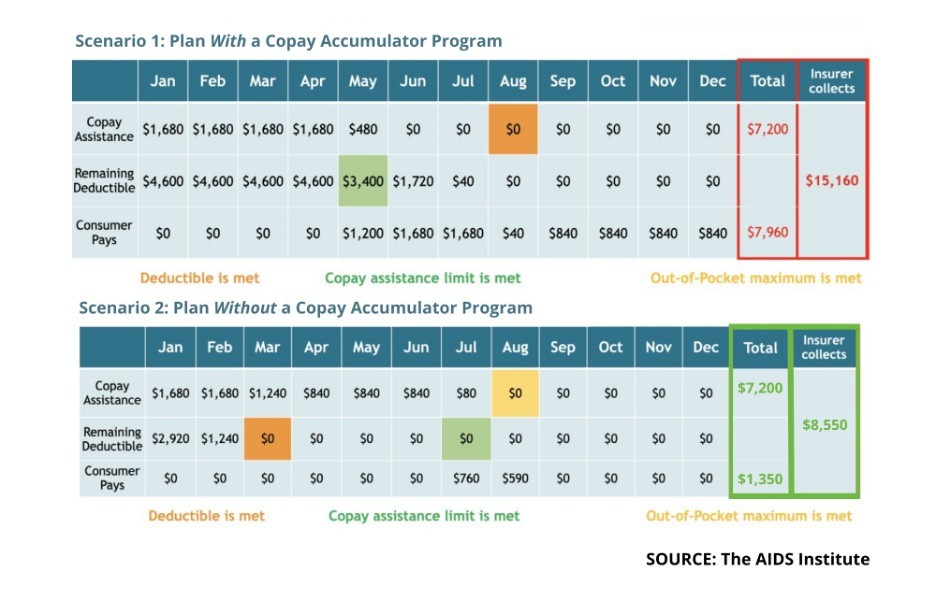
 The charts above show 2 scenarios, a plan with a copay accumulator program and a plan without a copay accumulator program. Courtesy/DPAC
Diabetes Patient Advocacy Coalition News:
WASHINGTON, D.C. — On behalf of the 42 million Americans living with HIV, Hepatitis and Diabetes, the HIV+Hepatitis Policy Institute, the Diabetes Leadership Council (DLC) and the Diabetes Patient Advocacy Coalition (DPAC) have filed suit in the U.S. District Court for the District of Columbia challenging a federal rule that allows health insurers to avoid counting the value of drug manufacturer copay assistance toward patients’ out-of-pocket cost obligations.
The U.S. Department of Health and Human Services’ 2021 Notice of Benefit and Payment Parameters rule, promulgated under the Trump administration, allows insurers to implement programs that allow them to “double dip” on a beneficiary’s deductible by first receiving copay assistance from the drug manufacturer and then receiving payment from the beneficiary. The complaint filed challenges the legality of the rule under the Administrative Procedures Act and asserts that the HHS rule violates federal law and directly contradicts the government’s own definition of cost-sharing.
“This practice is not only illegal but increases the cost of prescription drugs for millions of patients nationwide,” said Carl Schmid, executive director of the HIV+Hepatitis Policy Institute. “Nearly one in four Americans taking prescription drugs struggles to afford them. The growing practice of insurers and PBMs not counting copay assistance is one reason why. We trust the court will side with us – and invalidate the ability to implement these punitive practices that impact people with HIV, hepatitis and so many other health conditions that are treated with prescription drugs.”
“People today are struggling with an ever-increasing cost of living, including prescription drugs. On behalf of patients with diabetes who depend on copay assistance, we must end a cruel practice orchestrated by health insurers and PBMs,” said George Huntley, chief executive officer of DLC and DPAC. “As we urge HHS to reverse the rule, we continue to work at the federal and state levels to pass laws outlawing this practice. While we have been successful in 14 states and Puerto Rico, helping millions of patients in those jurisdictions, we need to end copay accumulator programs nationally. Success with this claim will do that.”
Additional background information:
- As part of the claim, the patient groups contend the current rule allows insurers to collect in excess of the legal amount they are entitled under the ACA
- The Affordable Care Act defines cost-sharing as “deductibles, coinsurance, copayments, or similar charges; and any other expenditure required of an insured individual which is a qualified medical expense.”
- Federal regulations define cost-sharing as “any expenditure required by or on behalf of an enrollee…”
How Copay Accumulator Adjustment Programs Work:
Under a CAAP, copay assistance programs dollars do not count toward a beneficiary’s deductible.
CAAPs actually increase the out of pocket costs for beneficiaries over the course of a plan year while letting insurance companies collect significantly more money. In the hypothetical scenario below, the beneficiary whose plan had a CAAP would actually pay $6,610 more out of pocket than the same beneficiary whose plan did not have a CAAP. At the same time, the insurer collects an additional $6,610.