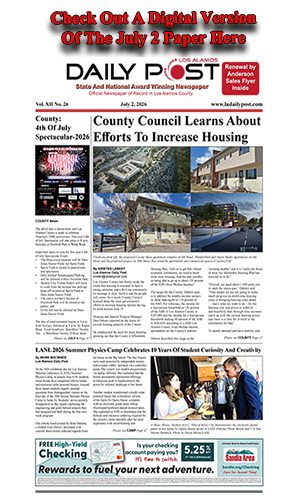
The Roundhouse in Santa Fe. Post file photo
By MARGARET Ó’HARA
The Santa Fe New Mexican
New Mexico is very close to joining all 10 major medical provider compacts.
Lawmakers have proposed several bills this session to join those compacts, allowing a freer exchange of working doctors, audiologists and speech language pathologists, occupational and physical therapists, counselors, psychologists, physician assistants, social workers and emergency medical technicians between New Mexico and other states.
The biggest one — a compact that would significantly ease the process for doctors from other states to practice in New Mexico — made it through the Senate Judiciary Committee late Wednesday, after major amendments.
But the remaining bills are in a bit of a traffic jam. Six are still stuck in the Senate Judiciary Committee. Two more are awaiting approval from the House Judiciary Committee.
Whether lawmakers took up those compacts today — the last full day of the session — remains unknown. As of late Thursday, neither judiciary committee had an agenda available online, though both regularly meet on Fridays.
Troy Clark, president and CEO of the New Mexico Hospital Association, said it’ll take “all of the above, plus some” to solve the state’s acute shortage of health care workers — including interstate compacts.
“It opens up the field for us, for the opportunity for people who would be interested to come to New Mexico and not have another obstacle to persuade them to go to a different state,” Clark said.
Clark likened the compacts to driver’s licenses: Other states will recognize a New Mexico driver’s license.
“If someone decides to drive from Albuquerque over to Dallas, when they cross the state line, they don’t have to call the state of Texas and ask for permission to drive over there,” Clark said.
He noted the compact for doctors works a little differently. Each state still has to grant a license to each doctor, but the compact would trim down licensing time by sharing original verification of static information, like where the doctor completed their undergraduate education, medical school, residency and fellowship.
The state has already joined the nursing compact, a move Clark said has been “great” from a hospital standpoint though some nursing associations have said the compact has made it harder to track the specific number of nurses practicing in the state.
Nonpartisan think tank Think New Mexico is backing the compacts, too, framing them as one way to address the state’s health care worker shortage. The physician compact bill has earned supporters in a group as diverse as Planned Parenthood and the Catholic Church — both of which are hurting for health care workers — said Fred Nathan, founder and executive director of Think New Mexico.
“If Planned Parenthood and the Catholic Church can come together on this bill … it’s hard to fathom that anyone else can oppose it,” Nathan said.