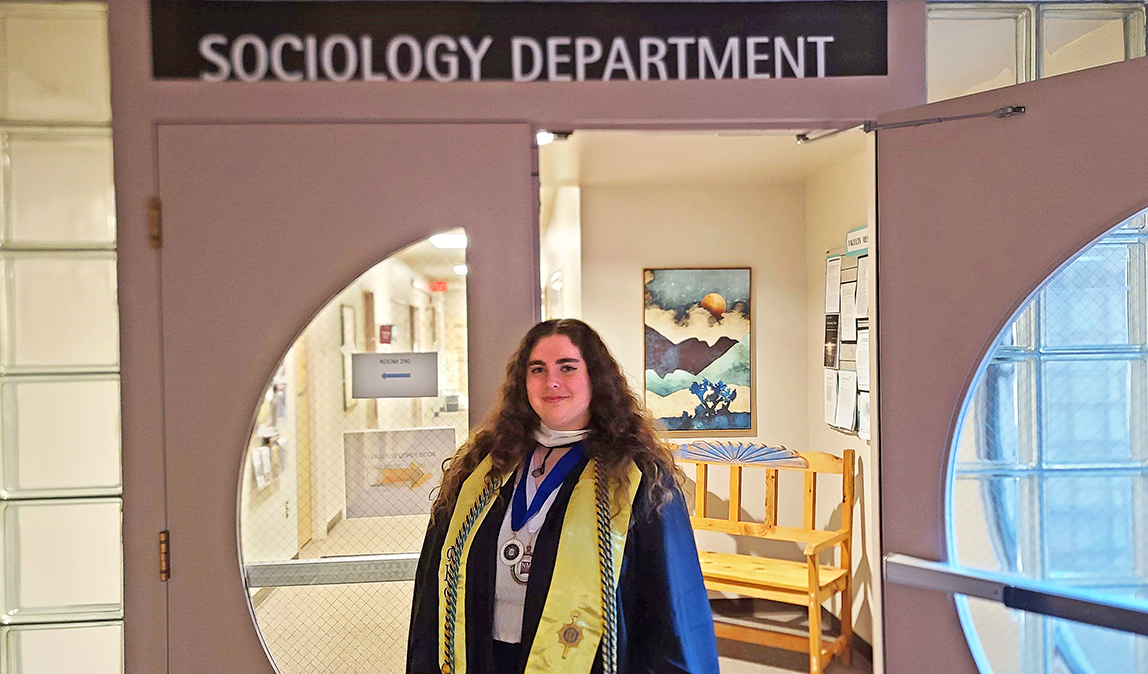
 Los Alamos High School 2019 graduate Brandi Weiss at her graduation last Friday from NMSU. Courtesy photo
By BERNADETTE LAURITZEN
Los Alamos
Editor’s note: This is the second of a two-part series highlighting Los Alamos High School graduate Brandi Weiss and her master’s thesis on adolescent risky behavior in Los Alamos.
“Ignoring the problem does not make it go away.” –Brandi Weiss
Important data is captured by a variety of people all of the time. We may not know where to look for it, why it matters to us or at least why it should matter. Our goal is to highlight the fact that knowing the data could lead to simple conversations or changes that could affect outcomes for the community and might save a life.
The Youth Risk Behavior Surveillance Survey (YRBSS) has been done in our community and indeed across the state for many years. While many people who work with youth are tuned into the data, perhaps the pandemic forced some change that made it fall off the radar. Luckily youth groups, like Key Club and National Honor Society keep some topics top of mind.
While Brandi Weiss is aware that she hasn’t yet raised a child, she has lived in this community since birth, until the age of 18. How exciting then that, “a product of the community” has in turn created a product of the community. Life in a Vacuum: A Network Analysis of Adolescent Risk in Los Alamos, New Mexico, is the title of her Master’s thesis presented last month at New Mexico State University (NMSU).
As a result of her last 13 months of research, what are the key highlights that the community should know about?
“Adolescent risk is a social problem in Los Alamos,” Weiss states in her thesis. Her results reveal that students in our community may be “masking” or hiding their behaviors in order to uphold Los Alamos’ image of perfection. She aimed to look at how behaviors may be happening together, such as drinking and smoking.
“Students may be participating in both ends of behaviors: ones that show they are still doing well in school and continuing to participate in healthy habits, but also revealing that they partake in select risky behaviors,” Weiss said.
The data point that concerned her most is one that has been increasing since it was last discussed with the community, but comes as no surprise. Looking at the overall section of questions is imperative, as it talks about how students have felt, their nerves, anxiety, ability to control thoughts, and how often they have felt down, depressed or hopeless.
“It was the high percentage of students who felt sad or hopeless. It is genuinely sad that one-third of the Los Alamos High School population between the years I analyzed felt that way,” Weiss said. “That should be of concern to the Los Alamos community as those numbers were consistent over the 10-year period.”
Weiss knows from being a student here that many students battled with perfectionism, and when they weren’t perfect, it really impacted them. Through many community conversations we have learned that pressure to be perfect doesn’t come just from parents. It can equally come from fellow students, in a competitive fashion, and from the students individually adding their own pressure. So, what can change is always much easier said than done.
Weiss said she believes that the culture of risky behavior in Los Alamos needs to be re-evaluated. She mentions in her thesis that for more than 40 years, students have felt similarly when going through the LAPS system. As a former graduate, she understands that students are supposed to learn and be challenged as a part of education.
“However, with the constant competition among families and their kids, it isn’t always about learning,” Weiss said. “Some students feel that with such high-achieving parents and peers if they don’t do well in school, they feel like ‘dirt and a failure’. A recommendation for the Los Alamos community going forward is to listen and be aware. If students are hiding how they are truly doing, no one wins. Being able to recognize and understand when an adolescent is struggling is a good first step in breaking this cycle for the community. It would be the start of positive change.”
As a parent, conversations need to be had that are not related to grades, but about life in general. Does your child have an adult they would go to, if they couldn’t talk to you about an issue? Do you as an adult and your child have coping mechanisms for stress, depression or grief that are healthy? Does the family practice relaxation techniques? Do you exercise, enjoy reading for pleasure, or listen to music. Do family members establish and maintain boundaries? Does everyone have an outlet for social and emotional expression?
Weiss found any related research compelling because not much exists for communities similar to Los Alamos. She found the research of Professor Sunyia Luthar at Teachers College-Columbia University, “extremely interesting research”. She identified Luthar’s work was impactful to read and incorporate, because it addressed many of the concerns held by Weiss while researching Los Alamos. Luthar’s research is one of very few papers that exist on this topic. One noted by Weiss was, When Parents Seek Perfection: Implications for Psychological Functioning Among Teens at High-Achieving Schools.
“Her work provided me with an incredible foundation,” Weiss said.
Dr. Marshall Taylor, Assistant Professor at NMSU’s Department of Sociology said, “While we know a fair bit about the causes and consequences of adolescent risk-taking in the United States, we still don’t know very much about how it plays out in communities with high educational and economic capital – such as lab towns. Brandi’s research helps bridge this gap. Her scholarship is a great example of how sociology can help address important local challenges while simultaneously informing larger conversations about young people’s psychological, emotional, and physical well-being.”
Anyone interested in obtaining a copy of the thesis may send their name and email address to Champions of Youth Ambitions. You can also request a copy of the 40 Developmental Assets from C’YA or check out the expansive resources available on SI website:
- Weiss Thesis Request and/or 40 Developmental Assets cya.org@att.net
- Youth Risk Behavior Surveillance Survey – https://youthrisk.org
- Search-Institute www.search-institute.org
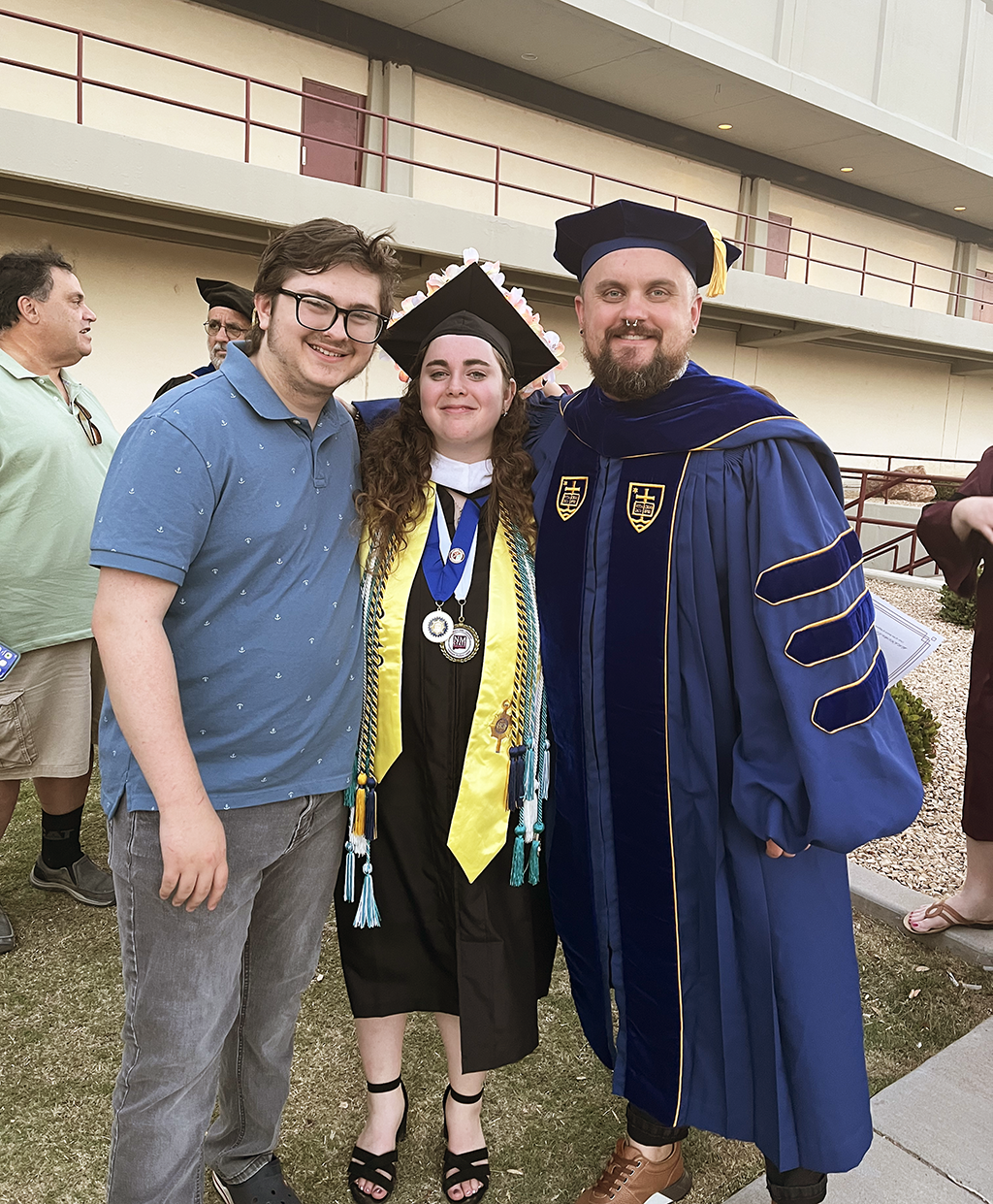 LAHS graduate Brandi Weiss at her graduation last Friday from NMSU with her fiancé Nash Taylor and Dr. Marshall Taylor (no relation). Courtesy photo