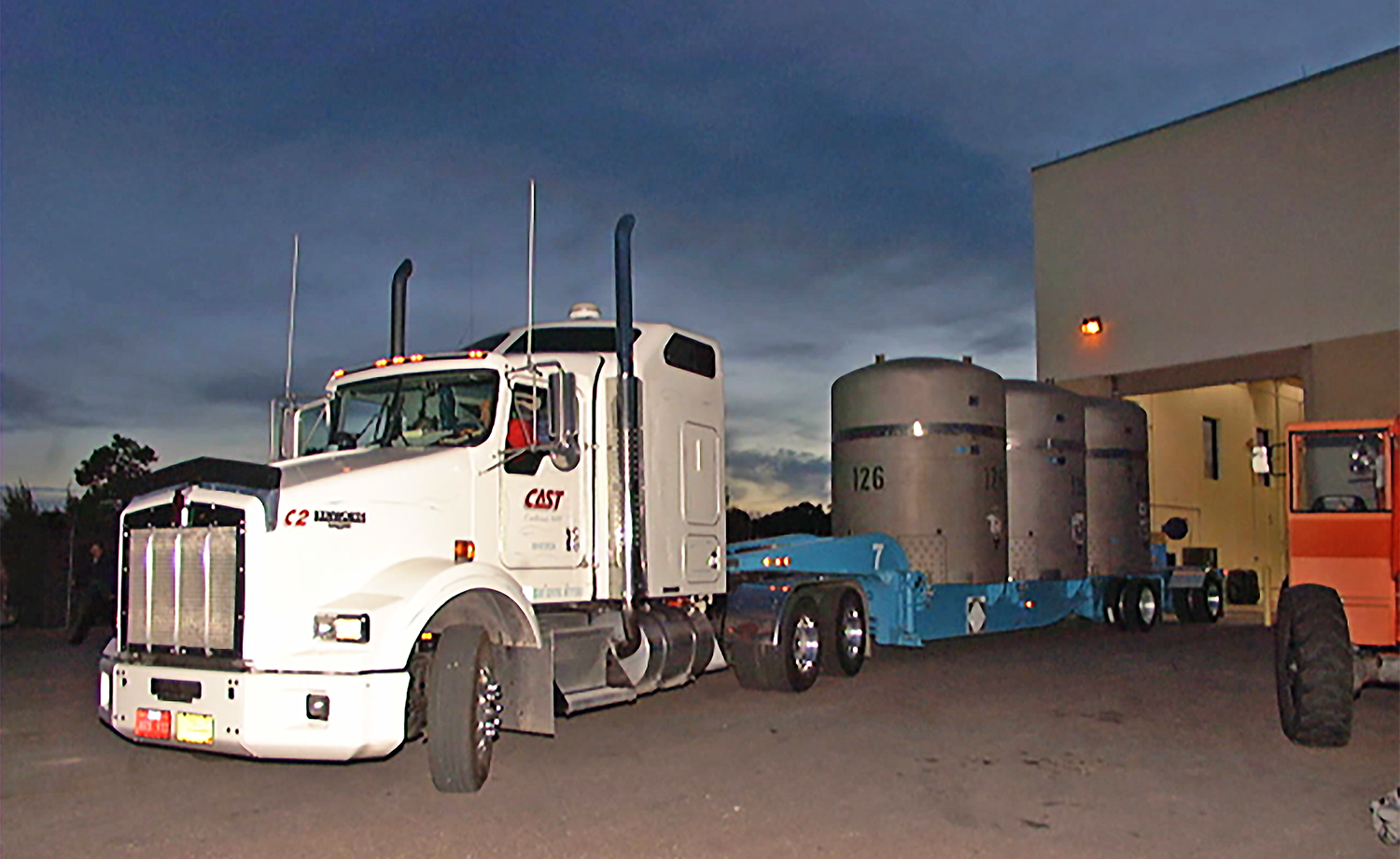
 Truck with TRUPACTs leaving LANL on March 25, 1999 to begin the historic 315 mile journey to WIPP … the first of many thousands. Courtesy LANL
By STANLEY (STAN) KOSIEWICZ
Special Projects Manager
LANL Retiree, Class of 2005
- Remembering First Shipment To WIPP On 25th Anniversary
Many Los Alamos National Laboratory (LANL) personnel worked together to make the first shipment to open the Waste Isolation Pilot Plant (WIPP) a reality. They designed a commemorative T-shirt that states, “As a team we made it happen.” Figure 1 Only a small fraction of the team them is named in this article. My technical files were recycled during my nearly 20 years of retirement. Consequently, I am depending upon my memory to a large extent. There may be some omissions in the story line. This article recounts my memories surrounding that significant event.
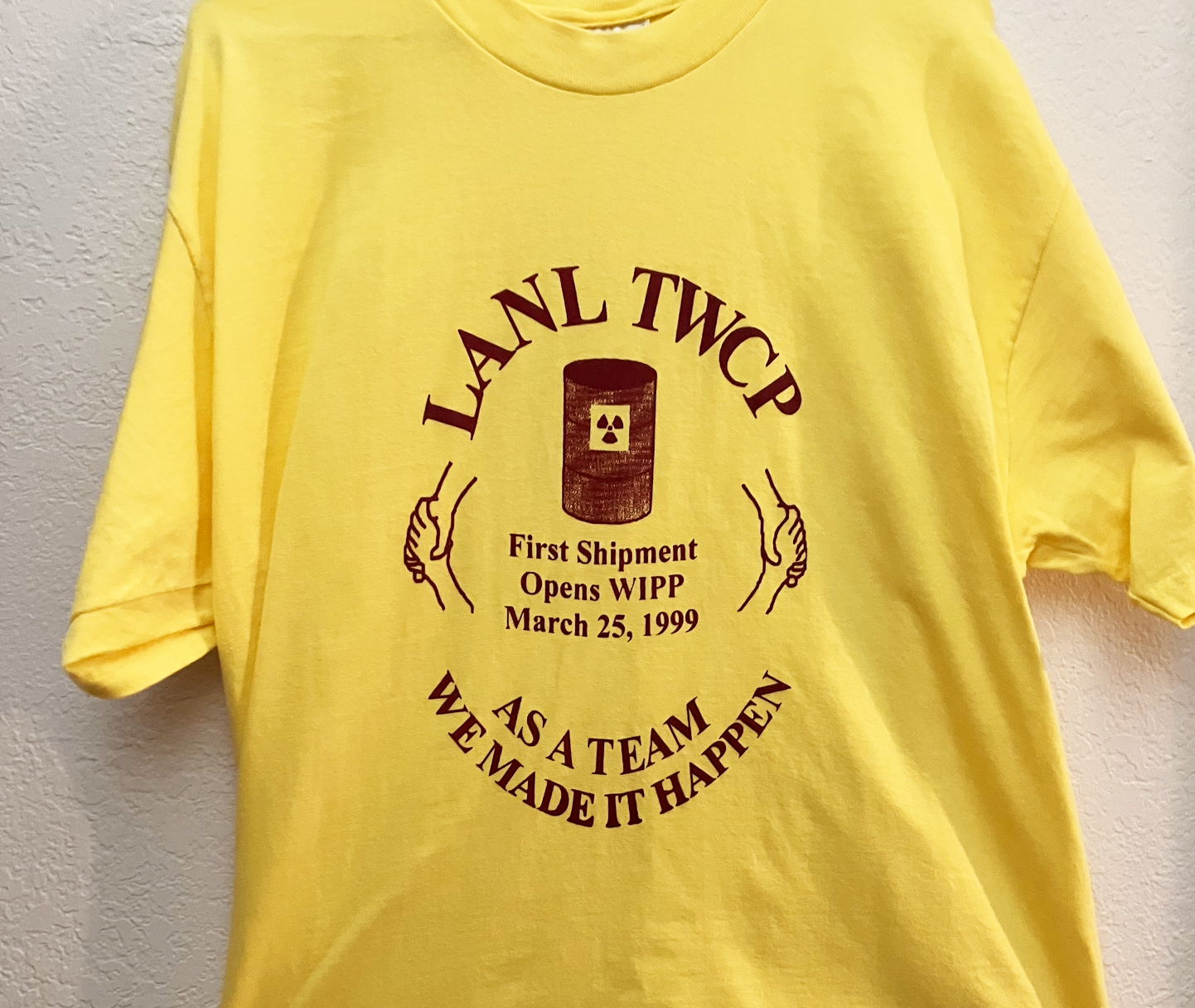 Figure 1 – Commemorative T-shirt ‘As a team we made it happen’. Photo by Stan Kosiewicz
Prologue:
On March 25, 1999, LANL sent the first shipment of transuranic (TRU) waste in TRUPACT-II canisters to WIPP. Figure 2 shows the truck with three TRUPACTs (#126, #131, and #128) inside the loading facility waiting to begin its historic journey to WIPP.
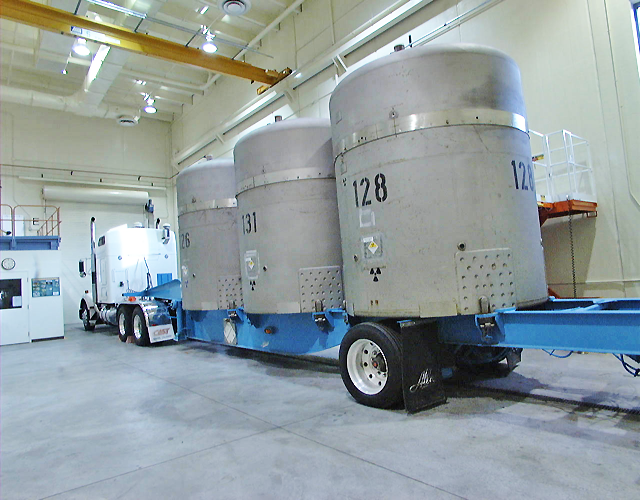 Figure 2 Three TRUPACTs with TRU waste waiting to leave for WIPP. Courtesy LANL
For 25 years DOE had been embroiled in a bitter battle for TRU waste disposal. At times, the situation seemed so complex that it appeared to be analogous to the fabled Gordian Knot. This was a knot in Greek mythology that was so intricate that an oracle proclaimed that whoever could undo it would rule all of Asia. The legend said that Alexander the Great severed the knot with a single blow from his sword. With the ruling of one federal judge, the WIPP Gordian Knot was severed and LANL quickly sent a shipment of TRU waste to get WIPP open.
Years earlier, DOE had proposed performing a test underground to prove the suitability of disposal of TRU waste in the bedded salt layers 2,150 feet below the earth’s surface. DOE initially proposed that a large number of drums of TRU waste were needed for the test. This was approximately the entire TRU waste inventory in the DOE Complex! This proposal was met with vehement opposition. Some of the opponents included Environmental Evaluation Group (EEG), Director Bob Neill, his Deputy Director, Lokesh Chaturvedi, and others like Greg Mello, Los Alamos Study Group. Bob Neill organized the EEG in order to provide oversight of WIPP for the State of New Mexico
Eventually, the DOE requested a Red Team to be organized to determine if an alternative to the test could be proposed. LANL employees, Phil Thullen and Deborah Bennett, organized and led a team of national class technical experts in different disciplines. I was the TRU waste management expert on this Red Team.
In 1993, this Red Team proposed to Secretary of Energy Hazel O’Leary that the desired information could be better obtained from above ground DOE sites. Secretary O’Leary accepted this important recommendation. For this accomplishment the LANL Red Team was given a Distinguished Performance Award while Sig Hecker was the LANL Director.
Then, DOE waste sites began to prepare for characterizing and certifying their stored TRU wastes. Idaho National Engineering Lab (INEL) received the lion’s share of funding because DOE had entered what was called the Governor’s Agreement wherein fuel rods from Navy submarines would be stored at INEL but only if INEL removed certain amounts of its TRU waste inventory by certain dates. LANL had no similar mandate to ship. So its funding level was much smaller in comparison.
At that time, WIPP was permitted to receive only non-mixed waste. Non-mixed waste does not contain heavy metals, nor organic constituents regulated by the Resource Conservation and Recovery Act (RCRA). LANL had identified a non-mixed TRU waste stream. While many LANL personnel worked on other vital parts of the TRU waste characterization project, I led a team to prove the non-mixed status of the waste we wanted to ship to open WIPP.
Shipping Week Narrative:
March 22, 1999 (Monday) A federal judge accepted the non-mixed waste status of the waste and lifted the injunction that had prohibited shipping of the waste.
March 23, 1999 (Tuesday) TRU waste drums were loaded into the TRUPACT canisters, #126, #131, and #128. (Figure 2 above)
March 24, 1999 (Wednesday) Final testing of the TRUPACT canisters is done and we were poised to send the trailer to WIPP.
March 25, 1999 (Thursday – 12:05 a.m.) The truck moved out of the loading facility and into the parking lot. However, there was a dense fog enveloping the road around Santa Rosa, so a decision was made to try to ship later in the day.
March 25, 1999 (Thursday – 7:50 p.m.) There was no fog at this time. LANL employee, George Vigil, gave the signal and the gate was opened, and the truck began its historic 315 mile journey to WIPP. It headed west for about a hundred yards and made a sharp hairpin turn to the left onto Pajarito road.
That evening, Leroy Sanchez, LANL photographer, was photographing the event. John Bass, LANL Public Affairs, and I were standing on a hill videotaping the truck as it accelerated downhill. As the truck passed us, the driver blasted the horn, and we listened to the beautiful Doppler affect as it roared past into the darkness.
Just outside of Santa Fe, protesters were beating on drums and wailing at the truck as it passed by. Near Lamy, a white Yugo was parked in the middle of the road in an attempt to block the truck. The Yugo was pushed off the road and the waste truck sped past to its WIPP destination.
March 26, 1999 (Friday) The waste was delivered to WIPP with resounding cheers from the waiting crowd. It was quickly emplaced down hole to be entombed in the bedded salt forever. History had been made!
The truck driver, Randy, said the trip was nerve wracking but went faster than he expected.
DOE and WIPP stated that LANL shipped its first TRU waste on March 25-26, 1999. A more accurate statement was that LANL had shipped on March 25, 1999 – and that WIPP received the shipment on March 26, 1999.
Epilogue:
LANL continued to ship TRU waste to WIPP until Nov. 27, 1999. The 17th and last shipment used the last of the non-mixed waste stream. Then, there was a two-year hiatus in shipments. During this time, LANL took the necessary steps to build a more robust infrastructure to work off its TRU waste inventory.
On April 19, 2001 LANL resumed shipments to WIPP. Figure 3 below shows shipment number 18 as it traveled on Pajarito Road.
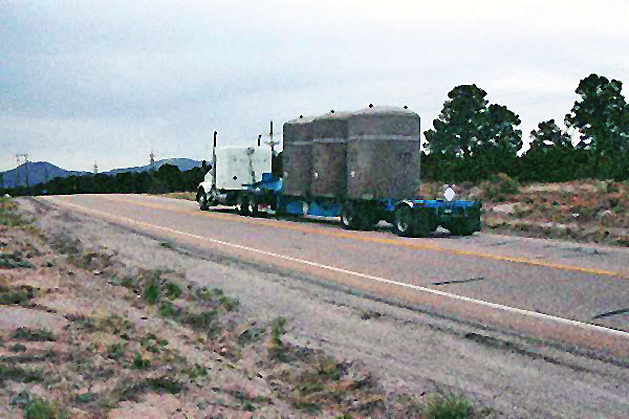 Figure 3 – Truck with three TRUPACTs on Pajarito Road bound for WIPP. Photo by Stan Kosiewicz
Some comments concerning the first shipment:
John Bass (LANL Public Affairs) said he was impressed with the dedication and precision the LANL personnel used to address the many challenges they overcame in spite of their small budgets. He also said this was a valuable milestone in cleaning up LANL’s legacy TRU waste.
Denny Erickson, the Lab’s then Director of the Environmental, Safety and Health Division, made similar statements in reflecting on the exciting events 25 years ago. He was so impressed he nominated the project team for two large-team distinguished performance awards necessary to accommodate the impressive number of participants. His actions in championing these efforts were successful. At a celebration later, Denny compared this achievement to some of the best Laboratory accomplishments that exemplify capabilities of multidisciplinary teams to solve difficult and complex problems.
Larry Sousa (Quality Assurance Support) said he was very proud of being a contributor to help open WIPP. There were a lot of good people to work with, including fabulous technicians! One of the major challenges was meeting all the NMED requirements to be able to ship the waste. We worked to be compliant with the regulations instead of resisting them. Consequently, our efforts were put towards fulfilling NMED requirements and getting the work done.
Bill Richardson (Secretary of Energy) said in a press conference that over the past two decades it had been proven again and again that the WIPP facility was the safest best solution for the nation, and it was ready to go.
Marji Gavett (Site Project Quality Assurance Officer) said a major challenge was that the compliance plan had to satisfy detailed line by line requirements. These were environmental in origin not from DOE nor WIPP. Further she said LANL deeply cared about properly disposing of the waste as much as performing science. Additionally, Marji said it was incredibly satisfying to work with such a talented and dedicated team of self-starters. We accomplished this feat in spite of a limited budget.
Dave Janecky (Analytical Methods QA/QC) said he assembled data that showed strict compliance with the shipping requirements of WIPP. This involved methods development that included first of its kind analyses. Dave echoed other comments that LANL assembled a talented, multidisciplinary team for this effort. He said it was great to have everything from high end technical capabilities to superb drum handlers and drum packers. Dave said he would want people to know that LANL was exceedingly careful to ensure we knew what was in those drums was fully compliant.
Commemorative pins were designed and made by Debbi Wersonick, Community Outreach Specialist. At the grand opening celebration on April 17, 1999, I attached a large version of the pin to Secretary Richarson’s coat lapel just before he met with the media, Figure 4. It was quite visible!
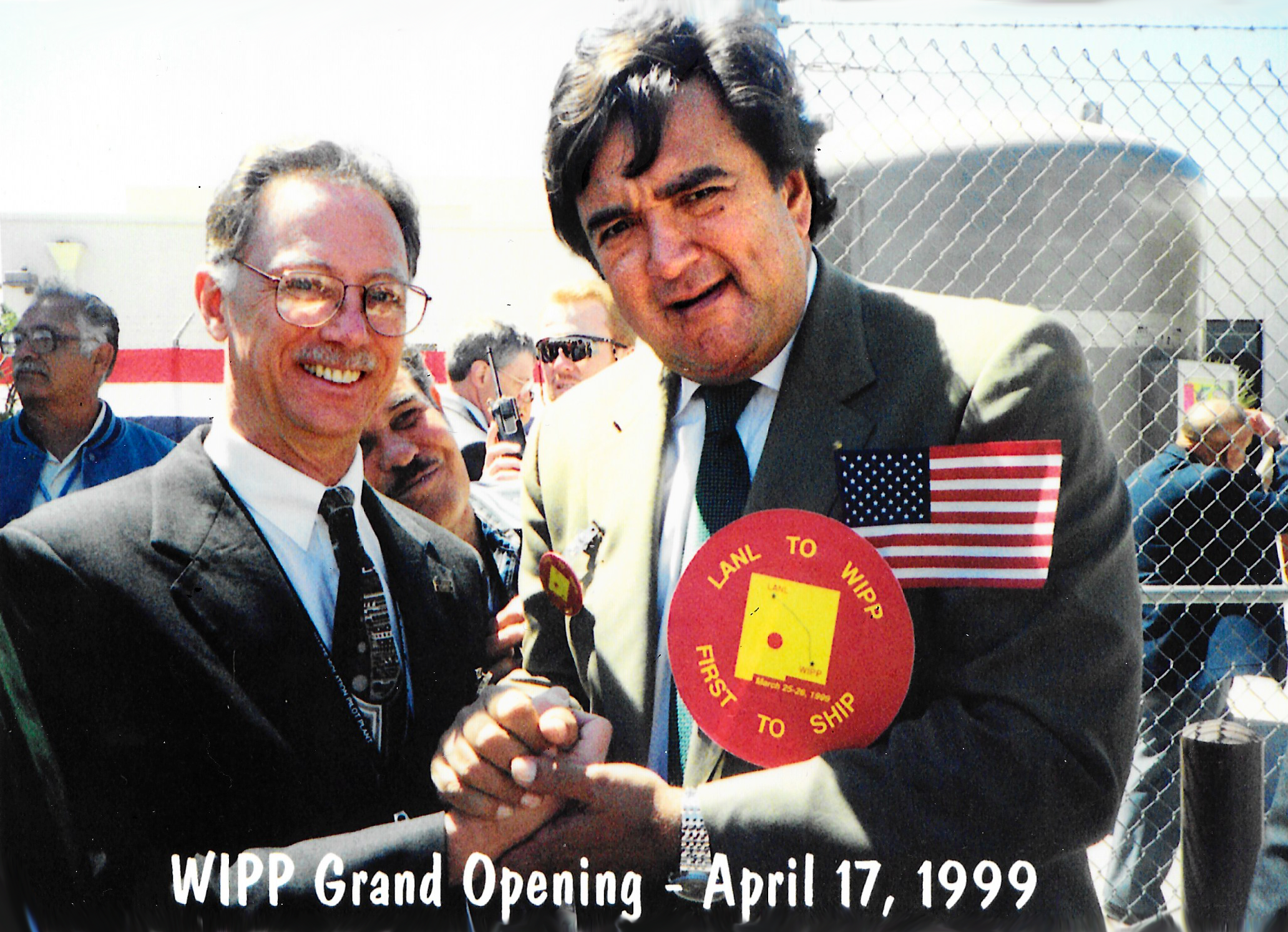 Figure 4 – Then Secretary of Energy Bill Richardson and Stan Kosiewicz at WIPP Grand Opening celebration on April 17, 1999. Photo by Amy Anderson
It was satisfying for me to reminisce and recall the successful culmination of all our hard work to get that first shipment through the gate. As stated earlier, as a team we made it happen!