SFI Seminar: Noise-Induced Phenomena in One-Dimensional Maps
 SFI News:
The next SFI Seminar is set for 12:15 p.m., Friday, Sept. 6, in the Collins Conference Room at the Santa Fe Institute, 1399 Hyde Park Road.
Yuzuru Sato of Hokkaido University, Japan will present the seminar: Noise-Induced Phenomena in One-Dimensional Maps.
Abstract: Noise-induced phenomena arise out of interaction between deterministic dynamics and stochastic noise. Stochastic resonance, noise-induced synchronization, and noise-induced chaos are typical examples in statistical and nonlinear physics. The central problem in this research area is in which way the asymptotic Read More
LANL’s Hazardous Waste Facility Permit Community Relations Plan Available Year-Round for Comments
 LANL News:
Los Alamos National Laboratory revises its Hazardous Waste Community Relations Plan annually in compliance with its Hazardous Waste Facility Permit (EPA ID No. NM0890010515.)
The website is available year round and LANL revises the plan in August to include necessary changes and comments it has received during the year. LANL welcomes public comments, which can be provided online via the Plan Comments Form.
The updated Hazardous Waste Facility Permit Community Relations Plan and responses to comments will be posted Sept. 1.
The attached Read More
B61-12 Life Extension Program Radar Drop Tests Completed Successfully
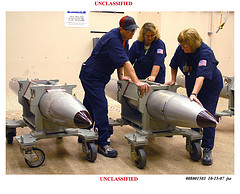 Pantex production technicians prepare a B61 for a surveillance test. The B61 is a tactical thermonuclear gravity bomb. Courtesy/NNSA
WASHINGTON, D.C. – As part of the ongoing effort to refurbish the aging B61 nuclear bomb without resorting to underground nuclear testing, two successful B61-12 radar drop tests were successfully completed at the Tonopah Test Range in Nevada on Aug. 14 and 15, 2013, by engineers from Sandia National Laboratories.
Current B61s use decades-old vacuum tubes as part of their radar system. The new radar system, which had not been tested outside of a laboratory Read More
Magnetic Charge Crystals Imaged in Artificial Spin Ice
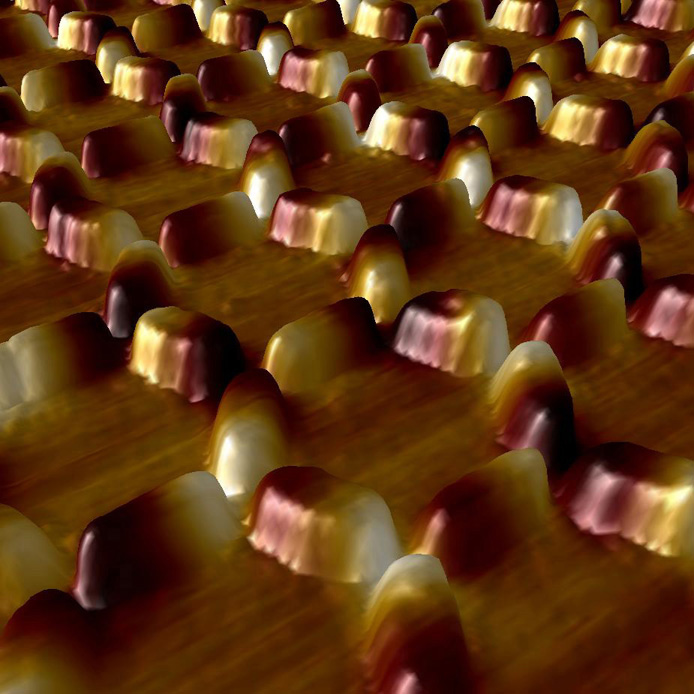 A 3-D depiction of the honeycomb artificial spin ice topography after the annealing and cooling protocols. The light and dark colors represent the north and south magnetic poles of the islands. Image by Ian Gilbert, University of Illinois Department of Physics and Frederick Seitz Materials Research Laboratory
LANL News:
A team of scientists has reported direct visualization of magnetic charge crystallization in an artificial spin ice material, a first in the study of a relatively new class of frustrated artificial magnetic materials-by-design known as “Artificial Spin Ice.”
These charges Read More
New Season of Teen Café Scientifique NM Launches Sept. 5!
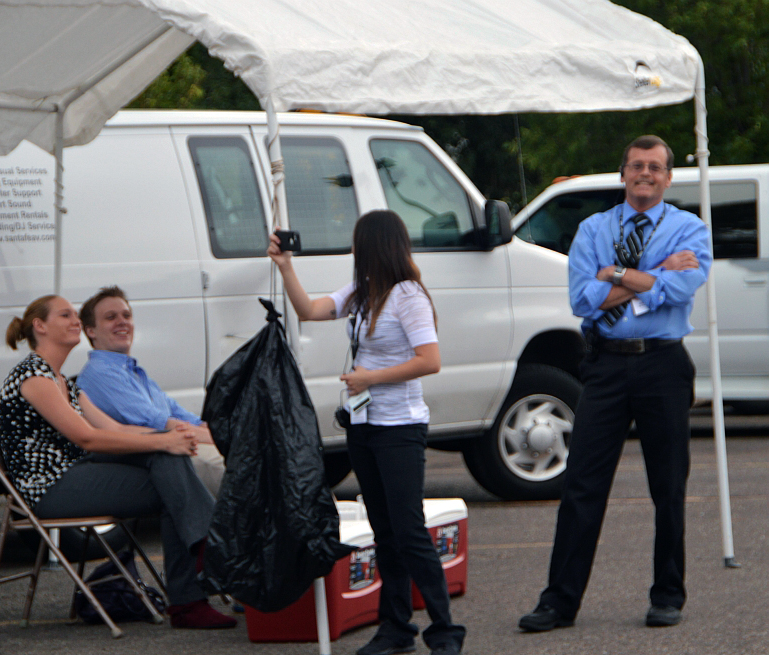 Students learn about robotics from LANL post doc Steve Anton during a Café last year. Courtesy photo
 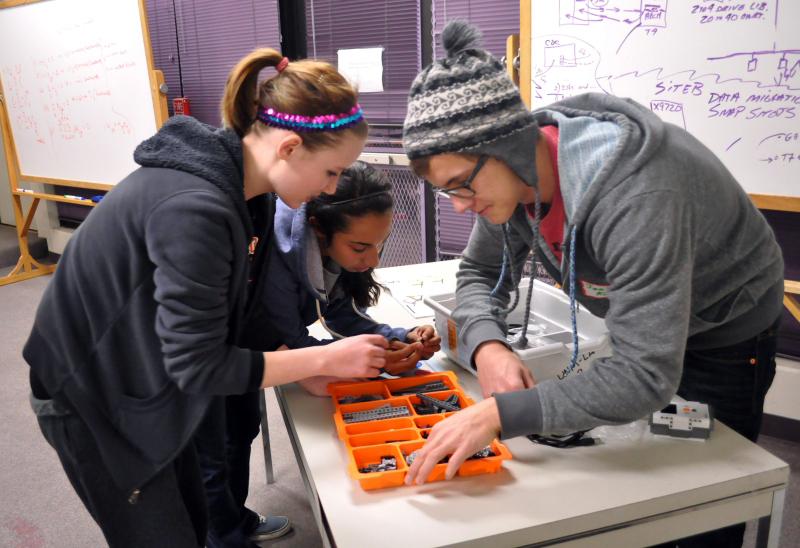 Courtesy photo
  Dr. Steven Brumby of Los Alamos National Laboratory, who studies neuroscience models for computer vision and develops computer codes to simulate vision, will present “Can You See Me Now? Teaching Computers to See.”
NIST Ytterbium Atomic Clocks Set Record for Stability
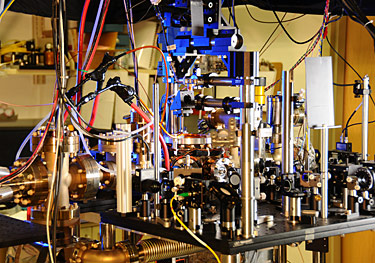 NIST’s ultra-stable ytterbium lattice atomic clock. Ytterbium atoms are generated in an oven (large metal cylinder on the left) and sent to a vacuum chamber in the center of the photo to be manipulated and probed by lasers. Laser light is transported to the clock by five fibers (such as the yellow fiber in the lower center of the photo). Photo by Burrus/NIST
NIST News:
A pair of experimental atomic clocks based on ytterbium atoms at the National Institute of Standards and Technology (NIST) has set a new record for stability.
The clocks act like 21st-century pendulums or metronomes that could Read More
LANL: Reliability Technology Earns Prestigious Los Alamos Award
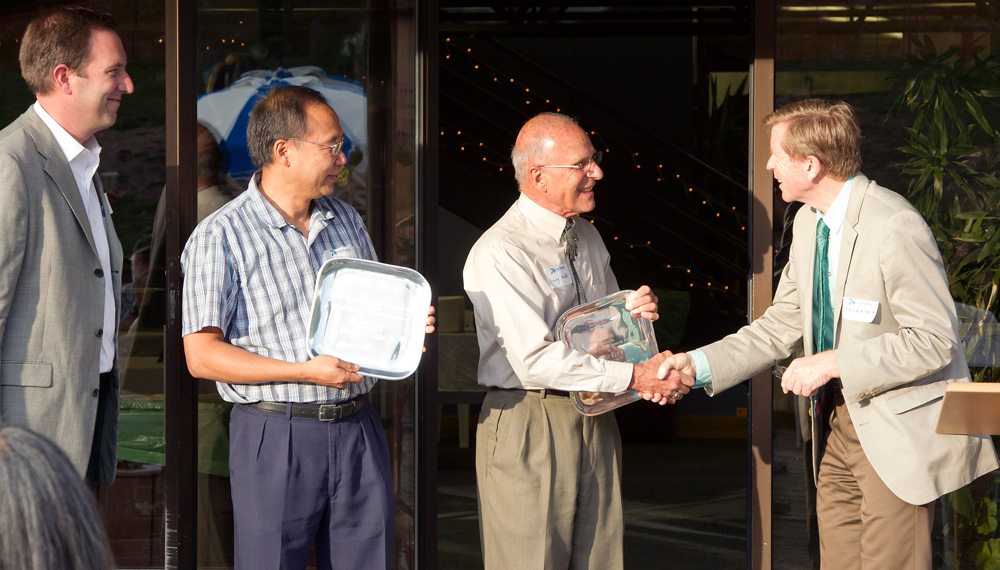 Terry Wallace, right, Los Alamos National Laboratory Principal Associate Director for Global Security, congratulates Harold Martz, second from right, and Michael Hamada, second from left, for winning the Laboratory’s first-ever Richard Feynman Prize for Innovation Achievement while David Pesiri, left, director of Los Alamos’ Technology Transfer Division looks on. Martz, Hamada and a team of Los Alamos researchers developed Reliability Technology, a system that has been used by Procter & Gamble to save billions of dollars each year through increased industrial Read More