NIST: Don’t Bet on The Dinosaurs
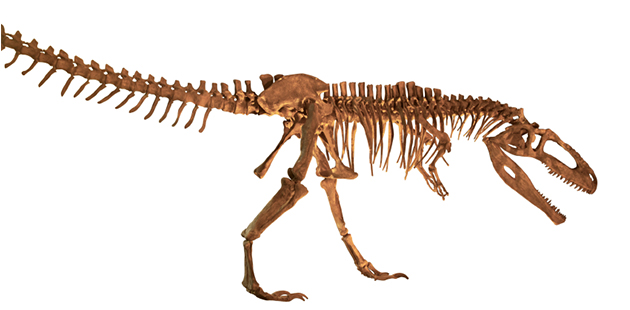 Courtesy/NIST
There’s nothing I love as much as a paradox. So there’s a lot for me to get excited about with America’s current manufacturing paradox, which is whether U.S. manufacturing is The Next Big Thing or a dying dinosaur. Should we steer our children from factory work or should we embrace the opportunity to get out in front of something that changes every single day and has the potential to remake our society and economy?
Brad Plumer in The Washington Post (May 1, 2013) is putting his bets on the advanced manufacturing renaissance, while Timothy Aeppel of Read More
May 14 Lecture: ‘Cold War Recollections: A Livermore Underground Testing Perspective’
 LAHS News:
The annual meeting of the Los Alamos Historical Society is 6 p.m. May 14 in Fuller Lodge and begins with the “Experience Auction” fundraiser, pizza and ice cream party, followed by a business meeting at 6:45 p.m. and lecture at 7:30 p.m. by Robert Kuckuck, “Cold War Recollections: A Livermore Underground Testing Perspective.”
Former Los Alamos National Laboratory Director Robert Kuckuck will discuss his experiences as a Cold Warrior and the nuclear testing work carried out by Lawrence Livermore National Laboratory during the 1970s and 80s.
About the Lecturer (from the LANL Read More
AGU: New Study Projects Warming-Driven Changes in Global Rainfall
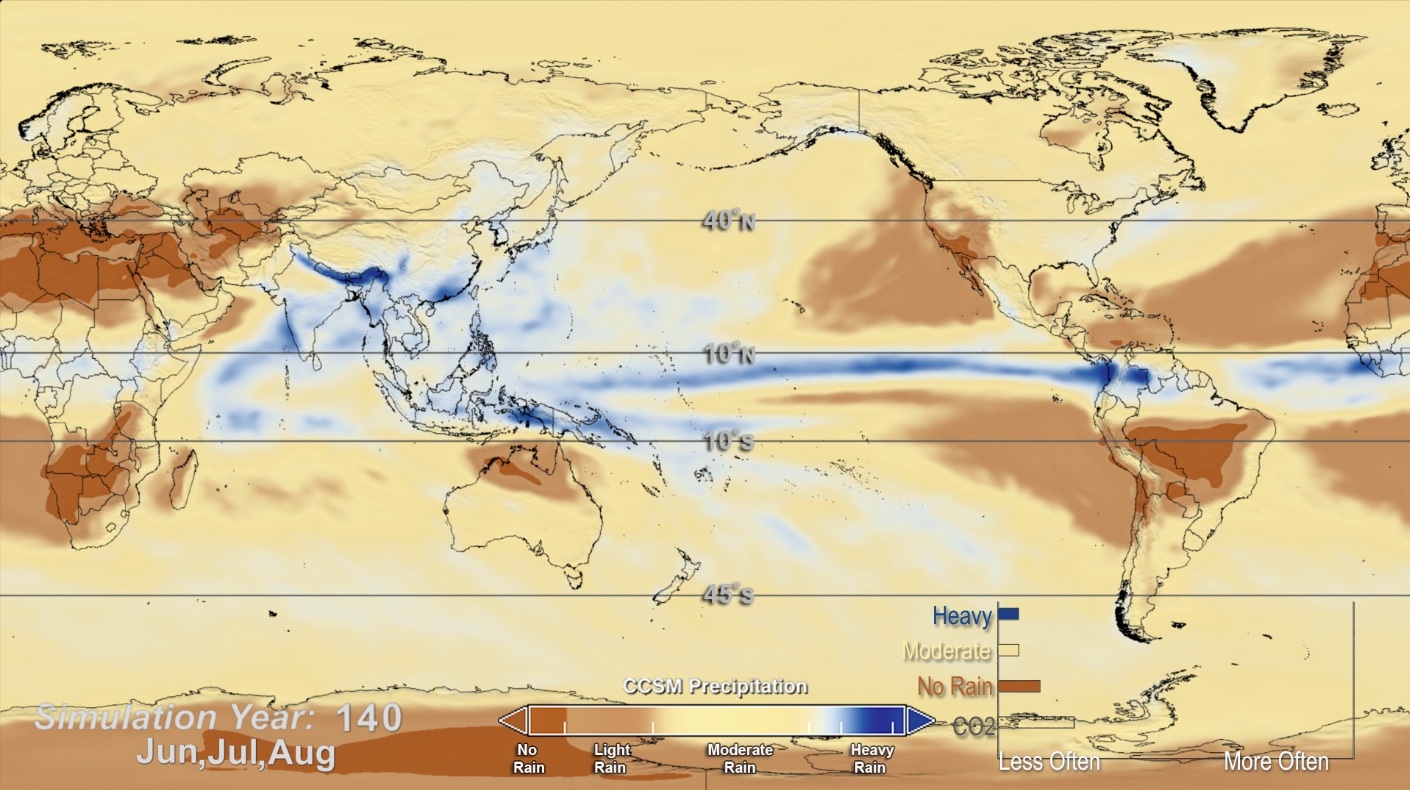 Model simulations spanning 140 years show that warming from carbon dioxide will change the frequency at which regions around the planet receive no rain (brown), moderate rain (tan), and very heavy rain (blue.) The occurrence of no rain and heavy rain will increase, while moderate rainfall will decrease. Courtesy/NASA’s Goddard Space Flight Center Scientific Visualization Studio
AGU News:
WASHINGTON, D.C. – Global warming may increase the risk for extreme rainfall and drought, according to a new modeling study. The research shows for the first time how rising carbon dioxide Read More
NIST Demonstrates Transfer of Ultraprecise Time Signals over a Wireless Optical Channel
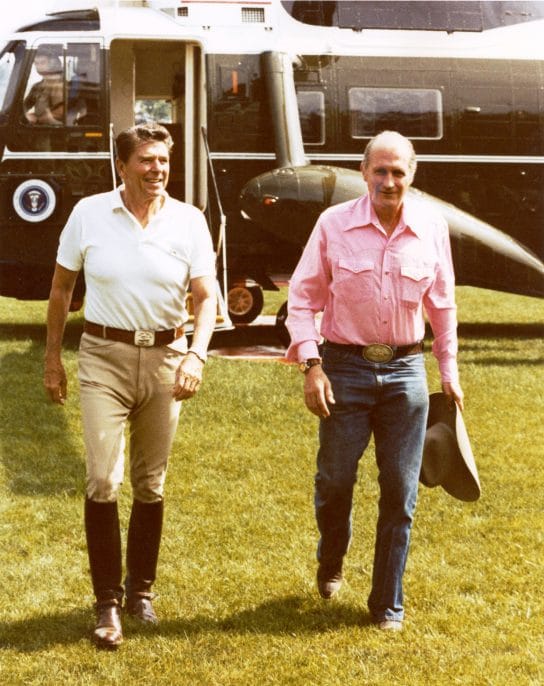 NIST researchers transferred ultraprecise time signals over the air between a laboratory on NIST’s campus in Boulder, Color., and nearby Kohler Mesa. Signals were sent in both directions, reflected off a mirror on the mesa, and returned to the lab, a total distrance of approximately two kilometers. The two-way technique overcomes timing distortions on the signals from turbulence in the atmosphere, and shows how next-generation atomic clocks at different locations could be linked wirelessly to improve distribution of time and frequency information and other applications. Photo Read More
SFI: The Origins of Human Cognition and Cell Biology
 SFI News:
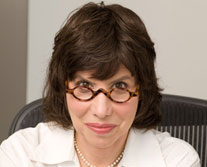
Alison Gopnik
Learn about the origins of human cognition and why children are better learners than adults at 12:30 p.m. Tuesday, May 7 in the Noyce Conference Room at the Santa Fe Institute, 1399 Hyde Park Road in Santa Fe.
The talk is by Alison Gopnik, professor of psychology and affiliate professor of philosophy at UC Berkeley and author of several books on child learning, including The Scientist in the Crib and The Philosophical Baby. The event is free and open to the public.
In the abstract of her talk, Gopnik writes, “I argue for a theoretical link between the development of an extended Read More
Current Issue of National Security Science Magazine Focuses on Supercomputing
 Courtesy/LANL
LANL news:
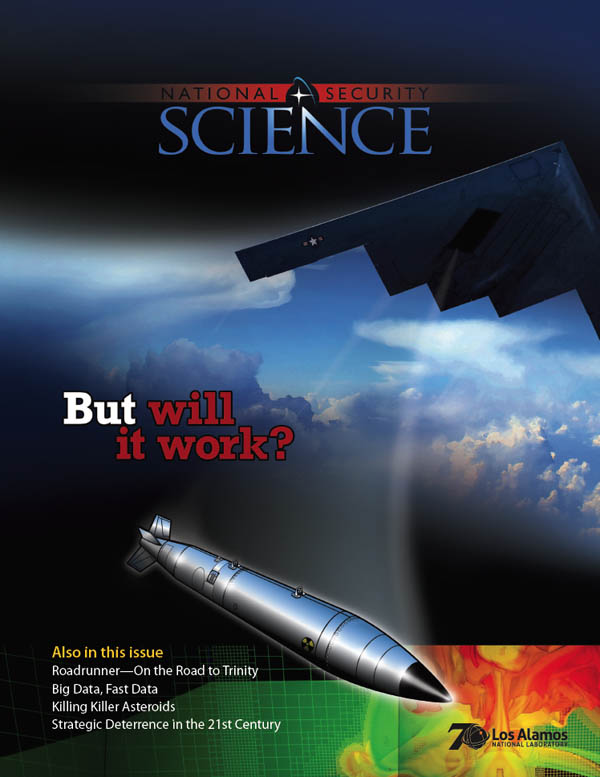
The Supercomputing Issue: look what’s inside the current issue of National Security Science magazine
- But Will It Work?—Supercomputing is key to assessing the performance and reliability of the aging U.S. nuclear stockpile.
- Roadrunner: On the Road to Trinity—The next big supercomputer, Trinity, will be based on what the Roadrunner supercomputer could, and couldn’t, do.
- The Tip of the Iceberg: Say, what is “under the floor” of a supercomputer?—That floor is the size of a football field. What’s even more amazing
Oppenheimer Scholarship Winners Announced