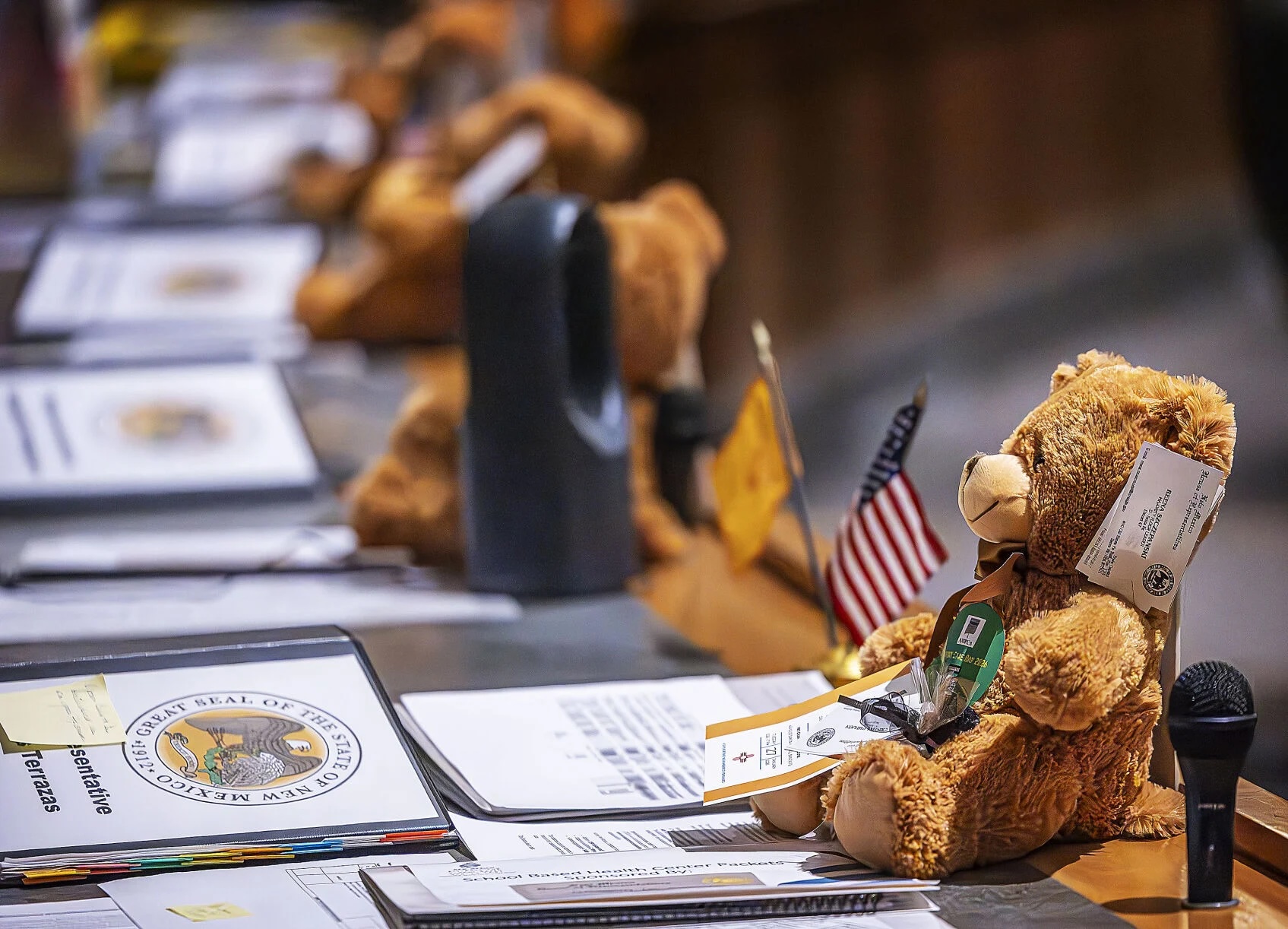
 Representatives of the New Mexico Primary Care Association pass out teddy bears to legislators and staff around the Roundhouse for Primary Care Day, Tuesday, Jan. 27, 2026, as the legislature starts to kick into full gear on the second week of the 30-day session. Photo by Jim Weber/The New Mexican
 Yvette Ramirez Ammerman, CEO at the New Mexico Primary Care Association, passes out teddy bears to legislators and staff around the Roundhouse for Primary Care Day Tuesday, Jan. 27, 2026, as the legislature starts to kick into full gear on the second week of the 30-day session. Photo by Jim Weber/The New Mexican
The Santa Fe New Mexican
Health Care Affordability Fund: A small contingent of doctors, patients and advocates called Tuesday for the passage of a bill that would bolster funding for the Health Care Affordability Fund.
“New Mexico is heading toward a coverage crisis,” Abuko Estrada, health care director at the Center on Law and Poverty, said during a morning news conference. “As federal subsidies are reduced and new administrative burdens create barriers, tens of thousands of families will be pushed off their BeWell and Medicaid coverage.”
Without state intervention, he said, families will lose access to care, and hospitals and clinics will face financial strain.
Their solution? House Bill 4, which would increase the distribution of the health insurance premium surtax to the Health Care Affordability Fund from 55% to 100% starting Sept. 1. The fund, established in 2021, helps reduce insurance costs for self-employed workers and others who purchase insurance on the state exchange.
House Majority Leader Reena Szczepanski, D-Santa Fe, who is sponsoring the bill, said health care is at a “critical moment.”
“The feds have pulled back support,” she said. “They are ratcheting down some of the programs that everyday New Mexicans depend on.”
While the state has stepped up to ensure its health insurance exchange and Medicaid program are strong, Szczepanski said New Mexico has an opportunity to “fully leverage” the fund during the 30-day session.
“The fund was established a few years ago, but only a portion of the proceeds from the revenue source are actually going into that fund,” she said. “We need 100% of that funding … so we can protect New Mexicans [and] ensure that people don’t lose the health care coverage they so desperately need.”
Felons with guns: Lawmakers considering a measure to significantly increase prison sentences for felons found illegally in possession of firearms decided to hold off on passing the bill until its sponsors could draft amendments to separate people who committed violent crimes from those who didn’t.
House Bill 49, sponsored by Albuquerque Democrats Rep. Joy Garratt and Sen. Heather Berghmans, would raise the basic sentence for anyone found guilty of possessing a firearm as a felon to nine years in prison on their first offense.
That’s up from the base sentence of three years for people found guilty of non-violent offenses, and up from six years for those convicted of violent crimes. Those found guilty of the crime more than once could face first-degree felony convictions and 18-year sentences.
Lawmakers expressed support for the measure, with some noting the measure could help fill the gap left by the federal government when it lacks capacity to adequately investigate or prosecute felons caught with firearms.
“We need to take responsibility for that and ensure that when we do see these repeat offenders accessing firearms that we do hold them to account,” said Rep. Andrea Romero, D-Santa Fe, during the Tuesday evening meeting of the House Consumer and Public Affairs Committee.
However, others expressed concern over the idea of imposing the same harsh penalties faced by people found previously found guilty of violent crimes on those who were convicted of much less serious offenses.
“Instead of just all out, ‘You’re a felon, you’re going to face the charges regardless,’ I’m willing to compromise,” said Bernalillo County Sheriff John Allen, who presented the bill.
Battery on police: A measure to increase the penalties for aggravated battery on a peace officer in which great bodily harm is inflicted or possible from a minimum of three years to nine years unanimously passed the House Consumer and Public Affairs Committee on Tuesday evening.
House Bill 61, which would increase the severity of the crime from a third-degree felony to a second-degree one, received strong support from a number of police officials and officers during the hearing.
“This will demonstrate that the sacrifices made by the men and women behind the badge are recognized and valued,” said Sgt. Rachel Discenza-Smith of the Farmington Police Department in urging lawmakers to pass the bill.
Some expressed concern over the measure, arguing that while the safety of police was critical, increasing penalties for the offense of committing aggravated battery on a peace officer threefold would not effectively deter the crime.
“There is no evidence that further increasing punishment will deter these incidents and make officers safer,” said attorney Denali Wilson.
Legislators, however, largely agreed it was important to make clear that violent attacks on police officers are serious offenses, noting the panel had passed similar bills in years past that later failed in the state Senate.
“This is the most extremely simple piece of legislation, and we need to ensure that police officers do have the resources necessary, that we know we will hold people accountable,” said Rep. John Block, R-Alamogordo.
Tax package like Tetris: The Senate Tax, Business and Transportation Committee continued to hear bills Tuesday that will be considered in a tax package if there’s room for one in the state budget.
Sen. Carrie Hamblen, a Las Cruces Democrat who chairs the committee, said she’s hearing there will be capacity for a tax package but that she won’t know for sure until later in the 30-day session.
“We should know more by the beginning of next week,” she said.
Hamblen said the committee is hearing bills now to avoid a “mad rush,” especially in a short session.
“This is really proactive in making sure that these bills get the hearings they deserve and get them ready. Now, whether or not we’ll be able to include all of these, that’s another story because it really depends on capacity,” she said. “Also, we want to try and stretch that as far as possible, so I often refer to it as like a Tetris. We are trying to find places.”
Among the bills the committee heard Tuesday was a proposal to increase the gasoline tax from 17 cents to 23 cents a gallon, which might be a hard sell. Previous efforts to raise the gas tax have failed.
“This is my 31th year in the Legislature, and out of that, I’m going to say that at least 20 of those years I have attempted in some form to bring additional revenue to Department of Transportation,” said Sen. Roberto “Bobby” Gonzales, D-Ranchos de Taos, who is sponsoring Senate Bill 76, which would raise the gas tax, as well as increase the special fuel excise tax from 21 cents to 26 cents per gallon.
Water bill flows: The House Agriculture, Acequias and Water Resources Committee on Tuesday morning advanced an annual bill giving the New Mexico Finance Authority the authority to give out loans and grants from a Water Project Fund.
Finance Authority CEO Marquita Russel told legislators in the committee that the dozens of initial funding requests, including for several projects in Santa Fe County, represent more than $520 million in requested funding — about $175 million more than the funds available.
Quotes of the day: “I don’t want a bunch of hate mail coming in from people,” said Sen. Candy Spence Ezzell, R-Roswell, after voicing her concerns about a bill extending the lifespan of a fee on pet food that funds low-cost spay and neuter programs. “I am an animal lover, and anybody that will go up against me, you can come out to my place and you can see how my animals are treated, OK? So don’t go down that path.”
“Thank you, we would not want to cross you,” Sen. Liz Stefanics, D-Cerrillos, replied.