By LAURA LEONARD
Doctor of Chiropractic
Los Alamos
Hypermobility affects roughly 30 percent of the population and is caused by a genetic variation in our structural collagen.
Ligaments contain collagen fibers and are responsible for attaching bone to bone in our body. When ligaments end up looser than normal, the joints of the body have too much motion.
People with hypermobility often end up in sports that require excessive flexibility like cheer, gymnastics and dance. Not everyone who has hypermobility struggles with health issues however, there are several warning signs to watch for that may indicate further issues.
Warning Signs To Watch For:
- Scoliosis due to looseness in the ligaments of the spine.
- Irritable bowel due to structural issues in our core and gut.
- Frequent sprains and strains without bone fracture.
- Chronic tightness and pain in the muscles as a protective mechanism.
- Chronic headaches.
- Increased tendency to acquire hernias.
- Fallen arches and foot pain.
- Increased risk of athritis due to excessive joint movement.
- Excessive weakness and intolerance to high impact exercise.
- Generalized anxiety because the fight or flight mechanism in the nervous system is over activated due to joint instability.
- Excessive popping of the joints and a tendency to want to pop joints.
- Poor coordination due to overstimulation of posture sensing receptors in the joint.
The Beighton Score is a screening tool to determine the severity of joint hypermobility. This scale is based on a series of five postural tests (see graphic above). Positions 1-4 are given 2 points if you can do them. Position 5 is only given 1 point for completion. Your score can range from zero for inflexibility to a nine for extremely hypermobile.
The good news is there are ways to treat hypermobility once you are aware of it. The primary way to get started is to begin a strength training program as soon as possible. The chronic muscular tightness and pain that occurs as a protective mechanism in the body will immediately improve.
Balance training and foot strengthening also is very helpful because it creates a stable base.
Finally, core strengthening to create a natural brace for the spine and pelvis will minimize any postural issues caused by hypermobility.
About Dr. Laura Leonard:
Dr. Laura Leonard has a BSc in Neuroscience and is a Doctor of Chiropractic. She has been in practice for 20 years and recently joined Dr. Lenz and Dr. Savoia at the Los Alamos Chiropractic Center. Dr. Leonard’s practice focuses on posture and performance using a combination of soft tissue release, adjustments and exercise recommendations. She also coaches patients on nutrition, self-care and body awareness so they can manage themselves in between visits. Los Alamos Chiropractic Center is in the Mary Deal building on Trinity Drive.
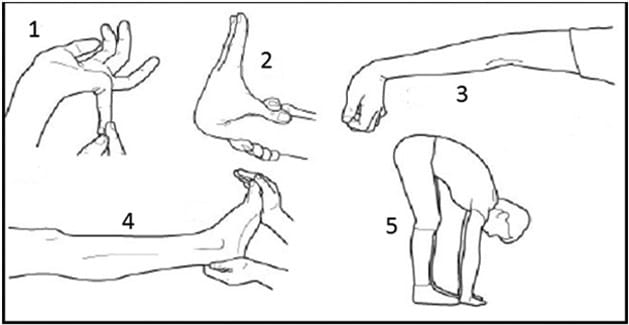 The Beighton Score, a screening tool for joint hypermobility, is based on a series of five postural tests. Courtesy image