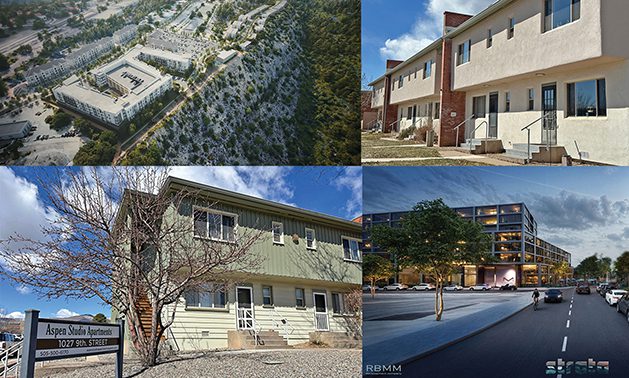
 Clockwise from left, the proposed Coyote Mesa apartment complex on DP Road, Thunderbird and Aspen Studio Apartments on 9th Street and the proposed project on 20th Street that would be apartments and commercial spaces. Courtesy/LAC
By KIRSTEN LASKEY
Los Alamos Daily Post
kirsten@ladailypost.com
Los Alamos County has firmly made the claim that housing is essential to have a strong economy and a thriving community. Its message is clear: build it and the people will come. As a result, County Council learned about the local government’s efforts to increase housing options during its work session June 23.
Housing and Special Projects Manager Dan Osborn reported on the status of several housing projects in the County.
He emphasized the need for more housing, pointing out that the County’s Affordable Housing Plan, “tells us to get that vibrant economic community, we need to build some more housing. And the plan justifies us being able to go up to about 120 percent of the AMI (Area Median Income).”
The target for the County, Osborn said, is to address the middle-income earners or those making 60 to 120 percent of the AMI. For reference, the income for a four-person household at 120 percent of the AMI in Los Alamos County is $205,080 and the income for a four-person household making 60 percent of the AMI is $100,020, according to a 2026 Los Alamos County Area Median Income spreadsheet on the County’s website.
Osborn described this range as the “missing middle” and it is “really the focus of what our Affordable Housing Plan has directed us to do.”
“Overall, we need about 1,300 units just to meet the status quo,” Osborn said. “That means we are not going to make much progress on stabilizing housing costs or bringing housing costs down … that’s what we want to do – for the housing cost and prices to stabilize … and hopefully then through time incomes catch up with the current housing prices and there is a little bit of relief in the community for that.”
To satisfy demand and have stability and have economic development, he said 2,400 new houses are needed.
“We think that’s doable,” Osborn said.
Diverse housing is important, he added.
For instance, he touched on the status of the 9th Street apartments where the County purchased deed restrictions on 89 units. This means those rents are capped, Osborn said. For the next 20 years, the rent prices will be 45 percent of the AMI or $1,300 a month per unit. However, for the first seven years of the agreement, the rents will be capped well below 45 percent of the AMI, the units are currently available for $945 a month.
“We really feel like we are heading in the right direction, we’re getting those units available for folks who really need those units at those AMIs so I think this has been a successful project,” Osborn said.
Right now, the apartments are 10 percent vacant. Upgrades are also underway on the electric infrastructure and there are plans to do mini splits, he said.
Osborn also provided an update on the Coyote Mesa apartment complex planned for DP Road. He explained it would cover almost 30 acres and offer 380 units that would range from one to three-bedroom apartments. The project is expected to cost $200 million. The County contributed $7.5 million to make 120 units permanently deed restricted. Through gross receipts taxes and construction costs, Osborn said the County should re-coup $8.5 million. Construction could begin in October.
Delving more into the 120 deed restricted units, Osborn said these would serve those who fall in the 60-100 percentile of the County’s AMI. The average would be 80 percent of the AMI. Additionally, Oborn said the project officials worked with the state to deed restrict an additional 98 units to benefit those who make 120 percent or less of the AMI. The additional 98 units were supported by the Office of Workforce Solutions who contributed almost $5 million to the project to hold rents down through time.
In terms of rent prices for those making 60 percent of the AMI, Osborn said the rent would be $1,500 for one bedroom. A two-bedroom would be $1,900 and a three bedroom would be $2,500. If renters make 100 percent of the AMI, one bedroom would be $2,800, two bedrooms would be $3,400 and three bedrooms would be almost $4,000.
“I know that seems like a lot of money because it is, how does that compare to what we might see in the private market where there will be no deed restrictions or limits on that? Some of the other two bedrooms, two bath units that we’ve seen on the market recently are north of $4,400 so you are talking about $4,600 up to $5,000 for those units on the private market,” Osborn said. “So, we do feel like we have additional cap on these (and) we are feeling pretty good about it and can help hold those rent prices in perpetuity.”
Plus, he said those who fall in lower income brackets of the AMI could qualify to live in a low-income housing tax credit project like the Canyon Walk Apartments and Senior Bluffs Apartments, he said.
So, what about those who are not in the missing middle? How is the County serving the minimum wage earners?
When the Los Alamos Daily Post asked if the AMI could be pushed aside in determining rent prices and instead use the minimum wage rate, Osborn wrote in an email, that “Minimum wage is a vital economic indicator – however, federal and state housing programs (such as Low-Income Housing Tax Credit and state programs) mandate the use of Housing and Urban Development (HUD) defined Area Median Income (AMI) limits to qualify tenants and set rents.”
He wrote, “Moving away from the AMI benchmark for affordable housing projects would jeopardize our ability to secure critical outside funding. Because federal programs have these rigid limits, the County is exploring ways to leverage local resources, land partners, and land contributions, as well as transportation and utility infrastructure support to help close the financial gaps. This is coupled with income qualification requirements so that projects are affordable to lower income earners.”
He added that the County is actively working to bridge the gap between the highest and lowest income earners, noting that 134 units at the Canyon Walk and Bluffs senior apartments are targeted at households earning 30 percent to 60 percent of the AMI.
Besides catering to a range of AMI percentiles, another focus of the County is to increase housing density and stock.
One way to do that, Osborn said, is to increase housing in the downtown areas.
“We think we can continue to bring that additional density in and create new amenities, some new things for the community and deliver some vibrancy to those downtown districts,” he said.
This would require a shift from dominant land use, which is 10 dwellings per acre or less in Los Alamos and between 5-7 dwellings per acre in White Rock.
“In some of those denser areas closer to downtown, we really need to get into the 10-15 dwelling units per acre to start to effect affordability and to start to create more of a market and economic development in those areas,” Osborn said.
When the Los Alamos Daily Post asked Osborn where in the downtown areas new, high-density housing would be feasible, Osborn wrote in an email, “Higher-density, mixed-use development is highly encouraged in areas with existing infrastructure and proximity to services like shopping and transportation. These areas have been identified in both the Downtown and White Rock Town Center master plans.”
He further wrote, “The County is also investing in these areas through LEDA (Local Economic Development Act) and MRA (Metropolitan Redevelopment Area) participation agreements. And, in some cases, through County participation there may be opportunities to add requirements for affordable and mixed income units in these areas.”
Osborn added there has been an increase in interest from the private sector to develop in Los Alamos.
He touched on some of those projects during the June 23 work session.
The development at 20th Street
Osborn reported that the project is on schedule. Since signing the development agreement, the developers have been doing their due diligence and are starting the design work and cost estimates. For its part, the County is working with the developer to stage street improvements.
Arbolada Titian Development
Osborn said the long-time local owners of the proposed housing project on North Mesa transferred ownership to Titian Development in Albuquerque. The plan is to have market rate build-to-rent multi-family cottage units on two-thirds of the property or 114 units. The remaining land will offer 23 single-family homes that will be market rate. Osborn reported that grading work is being done now and construction should happen this year.
Sherwood Rounds
Osborn said 29 multiple family homes are being planned in White Rock.
Upcoming projects include the County collaborating with Habitat for Humanity to build a single family home at 2400 Diamond Drive. Osborn said the County is working to complete the deed restrictions as well as the development agreement, which needs to comply with County and Habitat for Humanity’s policies.
Two duplexes, totaling four units, are under the early stages of discussion at 3661 Trinity Drive. Osborn said one unit is proposed to be priced at 30 percent of the AMI, one would be priced at 50 percent of the AMI, another would be priced at 80 percent of the AMI and the last would be priced at 120 percent of the AMI. These units would be for sale.
Finally, the County is turning its attention to the A-16 parcel on DP Road. Osborn said the plan is to preserve the parking lots, add bus stops, offer some parcels for commercial buildings and offer some parcels for storage uses such as RVs.