







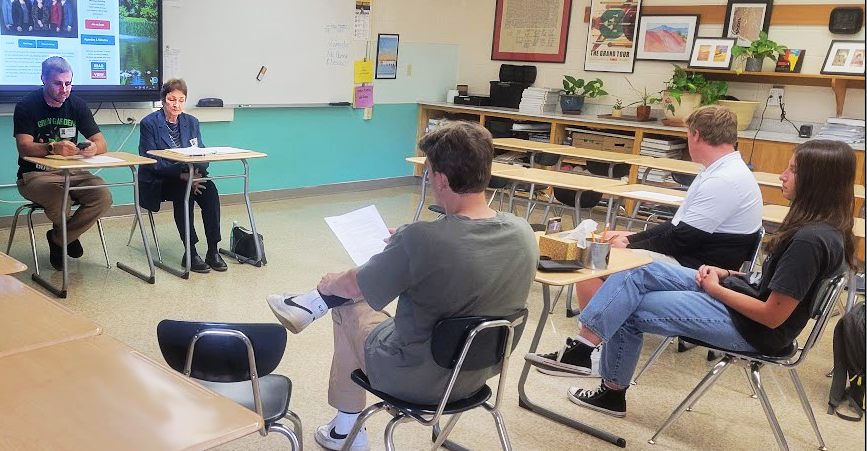
 Council candidates Denise Derkacs and James Wernicke answer climate-focused questions from Los Alamos High School Eco Club members. Courtesy photo
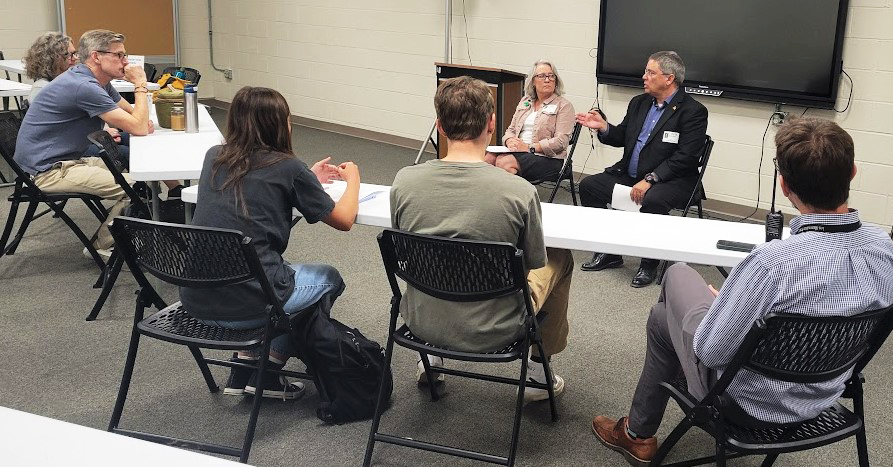 Council candidates Ryn Herrmann and David Reagor answer climate-focused questions from Los Alamos High School Eco Club members. Courtesy photo
Eco Club News:
On Tuesday, Oct. 15, the leadership team of the Los Alamos High School Eco Club, co-presidents Samuel Carmer and Ian Corey and vice president Irina Maiorov, hosted two climate-focused Q&A sessions with candidates running for Los Alamos County Council.
Candidate Responses:
Candidate Denise Derkacs
Eco Club Question: Please introduce yourself, share what office you’re running for, and explain the ways that office can impact environmental policy in Los Alamos.
My name is Denise Derkacs. I am serving in my fourth year on Council and my second year as Council Chair. I am running for re-election to County Council to continue planning for growth and embracing the future while preserving the past and the amenities that make Los Alamos County a great place to live.
The County Council is directly responsible for setting environmental policy, and all policies, for the County and for also approving funding for specific actions to implement policies.
I voted with the majority of Councilors in February 2022 to accept the short-, medium-, and long-term recommendations of the Los Alamos Resiliency, Energy, and Sustainability (LARES) Task Force to achieve net zero greenhouse gas emissions and advance other sustainability practices in the face of climate change.
I voted with the majority in April 2022 to create a Sustainability Manager position and with the majority in April 2024 to allocate $1.2 million in Fiscal Year 2025 for sustainability initiatives.
And, I also voted with the majority for the interim measures proposed by the Council LARES Working Group in July 2024 to initiate actions to reduce greenhouse gas emissions while awaiting completion of the Climate Action Plan. I anticipate additional funding allocations once the Climate Action Plan is finalized and approved by Council.
For more information about my campaign, see https://denise4countycouncil.com and https://www.facebook.com/denise4countycouncil.
Eco Club Question: What measures would you advocate for to improve public transit utilization in Los Alamos County, particularly in relation to increasing housing density around transit?
The County assumed all public transportation operations in 2007, although public transportation has existed here since 1980. The County’s bus service, Atomic City Transit, is funded primarily (~80%) by state and federal grants. The remainder (~20%) is funded from the County general fund under its public works budget.
As we build more housing, particularly high-density multi-family housing in the downtown areas of Los Alamos and in White Rock, with reduced parking availability, encouraging the use of public transportation is essential.
Increasing the number and frequency of bus routes would make bus transportation more available and attractive to riders. However, the County faces a shortage of bus drivers. To address this shortage, Council unanimously approved, and the County implemented, a 10 percent increase in bus driver salaries.
The County is also evaluating possible locations for transit centers in Downtown Los Alamos and in the White Rock Town Center to facilitate assess to busses and to enable easier transfer between bus routes, which would support broader use of public transportation.
Maintaining and expanding public transportation will be even more important as the County adds new housing and the population increases.
Eco Club Question: How would you prioritize investments in pedestrian and cycling infrastructure to reduce reliance on personal vehicles and protect pedestrian and cyclist safety?
Reducing reliance on personal vehicles is part of the County’s sustainability strategy and is a priority for the Council. I support infrastructure investments including extending the road diet on Trinity Drive and expanding and connecting the County’s trail system to enhance pedestrian and cyclist safety and reduce reliance on personal vehicles.
Following a Road Safety Audit in 2016, the County was awarded Federal funding through the State Department of Transportation for safety and accessibility improvements on Trinity Drive, NM 502, a state-owned highway.
A road diet is a traffic-calming measure that involves reducing the number of travel lanes to make space for turn lanes, bike lanes, and sidewalks. The goal is to slow traffic, reduce accidents, and make roads safer and more accessible for all users.
The first portion of the road diet, from Diamond to Oppenheimer, was approved by Council in June 2020. The extension of the road diet from Oppenheimer to Knecht, was just approved by Council in September 2024. This section will be a hybrid road diet with two eastbound lanes to facilitate the movement of traffic out of town.
The County is also expanding its trail system. The new Urban Trail from 20th Street to the Aquatic Center was fully funded by federal grants. The Canyon Rim Trail will eventually connect to the Urban Trail at 20th Street. The County is working with property owners to obtain easements to complete the trail.
Eco Club Question: What role do you envision local and state government playing in supporting electric vehicle usage in Los Alamos?
Supporting electric vehicle usage is one of the recommendations of the LARES Task Force and one of the actions proposed by the Council LARES Working Group.
Council has already allocated, and I supported, funds ($550K) to expand the publicly available EV charging infrastructure in the County. Two new fast-charging stations were recently installed in Los Alamos and in White Rock, with payment mechanisms through ChargePoint. Other locations are being identified for additional EV chargers.
Council also allocated, and I supported, funds ($65K) to replace two gas vehicles with electric vehicles in the County fleet. Funding is planned in future budgets to replace additional County vehicles.
I will note that my husband and I have owned an EV for several years and use it for both local and long-distance driving. We have a 240-volt outlet in our garage for home charging and have a ChargePoint account for fast-charging, when needed.
Council also allocated, and I supported, funds ($80K) for educational, marketing, and outreach services focused on greenhouse gas reduction.
Additional actions and funding are expected once the Climate Action Plan is finalized and adopted by Council.
Eco Club Question: How should the County balance protection of open spaces with the need for land-use reforms to encourage higher-density multifamily housing?
County residents strongly value our open spaces, as documented in the 2016 Comprehensive Plan.
The County has some 60 miles of trails and some 4,000 acres of designated open space. The Development Code and Official Zoning Map, both revised in December 2022, established four open space designations: public parks, recreational open space, active open space, and passive open space. The Code also increased building heights to 86 feet in Downtown Los Alamos and 54 feet in the White Rock Town Center; reduced parking requirements; and expanded mixed-use development to encourage higher-density multifamily housing.
Not all vacant properties in the County are designated open spaces. Officially designated open spaces, as well as trails, parks, and recreational spaces, should be protected and maintained. Other vacant properties should be considered, with robust community input, for development compatible with surrounding neighborhoods to address the diverse housing needs of a growing population in the County.
The County also should finalize its Open Space and Trails Management Plan to protect and maintain these County treasures and continue to address the shortage of maintenance staff.
Candidate Ryn Herrmann
Eco Club Question: Please introduce yourself, share what office you’re running for, and explain the ways that office can impact environmental policy in Los Alamos.
Hi I’m Ryn Herrmann. My family has lived in Los Alamos for 27 years and our 3 kids graduated from LAHS.
I worked for Los Alamos Commerce and Development Corp for the past 10 years and recently retired from being the Los Alamos Chamber of Commerce Director, helping our business community. I started and ran the Los Alamos Business Accelerator to help entrepreneurs open successful businesses in town. Now I would like to continue to serve Los Alamos as a County Councilor. This position can significantly impact environmental policy which is an important issue for me. I certainly believe the scientists when they say that human induced climate change is real and I believe we have a duty to be a leader in this. Some of our County Council candidates say anything our small town does won’t make a difference. But we are a science-based community and I believe that we should set an example for all of New Mexico and beyond.
The county has a goal of being carbon neutral by 2040. The Los Alamos Resiliency, Energy & Sustainability Citizen Task Force recommendations were accepted by council and most of these ideas are already being Incorporated into the goals. The draft Climate Action Plan got great feedback from our citizens and is currently being revised by county staff and should be presented to council again soon.
Some ways that office can impact environmental policy in Los Alamos:
Advocating for Sustainability & Promoting Climate Action: As a council member, one can advocate for a long-term vision of sustainability that considers the environmental, social, and economic aspects of development. This holistic approach can help ensure that future policies align with the community’s values and goals for a sustainable future. One could also lead initiatives to address climate change, like encouraging energy efficiency and protecting local habitats.
Budget Decisions: The County Council decides how our money is spent. By prioritizing funding for environmental programs, we can support projects that help the planet.
Community Engagement: We can organize or support events and discussions to get the community involved in environmental issues, helping everyone understand why these issues matter and fostering a culture of sustainability within the community. Collaborating with local environmental organizations can strengthen efforts to protect nature and promote sustainability.
Creating Regulations: The Council can influence local laws that protect the environment, ensuring that new developments are eco-friendly. Low hanging fruit. Single use bag ban. Los Alamos County considered a ban on plastic grocery bags in the past but it didn’t pass, Meanwhile, the city of Santa Fe banned single-use plastic bags in 2015. Then earlier in March of this year, Santa Fe County banned single-use plastic bags and polystyrene containers. I believe something as simple a bag ban is a step in the right direction and I think we now have enough citizens now who care about making a difference in our environment to pass this.
I admire the work that the EcoClub is doing and I agree with your efforts to move towards electric vehicles, appliances, and battery-powered or plug-in landscaping equipment. I also am committed to the use of renewable energy. By running for council, I would have the chance to inspire positive change in our environmental policy and help create a healthier environment for everyone in Los Alamos.
Eco Club Question: What measures would you advocate for to improve public transit utilization in Los Alamos County, particularly in relation to increasing housing density around transit?
Tricky question since so many challenges exist already:
Infrequent Service: Low frequency of buses can be a barrier for those relying on public transportation.
Scheduling Challenges: If schedules are not aligned with the needs of commuters or local events, it can further reduce ridership.
Funding and Resources: Budget constraints may hinder the ability to improve services, expand routes, or enhance facilities.
Even when funded, these jobs are hard to fill and routes get canceled when there are no drivers available.
Keeping all of that in mind, for our community we really can’t increase housing density around transit. There are only a few locations where we can build dense housing, which is in our downtowns. The buses will be scheduled where there is housing density.
I think the one thing that would make a difference in increasing demand for public transit is if the lab and other big employers incentivized using it. Local businesses encourage their employees to use public transit, maybe by offering discounts or free passes.
Eco Club Question: How would you prioritize investments in pedestrian and cycling infrastructure to reduce reliance on personal vehicles and protect pedestrian and cyclist safety?
To improve pedestrian and cycling infrastructure in Los Alamos County and reduce reliance on cars, here’s how I would prioritize investments:
I would prioritize specific projects to improve walking and biking paths that connect neighborhoods to schools, parks, and shops, making it easier for people to get around without a car. The Urban Trail is a great example of connecting existing trails.
Safety is always key! I would push for better crosswalks, bike lanes, and traffic calming measures in busy areas. Adding good lighting and clear signs can also help keep everyone safe.
Where we can, we should have dedicated bike lanes: I would prioritize creating separate bike lanes and multi-use paths that keep cyclists and pedestrians away from cars. This makes it safer and encourages more people to walk or bike instead of driving.
Get Community Input: It’s important to hear from the community. I would hold meetings and surveys to find out what improvements people want and need. This way, we can make sure the changes are helpful for everyone.
Find Funding: I would look for funding from state and federal programs that support transportation improvements. Partnering with local businesses and organizations can also help us get the resources we need for these projects.
As with public transportation, the lab could incentivize walking or bicycling to work.
By focusing on these steps, we can create a safer and more enjoyable environment for walking and biking in Los Alamos County, making it easier for everyone to get around without relying on cars!
Eco Club Question: What role do you envision local and state government playing in supporting electric vehicle usage in Los Alamos?
Local and state governments can play a crucial role in supporting electric vehicle (EV) usage in Los Alamos through several strategies:
Infrastructure Development: Investing in the installation of EV charging stations throughout the community can make EVs more accessible. This includes both public charging stations and incentives for private installations.
Incentives and Rebates: Offering financial incentives, such as tax rebates or grants for purchasing EVs, can encourage residents to switch from gasoline-powered vehicles to electric ones.
Public Awareness Campaigns: Educating the community about the benefits of EVs, including cost savings, environmental impact, and available incentives, can help increase adoption rates.
Support for Renewable Energy: Promoting the use of renewable energy sources for charging stations can enhance the sustainability of EVs, making them even more attractive to potential users.
Partnerships with Local Businesses: Collaborating with businesses to provide charging stations at workplaces or popular destinations can improve convenience for EV owners.
Zoning and Planning Policies: Integrating EV-friendly policies into urban planning, such as dedicated parking spaces for EVs and requirements for new developments to include charging infrastructure, can create a more supportive environment for electric vehicles.
Transportation Planning: Incorporating EVs into public transportation options, like electric buses, can further promote their use and reduce reliance on fossil fuels.
By implementing these strategies, local and state governments can significantly enhance the infrastructure and support systems needed for increased electric vehicle usage in Los Alamos.
Eco Club Question: How should the County balance protection of open spaces with the need for land-use reforms to encourage higher-density multifamily housing?
I firmly believe we should not build on our open spaces. Trails and open spaces are one of the things that make our community exceptional. We have tried and will continue to try to find excess land. Land transfers from LANL are hard and take a long time. So let’s look at what we can do with what we have.
We need to look for creative, more equitable housing, as that helps everyone and creates inclusivity. And as we are redeveloping our downtowns we need to incorporate high density housing there with mixed use buildings offering mixed income units.
To further protect & enhance our open spaces as per the 2016 Comp Plan, the County should enforce zoning laws favoring open space, and encourage public involvement.
Through actions like this, we can effectively protect our natural resources and keep Los Alamos outdoor oriented.
Candidate Beverly Neal Clinton (Not able to attend Q&A session in person)
As a county councilor, here’s how I would approach these key issues concerning public transit, pedestrian and cycling infrastructure, electric vehicle (EV) usage, and land-use reforms in Los Alamos County:
I am running for Los Alamos County Councilor because I believe we can do better… Better by including various underrepresented voices and viewpoints, better by creating sustainable and affordable living spaces for our residents, better by removing the stigmas associated with mental health and better by understanding that small businesses are the lifeblood of all small communities in that they reinforce what community is and we are only as strong as our weakest link…
I am a Marine, a mother, a sister, an aunt, and a Gigi. I have lived in Los Alamos for over 24 years and my husband and I have raised all three of our sons here and of all of the places we could live, we choose to call Los Alamos home. I believe that as a County Councilor, our job is to protect the community and value its residents. We do that by doing better, by improving our processes. For God’s sake, our tagline is “Where discoveries are made.” Let’s live up to that statement.
- Measures to Improve Public Transit Utilization and Increase Housing Density
Advocating for Transit-Oriented Development (TOD) – I would push for Transit-Oriented Development policies to increase housing density around key transit hubs. This would include:
- Zoning reforms to allow for higher-density multifamily housing near transit stops.
- Incentives for developers, such as tax breaks or reduced development fees, to build mixed-use buildings that combine residential spaces with retail or office space near transit corridors.
- Improved transit accessibility by expanding bus routes, increasing frequency, and making transit stops more accessible with better walkways, shelters, and lighting.
- Community engagement programs to educate residents about the environmental and economic benefits of using public transit, such as cost savings, reduced emissions, and decreased traffic congestion.
- Prioritizing Investments in Pedestrian and Cycling Infrastructure
Protected Bike Lanes and Multi-Use Paths – I would prioritize funding for protected bike lanes and multi-use paths that provide safe and dedicated spaces for cyclists and pedestrians. Los Alamos has a unique natural environment, so designing pathways that integrate with the landscape while protecting users is key.
Safe Pedestrian Crossings – Creating safer pedestrian crossings, especially at busy intersections, using signalized crossings, pedestrian islands, and raised crosswalks would be essential.
Complete Streets Policy – Advocating for a “complete streets” approach that ensures all streets are designed with pedestrians, cyclists, and public transit in mind, not just cars. This would create a safer environment for all modes of transport.
Traffic Calming Measures – Introducing speed bumps, narrower lanes, and more pedestrian-focused design in neighborhoods where walking or biking should be prioritized would reduce accidents and encourage non-vehicle transport.
- Support for Electric Vehicle (EV) Usage
Public Charging Infrastructure – I would advocate for the installation of more EV charging stations, particularly in public parking lots, near shopping centers to possibly include Smith’s, and along main commuting routes to make it more convenient for EV users.
Incentives for EV Adoption – Collaborating with the state to expand incentive programs that offer tax rebates or subsidies for EV purchases, as well as for installing home charging units.
Government Fleet Electrification – Aiming to convert the county’s vehicle fleet to electric vehicles where feasible, setting an example and helping create demand for local charging infrastructure.
Collaborations with Utilities – Partnering with local utilities to develop infrastructure that supports increased EV usage, such as incentives for installing solar panels alongside EV chargers, and ensuring the grid can handle increased demand from EVs.
- Balancing Open Space Protection and Land-Use Reforms
Strategic Zoning Adjustments – I would support land-use reforms that focus on infill development, particularly in areas where infrastructure already exists, rather than expanding into open spaces. This would include higher-density multifamily housing near transit and services, while maintaining large swathes of open space elsewhere.
Cluster Development – In areas adjacent to open spaces, I’d advocate for cluster development that preserves large portions of natural land while concentrating housing in smaller areas. This would allow for higher density housing without a significant loss of open space.
Open Space Offsetting – For any development that encroaches on open spaces, developers should contribute to an open space fund that supports the conservation of other natural areas in the county.
Community Engagement and Environmental Assessments – Ensuring that new developments are subject to robust environmental impact assessments and involving the community in discussions about land use is crucial to balancing growth with the protection of natural resources.
Balancing the need for growth with environmental and community priorities requires a careful, integrated approach, and I believe the solutions I’ve outlined could provide a path forward for Los Alamos County.
Candidate David Reagor
Eco Club Question: Please introduce yourself, share what office you’re running for, and explain the ways that office can impact environmental policy in Los Alamos.
My name is David Reagor and I am running for reelection to the Los Alamos County Council. I have lived in White Rock, Los Alamos County since 1986. After 32 years at LANL I retired, took a year off, and then entered the election of 2020. In many other towns the utilities are provided by various corporations, one for gas, one for electric, etc., and the local community has little control of these companies, but Los Alamos County runs its own utilities. We own and operate the electric, natural gas, water, sewer, and refuse systems. The County Council selects a Board of Public Utilities that manages the Department of Public Utilities. The Board sets policies and budgets with County Council approval. This means we have the unusual good fortune to control our utilities with our local elections.
Eco Club Question: What measures would you advocate for to improve public transit utilization in Los Alamos County, particularly in relation to increasing housing density around transit?
We have recently added housing on DP road and near Trinity on 35th St. In the future we plan to add more housing between Trinity and Central. This will total over 1000 units in our downtown area in a very short period of time. We also plan to add housing in central White Rock and on N. Mesa near the middle school. I expect that this will add a large number of riders to the Atomic City Transit System.
One way to encourage this is to minimize delays in the system. The road diets we have done and plan to do in the future are probably counter-productive and should not be accepted.
Eco Club Question: Eco Club Question: How would you prioritize investments in pedestrian and cycling infrastructure to reduce reliance on personal vehicles and protect pedestrian and cyclist safety?
We have two major East-West streets in downtown Los Alamos. One of them is the Central Ave./Canyon Rd. route. This serves existing housing areas, and is perfect for pedestrian and bicycle traffic. This should include bike lanes with some barrier more impressive than a white line between bikes and cars. We will need a second good East-West bicycle route, the Rim Trail, that is not completed but will be an important addition. Trinity should be friendly to busses, trucks, and cars, while Central Avenue is best for bicycles and pedestrians with good crosswalks and two single lanes of cars.
Eco Club Question: What role do you envision local and state government playing in supporting electric vehicle usage in Los Alamos?
We should always encourage electric vehicles and currently offer charging stations at several common destinations. The best electric car incentive is in place: Our roads are maintained by taxes on gasoline that electric cars do not pay. It would be problematic if we mandated electric cars. They simply do not fit into many lifestyles.
Eco Club Question: How should the County balance protection of open spaces with the need for land-use reforms to encourage higher-density multifamily housing?
The open spaces in and around Los Alamos are its most popular feature. I will always support open space retention in our public parks. The best place for more high-density housing is between Central and Trinity, where it is easily serviced by the existing bus system. We are still thousands of housing units short of meeting existing demand. The NNSA is still expanding LANL leading to additional future shortfalls. With all this housing pressure, how do we protect our open spaces? One large-scale solution for this is a new commuter rail line straight south to Albuquerque. This infrastructure will cost far more than the county can afford, but it is needed due to all the hiring the NNSA does and should be their responsibility.
Candidate James Wernicke
Eco Club Question: Please introduce yourself, share what office you’re running for, and explain the ways that office can impact environmental policy in Los Alamos.
I’m James Wernicke and I’m running for County Council. County Council can support zoning laws and building codes that balance development and environmental impact, energy policy that balances carbon emission and resilience, and open space management that balances usage with preservation. It can support strategic priorities like conserving natural resources and reducing carbon emissions. It can engage with community stakeholders and industry experts to gain understanding about issues like sustainable development and environmental stewardship. It can also approve economic incentives and enforceable ordinances for sustainable practices.
I would like to see our community leverage local industries, education, and R&D centers to become green tech leaders in environmental science, low-carbon energy, and carbon capture. I would also like to see us drive adoption of sustainable solutions among community members by reducing fees and speeding up permits for efficiency and electrification upgrades. We must also hold our government accountable for cronyism and greenwashing if we desire a genuine and equitable carbon transition.
Eco Club Question: What measures would you advocate for to improve public transit utilization in Los Alamos County, particularly in relation to increasing housing density around transit?
To boost public transit in Los Alamos, I’d advocate for higher-density, mixed-use zoning to provide options live-work housing near transit hubs, expanding building codes to support affordable, space-efficient designs and materials like container housing and ICF, and removing parking mandates. We should cut fees and expedite permits for affordable, high-density housing options, invest in autonomous microtransit to address the bus driver shortage, build cable cars across canyons to provide cost-effective, low-carbon access between residential and commercial areas, and encourage the lab to provide commuter shuttles between NM502 and lab areas.
Eco Club Question: How would you prioritize investments in pedestrian and cycling infrastructure to reduce reliance on personal vehicles and protect pedestrian and cyclist safety?
My priorities for pedestrian and cycling infrastructure would include obtaining easements to complete the Canyon Rim Trail and reopening Los Alamos Canyon to non-motorized traffic. I’d also pursue a bike path along NM-4 to White Rock, protected bike lanes on Diamond and Central, and flashing signals at high-traffic crossings. Additionally, I’d support autonomous microtransit and cable cars to enhance connectivity without relying on personal vehicles.
Eco Club Question: What role do you envision local and state government playing in supporting electric vehicle usage in Los Alamos?
Local and state governments should invest in resilient electrical infrastructure including public EV chargers and fleet electrification, implement demand-based electric utility rates, and reduce fees and expedite permits for private charger installations. I’d prioritize and support autonomous microtransit to complement private EV adoption. Building cable cars across canyons would also provide direct access to commercial areas, reducing reliance on private vehicles while promoting sustainable transit options.
Eco Club Question: How should the County balance protection of open spaces with the need for land-use reforms to encourage higher-density multifamily housing?
The County should streamline infill and mixed-use development, adjust codes for affordable, space-efficient designs, and remove parking requirements to foster higher-density housing while preserving open spaces. Auctioning County land for affordable housing and expediting permits for diverse housing types can further support density. Investments in autonomous transit, cable cars, and lab shuttles will reduce housing pressure. Shifting to a land value tax would promote responsible land use and balance growth with green space protection.


























