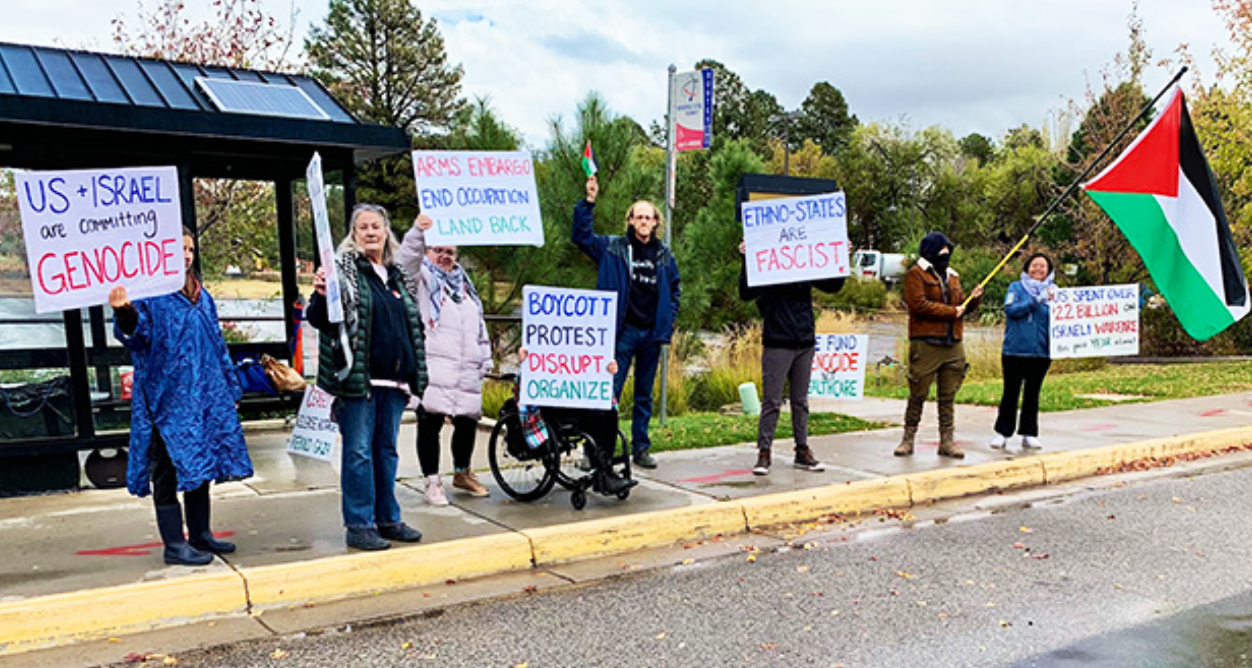
 Protestors for Palestine brave the rain to get their message out to the public recently along Central Avenue and Trinity Drive. Courtesy photo
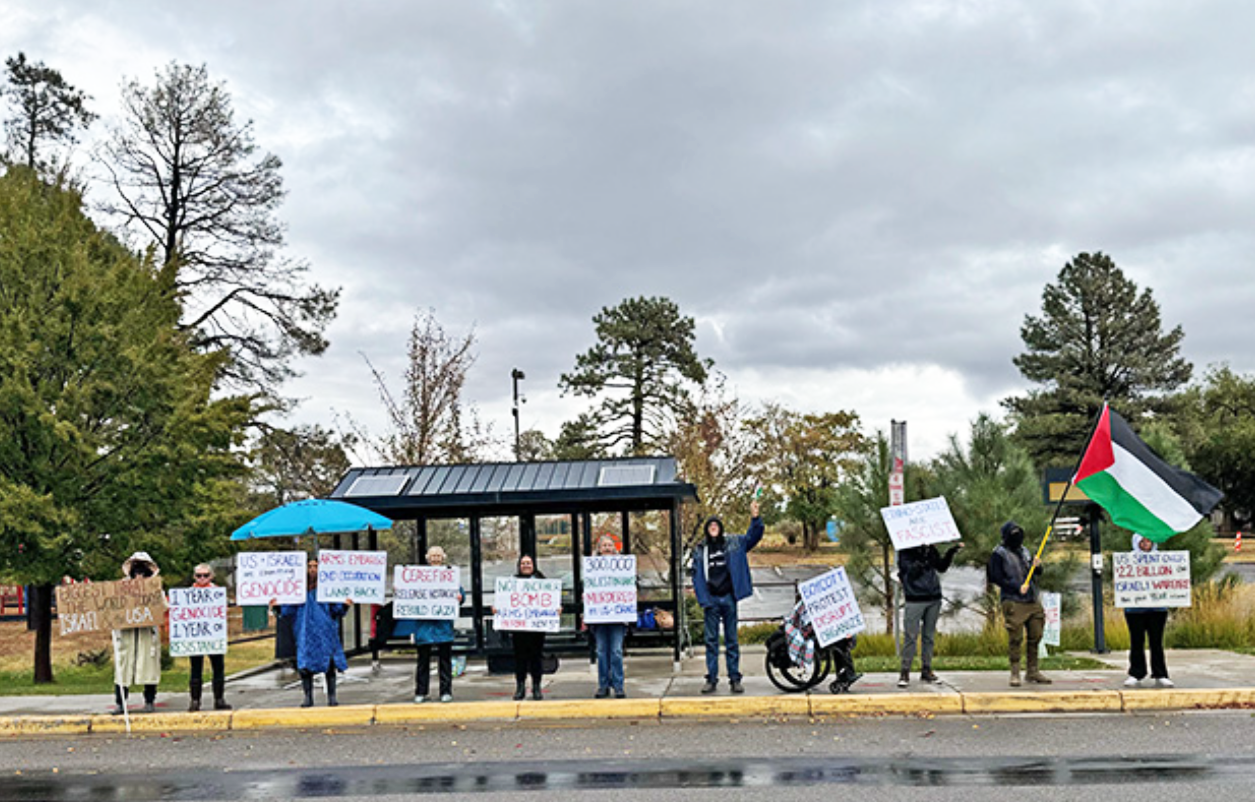 Protestors for Palestine brave the rain to get their message out to the public recently along Trinity Drive and Central Avenue. Courtesy photo Courtesy photo
By KIRSTEN LASKEY
Los Alamos Daily Post
kirsten@ladailypost.com
They have been out in force for more than a year; working to do their part to nudge the world into a better place. In sunshine, snow or rain, every Saturday protestors in Los Alamos have held up signs and stood along Central Avenue and Trinity Drive demanding a ceasefire in Palestine.
What brought these individuals to protest and what fuels them to continue differs with each one, but a few shared their reasons with the Los Alamos Daily Post.
Kelly Myers:
When Israel responded to Palestinian resistance on Oct. 7, 2023, with overwhelming and disproportionate force, I felt compelled to act. I feared this escalation might again pull the U.S. into a costly, devastating proxy war. Reflecting on Afghanistan and Iraq, where nearly a million lives were lost, mostly civilians, and almost $6 trillion was spent, I was reminded of how quickly justifications for violence can become normalized on a massive scale. As I learned more about Palestinian history, I saw that this was not a new struggle; it stretches back to 1948, when 80% of the Palestinian population was forcibly displaced during the Nakba. This ongoing legacy of apartheid and racial segregation in Palestine by Israel echoes struggles for justice and liberation here in the U.S., particularly for Black Americans, as both groups have endured persecution under expansionist colonial systems.
Now, with Donald Trump returning to office, there is an opportunity for all of us, especially those of us who are white and upper class, to reflect on what this means for our role in society. This isn’t about what might happen in the future; fascism isn’t something looming — it’s already affecting us, shaped by a long history of settler-colonial policies and practices. Recognizing this can be uncomfortable, but it also offers a chance for meaningful transformation. By shifting away from elite, white-centered perspectives, we can come together to create a future that is not bound by the injustices of the past. This work begins within each of us, but it can grow into building communities that uplift and support every voice, especially those we may not have fully heard or understood. I believe that by reimagining solidarity and taking steps to educate ourselves, listening to indigenous voices and leaders, and supporting others, we have the chance to resist the normalization of violence and oppression. These protests stand in solidarity not only with Palestinians, but also with all oppressed groups, both within the United States and around the world. So, it does not look like there will be an end in sight for these weekly protests.
Adelaide Jacobson:
Why I protest each Saturday for Palestinian human rights:
Twenty-five or 30 years ago I read an article in the IEEE Spectrum magazine about the deteriorated water/electrical infrastructure in Gaza and how the Palestinian engineers were working to improve conditions, given the Israeli restrictions of material into Gaza. That was the first time I was aware of the humanitarian plight of the Palestinian people.
Some years after that I heard Israeli author Gideon Levy speak and I read his book, ‘The Punishment of Gaza’. About that same time, I became acquainted with the American Friends Service Committee.
‘AFSC first began working in Palestine and Israel in 1948, when the United Nations invited the organization to set up the refugee camp system for Palestinians in Gaza. We also provided humanitarian relief to people displaced inside the new Israeli state.’ –Quaker Action Fall 2024
I have always been interested in justice. I support groups that advocate for human rights whether domestically or internationally. The Universal Declaration of Human Rights was adopted by the United Nations in December 1948, the same year the state of Israel declared its existence. If one reads information from B’Tselem, Jewish Voice for Peace, Human Rights Watch, Amnesty International, Peace Now, and writings or interviews of Ilan Pappe, Norman Finkelstein, Thomas Suarez, President Jimmy Carter and others, Palestinian human rights since the creation of Israel have been imperiled.
I have been sickened by indiscriminate killing of women, children, patients in hospitals, journalists and the total destruction of civil infrastructure, schools, universities, libraries, hospitals and residential buildings. This is why I go out on Saturdays.
A quote attributed to Dietrich Bonhoeffer says, ‘Not to speak is to speak. Not to act is to act’ or as the United States Memorial Holocaust Museum literature states, ‘Never again begins with you.’ If I inspire just one other person to act on behalf of human rights for ALL people regardless of nationality, religion, race, gender identity, it is worth my time.
Jody Benson:
I’m not against Israel. I was born 11 days before the state of Israel and grew up a Zionist inflamed by the heroism and resilience of the new nation. We kids were not shielded from knowing about the Nazi Holocaust or from seeing pictures of hollow-eyed survivors or of piles of emaciated bodies in mass graves. In school, the Holocaust was a fact of history, not some fake news. We learned about it so we would not repeat it. Never Again. Never Again means Never Again for Anybody. The indiscriminate bombing of Gaza, its schools, churches, refugee camps, hospitals, apartment buildings, playgrounds with children, grandparents, moms, dads, cousins, teachers, doctors, people standing in line for water—all in the name of revenge against the Hamas terrorists is not Never Again. When its Arab neighbors attacked Israel, I protested them. I’m not against Israel, I’m against genocide. Never Again means Never Again for Anybody.
Emma Abata:
With a background in Black Liberation organizing, I learned from leaders like Angela Davis, Nelson Mandela, Adrienne Maree Brown and Assata Shakur about the illegal Israeli occupation and apartheid system imposed on Palestinians. The parallels between their struggle and the oppressive systems faced by Black and Indigenous people in the U.S. are clear to anyone who has studied these histories. When the Al Aqsa Flood operation happened on Oct. 7, where Palestinian resistance fighters broke through the illegal blockade of the Gaza Strip after 16 years of suffering in an open-air prison to leverage a hostage exchange, I immediately anticipated Israel’s violent response. Palestinians have been held hostage in Israeli military prisons and endured torture, starvation, beatings, and systemic rape for decades, and I knew this act of resistance would be met with brutal and disproportionate attacks, as well as racist war propaganda attempting to justify ethnic cleansing and genocide.
I, along with millions of Palestinian, Muslim, Arab, Black, Indigenous and Anit-Zionist Jewish advocates globally who understand the colonial violence Palestinians have resisted for over 75 years, knew action was needed. I reached out to local organizations to see what was being organized—but there was nothing in Los Alamos supporting Palestinian human rights. So, I invited friends and family to join me in taking to the streets to fill that gap and stand for Free Palestine in our own community.
Starr Caswell:
My involvement in protesting began as a favor to a friend! And quickly turned into a feeling I could not ignore to DO “something” and to learn the truth behind the United States involvement with Israel in the genocide of Gaza.
The protestors’ intentions haven’t been universally embraced but several said with the conflict worsening and spreading to other countries, the public’s attitude seems to have shifted, at least slightly.
Kelly Myers:
The first few months were difficult. My daughter and I were often met with hostility – angry shouting, lots of middle fingers, insults and being spit on. Some accused us of anti-Semitism or being ‘Jew haters’. Public support was minimal, and no local, state, or national news sources were covering the Palestinian perspective. Yet, in recent months, I have noticed a subtle shift. We’ve had small gestures of support, like honks or waves, especially when other groups joined our protest. Though we’re not seeing huge crowds or full-fledged support, I sense that more people are quietly acknowledging what is really happening.
Adelaide Jacobson:
As the killing and destruction has continued in Gaza and begun in Lebanon, I have seen increased support for our protest.
Jody Benson:
I think the public is becoming more supportive of a ceasefire that America can begin today by ending supplying weapons to Israel. At first, the majority of people supported the retribution against the terrorist attack. Now? It’s the same dwindling support for Israel’s revenge as it was for America’s war on Iraq. More and more people understand that we can’t defeat terrorism as we could a nation; terrorism is an ideology. You can’t defeat it by killing people—in fact, the more innocents we kill, the more terrorists we create. Like our invasions of Iraq and Afghanistan. Killing families doesn’t make the killers safer. It only serves to enlist more people to become terrorists to revenge all those families’ deaths. It’s true: “An eye for an eye makes everybody blind.
Emma Abata:
At first, we encountered everything from silence to hostility, with people openly expressing aggression, insults, and even spitting at us. Despite this, we continued to show up. Over time, we began receiving quiet gestures of support and gratitude. Eventually, that support grew more visible, with people honking, waving, and joining us in solidarity. Now, most weeks, we experience more support than hostility — a significant change from when we first began.
Starr Caswell:
There will always be ‘haters’ and ignorance is rampant! But there are also people who honk and react positively! There has been more overall involvement the longer the genocide continues. (Not necessarily in Los Alamos, but certainly in other parts of the U.S.)
The public’s response may have changed but the protestors’ resolve to keep holding signs and keep spreading the message hasn’t wavered.
Kelly Myers:
This protest has lasted over a year because the violence has not stopped, instead it has spread. Palestinians are enduring unimaginable horrors: starvation, no clean water, medical procedures like amputations and cesareans without anesthesia, disease, and millions have been displaced 4 or 5 times. 21,000 Palestinian children have been killed (averaging five children killed per day!) (Source: Save The Children, Sept. 17, 2024). One hundred thirty-four Palestinian journalists confirmed killed with 130 additional cases of potential killings, arrests, and injuries! (Source: Committee to Protect Journalists (CPJ), Nov. 1, 2024.) Four hundred ninety Palestinian healthcare workers have been killed! (Source: Fick, Aboulenein, Salem, Reuters, June 2024.)
These realities fuel my persistence. As we continue, we have also formed connections with allies from Taos to Albuquerque, which has helped us feel more supported.
Adelaide Jacobson:
The longevity of the protest is a direct reflection of the failure of the Netanyahu government to enter into a ceasefire that would have ensured the Israeli hostages would be exchanged alive.
Jody Benson:
Longevity? Of course, we wouldn’t be here except that the war hasn’t stopped. We Americans keep supplying weapons to Israel. Despite the multiple peace deals that include the release of the hostages, the war continues.
Emma Abata:
I think the longevity of our protest stems from several factors. First and foremost, I want to recognize that our actions are part of a legacy led by Palestinians, Black liberation leaders and Anti-Zionist Jews who have opposed the Zionist colonial project called Israel since its inception following the Nakba of 1948. Our year of protest is a continuation of a movement with decades-long resilience and resistance.
Additionally, as a millennial, I grew up learning about the Holocaust, slavery, and the Native American genocide, and was constantly asked, ‘What would you have done?’ My answer has always been that I would stand with the oppressed, even if it meant personal or social risk. Fannie Lou Hamer’s words, “Nobody’s free until everybody’s free” resonates deeply with me, and I felt it was essential to be about it, not just talk about it. Watching the live-streamed atrocities in Palestine every day compelled me to do more than grieve from a distance—I felt a moral responsibility to act.
Following Palestinian journalists like Motaz Azaiza and Bisan Owda, who document the daily horrors in Gaza that mainstream media often omits, has only deepened that sense of responsibility. Witnessing the violent realities—seeing children, grandparents, doctors and journalists killed, families torn apart—filled me with grief and even nightmares. As a mother, it’s unbearable to see children, so much like my own, ripped to shreds by U.S.-made bombs, starved and orphaned. Hearing doctors describe performing amputations and C-sections without anesthesia defies comprehension. Protesting each week became a place to channel this pain and rage, to find healing through action, and to stand with others equally horrified. Witnessing genocide firsthand, even through a screen, changed me and strengthened my commitment to this protest.
Starr Caswell:
Longevity in the Los Alamos protest = Kelly Myers and Emma Abata. Committed, knowledgeable leaders and activists.
The unanimous opinion seems to be if at least one person is impacted by their efforts, then this more-than-year-long protest will be a success.
Kelly Myers:
I know our message will not change most minds here – openly. This is a town deeply concerned with image, reputation, and comfort (I have lived here for 60 years – I am a part of this), and our government’s shift to the right has made it risky to speak out. Criticizing Israel can lead to accusations of anti-Semitism. Just look at university crackdowns on students protesting for Palestine! Chuck Schumer, the Senate Majority Leader, is currently working on legislation called the Antisemitism Awareness Act which will identify anti-Zionism or criticism of Israel as anti-Semitic. This Bill infringes on free speech and discourages legitimate discourse on Israel’s policies. For me, the protest’s goal is to make people question what their taxes are funding ($17.9 Billion or 73% of Israel’s genocide) (Source: Knickmeyer, Ellen, Time Magazine, October 2024.) and to question the media they are consuming – this is about wanting to find out about these issues. If even one person decides to speak up, write or call Congress, or join a boycott, then these Saturdays of protesting will have the effect intended.
Adelaide Jacobson:
Our presence is a reminder to the community of the death and destruction perpetrated by the Israeli government with the support of our U.S. government. According to the Council on Foreign Relations, ‘Israel has been the largest recipient of U.S. Foreign Aid since its founding, receiving about $310 billion (adjusted for inflation) in total economic and military assistance.’
Jody Benson:
Maybe the protest is making an impact despite the fact that many just ignore us. But even though international news hourly lists the numbers of people killed by the hour in the endless slaughter that is supposed to … what … get the hostages back?… despite all the news, I’m wondering if the war is just background noise. Except with the faithful. Some groups of all faiths are paying attention and asking how this invasion supports the Peace of God.
Emma Abata:
Yes, I believe it’s making a local impact. For a full year, our community has been reminded weekly that U.S. tax dollars support a genocide in Occupied Palestine. The fact that, a year later, we’re still having this conversation is significant; it breaks through decades of silence around the Palestinian struggle. Our goal is to confront this silence, encourage people to call Congress to demand an arms embargo and an end to the genocide and occupation, and to inspire others to look beyond Zionist narratives. We want people to understand the reality in Palestine and recognize how it’s connected to our own struggles—and privileges—here in the United States.
Starr Caswell:
If our protesting makes even one person want to know the truth about the genocide of Gaza and or makes a person search their heart for what they believe, then we have achieved an important part of our ‘goal!’
Things don’t stay static; so even though the local protest regularly occurs, it has evolved during the course of the year.
Kelly Myers:
Over time, our connections have expanded across northern New Mexico. However, as the violence has spread beyond Palestine to include Lebanon, Syria, Yemen, Iraq and Iran, our mission as grown, too. Now we stand not only for Palestine, but against broader oppression which has only strengthened our commitment.
Adelaide Jacobson:
I would say that the participants are becoming more connected with others in the local community and in other locations within the state.
Emma Abata:
At first, our goal was to raise awareness about the genocide in Palestine and urge people to demand a permanent ceasefire. We wanted to encourage critical thinking about the racist Zionist narratives around Palestinian resistance and help people learn the unbiased history of Israel’s occupation. Over time, our objectives grew in response to the calls coming from Palestinians themselves, such as joining the Uncommitted Movement, demanding an arms embargo, and boycotting companies on the Boycott, Divest, Sanctions (BDS) list. We’ve also connected with other organizers across northern New Mexico like Jewish Voices for Peace Albuquerque and the UNM Palestinian Solidarity Camp folks, to build a network and community committed to not just Free Palestine but movements like Free Congo, Free Sudan, Land Back, Black Lives Matter and other liberation struggles worldwide.
Starr Caswell:
Perhaps our greatest evolution is the formation of a like-minded community. And the support one feels from said community.
While the protest has created connections and community, it also has effected the protestors themselves.
Kelly Myers:
Protesting is empowering! It is visible proof of my stance against war and genocide and my commitment to justice. But it’s also only one way to show solidarity with Palestine and other peoples around the world experiencing the violent impact of western, colonial imperialism – Sudan, Democratic Republic of Congo, Haiti, Cuba and more. I invite anyone interested to join us on Saturdays, from 11 a.m. to 1 p.m. We meet on the south side of the pond on Trinity Drive, then move to the north side on Central Avenue. I welcome anyone who wants to learn, especially those who may not know how to access information beyond Western media. Protesting is educational! We have had young people approach us with genuine questions, and we try to provide facts. Our small group of protesters share information about the genocide, and we allow space for each other to process all the violence. Lastly, true liberation begins within us. Part of this journey is honestly examining my own privilege and class and recognizing how I have directly benefited in this life, often at the expense of others, only because I am White and in the upper class. Protest allows me to do this work outwardly while also challenging myself inwardly, which has been one of the most meaningful aspects of this experience. I want to acknowledge the teachers who have shaped my current worldview, particularly my support for pro-Palestinian and pro-Indigenous perspectives: Dr. Rocio Rosales Meza, Toi Smith and Sandra Kim.
Adelaide Jacobson:
It has increased my appreciation for individuals who subject themselves to public disapproval and approval in support of values and beliefs.
Jody Benson:
We do what we can. To stand for peace is what my soul wants of me.
Emma Abata:
Participating in this protest has strengthened my courage to speak out and engage politically, even in a small town. It has deepened my commitment to a daily practice of working toward liberation and decolonization through action. I’ve been inspired by the people who have joined this protest for their own reasons, as we protest side by side, sometimes with different perspectives but always united by one belief: that nothing—absolutely nothing—justifies genocide.
Starr Caswell:
For me, it’s about the children. The innocent children. I would like to think that if it were “our children” caught up in the horror of genocide that there would be a woman across the miles holding those children up in the light, for all the world to see. Our intention and our empathy matter!