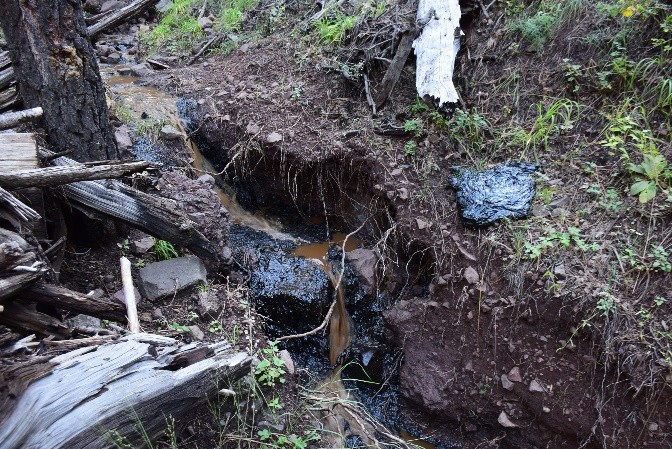
 Portions of Jaybird Canyon Oct. 4. Courtesy/NMED
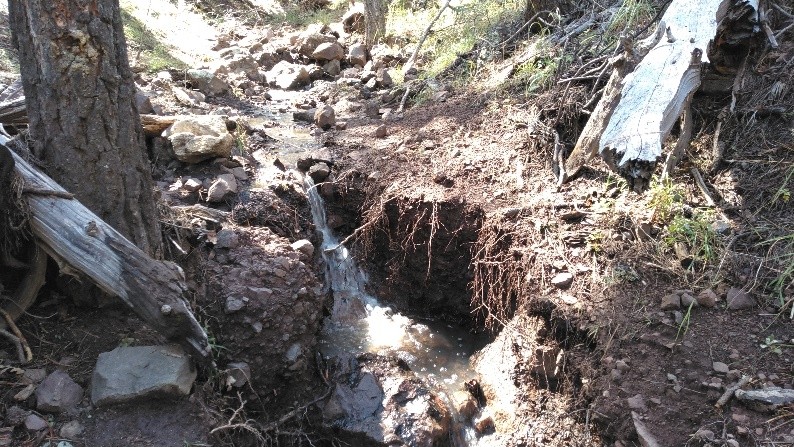 Portions of Jaybird Canyon Oct. 20. Courtesy/NMED
NMED News:
SILVER CITY — The New Mexico Environment Department (NMED) has issued a Notice of Noncompliance (NONC) to R. Marley, LLC, for their failure to notify the department of a recent spill involving emulsified asphalt that discharged refuse into a watercourse.
When spills of this nature take place, New Mexico law requires the party responsible to clean it up. NMED has jurisdiction to oversee and enforce proper clean-up and is closely monitoring clean-up of the site. Because the spill occurred in the Gila National Forest, NMED is in regular communication with the U.S. Forest Service.
NMED also is coordinating with the U.S. Environmental Protection Agency (USEPA) consistent with the department’s role as the lead authority over the spill. NMED staff are on-site to directly observe clean-up activities and meet with the responsible party every day. Contract laborers hired by R. Marley, LLC are cleaning the site every day, as weather and stream conditions allow.
The use of shovels and sifters to screen and remove material that is partially or fully buried in sediments has increased the volume of material collected, with crews removing 29 bags of emulsion from Jaybird Canyon Thursday, Oct. 20. Similar results were expected Saturday, Oct. 22. In addition, the best management practices (BMPs) that are deployed on-site to prevent further transport of material downstream are evaluated daily by the work crew, NMED, and USFS. The BMPs are adjusted as needed to ensure they are functioning properly and capturing mobile material being transported by the stream by natural flows. R. Marley, LLC will continue to deploy workers to the site until NMED deems the clean-up and restoration complete.
R. Marley, LLC submitted a report Oct. 11 to NMED describing clean-up activities the company had taken and/or will be taking relative to the spill. NMED is currently reviewing the report and evaluating its sufficiency related to the ongoing clean-up. If the report is not satisfactory, NMED will identify any shortcomings and deficiencies, including any requirements necessary to protect water quality. NMED is committed to conducting independent confirmation sampling to evaluate whether removal of the material is complete.
Should NMED determine that the clean-up is not being conducted in an effective or timely manner, NMED has the right to hire independent contractors and/or request USEPA assistance to conduct the clean-up and bill the responsible party for the costs. Based on daily site visits, NMED and USEPA agree that a new team would use similar methods of clean-up as those underway by R. Marley, LLC, and there is no environmental advantage to deploying agency contractors at this time.
In addition to monitoring clean-up activities and reviewing the plan for clean-up, Oct. 19, 2022, NMED issued a NONC to R. Marley, LLC for failing to notify the department that approximately 2,000 gallons of asphalt emulsion was released into Jaybird Canyon on Monday, Sept. 26, when a truck owned by R. Marley, LLC overturned in the Gila National Forest. NMED’s NONC also covers noncompliance related to disposal of refuse in a watercourse.
Anytime contaminants are unexpectedly released into the environment, the party responsible must report it to the department immediately, and no later than twenty-four hours after the spill. NMED is holding R. Marley, LLC accountable for their failure to report that caused an eight-day delay in official clean-up response. NMED anticipates additional compliance and enforcement measures associated with this spill in the future. Violations of State water quality standards can lead to penalties under the New Mexico Water Quality Act. Section 74-6-10 NMSA 1978.
While clean-up efforts in the spill area were underway, staff at NMED’s Hazardous Waste Bureau (HWB) investigated the specific composition of the spilled material to determine whether it presents a threat to public health. After reviewing documentation from the material’s manufacturer and scientific literature related to the materials, HWB determined that such material is not a hazard to public health. This material is used widely in road projects throughout the country, including on paved roads in the Gila National Forest. By design, the material is limited in mobility once cooled and sticky so that it adheres to road surfaces and the roads remain safe. Because it is sticky, removal will also remove soils, rocks, leaves, and other debris where the material has attached. The Safety Data Sheet (SDS) for this material references hydrochloric acid at less than 1%, which is not at a high enough concentration to lower the pH to levels that would be hazardous and is especially true where there are neutral or alkaline soils like those found in New Mexico.
Later this week, NMED’s Surface Water Quality Bureau (SWQB) will sample the material remaining inside the tanker and analyze it for a mixture of petroleum chemicals found in crude oil, including polycyclic aromatic hydrocarbons (PAHs), and metals that may be present in asphalt (i.e., nickel, iron, vanadium). Results will be used to identify the composition of material that entered the stream and help target water quality analysis post clean-up to confirm or refute that no further actions are required.
Since the spill, NMED Incident Response personnel are engaging with both the New Mexico Department of Transportation and the New Mexico Department of Public Safety to update their standard operating procedures regarding spills on the roadways of New Mexico to prevent unreported spills in the future. The state’s Hazardous Material Emergency Response Plan is scheduled for an update by the Hazardous Materials Safety Board in the coming months, which presents another opportunity for the state to revisit plans and procedures to support prompt reporting and spill response for future incidents.