Environment Secretary James Kenney
NMED News:
SANTA FE — The New Mexico Environment Department (NMED) is providing guidance to water systems following the U.S. Environmental Protection Agency’s (EPA) March 14, 2023 announcement of new proposed drinking water standards for Per- and Polyfluoroalkyl Substances (PFAS).
PFAS are a group of man-made chemicals that have been used for a large number of purposes since the 1950s. PFAS have been used in food packaging, cleaning products, stain resistant carpet treatments, nonstick cookware and firefighting foam, among other products. Due to the widespread use of PFAS and the fact that they bioaccumulate, they are found in the bodies of people and animals all over the world, as well as ground and surface water.
Once EPA finalizes their guidelines, public water systems in New Mexico need to ensure that PFOAs and PFOS are at or below 4.0 parts per trillion. In addition, EPA is also proposing health-based, non-enforceable Maximum Contaminant Level Goals. The new proposed PFAS rules would also require public water systems to regularly monitor for PFOA, PFOS, PFNA, PFHxS, PFBS, and HFPO-DA (GenX) compounds, notify the public of the levels of these PFAS found in their regulatory samples, and reduce the levels of these PFAS in drinking water if they exceed the proposed regulatory standards.
EPA issued interim drinking water health advisory guidelines June 15, 2022. Those guidelines provided recommended thresholds for PFAS in public drinking water systems. The EPA’s recent announcement will make PFAS thresholds a requirement once fully adopted, a process which is expected to take several years.
“I applaud EPA’s action in proposing science-based standards to protect our drinking water from these toxic chemicals,” Environment Secretary James Kenney said. “This is an important step forward in addressing the harm that PFAS poses to the people the New Mexico.”
“New Mexico water systems have a unique opportunity to utilize funds from the Bipartisan Infrastructure Law to address PFAS contamination in their systems,” Water Protection Division Director John Rhoderick said. “I urge every system to take advantage of available funding now to be ready when these standards take effect in the coming years.”
Water systems seeking funding to address PFAS should contact the Drinking Water Bureau.
President Biden signed the Bipartisan Infrastructure Law (BIL) Nov. 15, 2021. As part of this historic law, the State of New Mexico will receive significant increases to its Drinking Water State Revolving Loan (DWSRF) programs over the next five years. These historic investments represent a unique opportunity to rebuild and replace New Mexico’s aging water and wastewater infrastructure and foster more resilient communities.
EPA allows DWSRF funding to be used in combination with additional funding sources to finance water infrastructure projects, as well as to fund projects that will address emerging contaminants, such as PFAS.
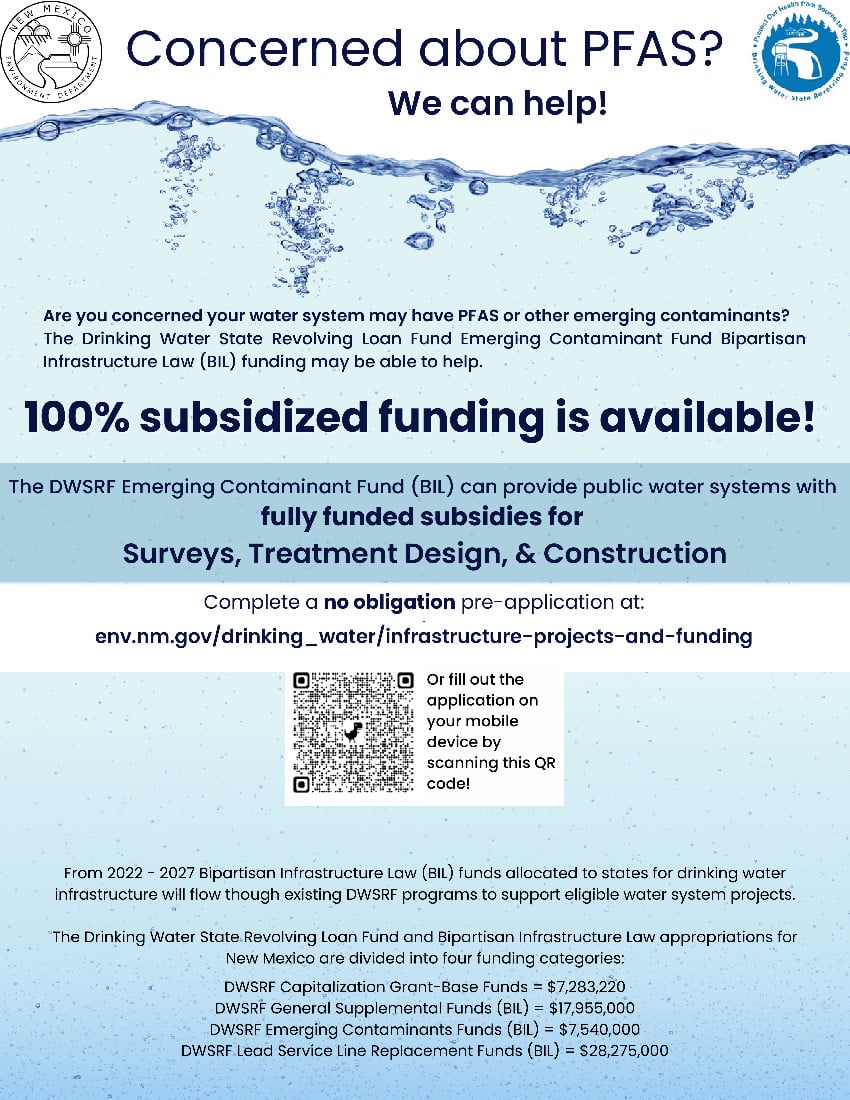
New Mexico’s current (FY23) allotment of BIL funding includes the following:
- DWSRF Capitalization Grant Base Funds – $7,283,200
- DWSRF General Supplemental Funds (BIL) – $17,955,000
- DWSRF Emerging Contaminants (PFAS) –$7,540,000
Feb. 13, 2023, EPA Administrator Michael S. Regan announced the availability of $2 billion to address emerging contaminants, like PFAS, in drinking water across the country. This investment, which is allocated to states and territories, will be made available to communities as grants through EPA’s Emerging Contaminants in Small or Disadvantaged Communities (EC-SDC) Grant Program and will promote access to safe and clean water in small, rural, and disadvantaged communities while supporting local economies. New Mexico was allocated $18.9M for this program for FY23.
The health effects of these emerging contaminants are still being studied, but research indicates that some PFAS may affect reproductive health, increase the risk of some cancers, affect childhood development, increase cholesterol levels, affect the immune system, and interfere with the body’s hormones.
PFAS contamination in New Mexico is one of the NMED’s top priorities, as is the protection of human health and the environment. NMED commissioned a PFAS sampling study for PFAS from mid-2020 until summer of 2022. The results of that study found here. Additional information about PFAS in New Mexico is available here.
 Courtesy/NMED