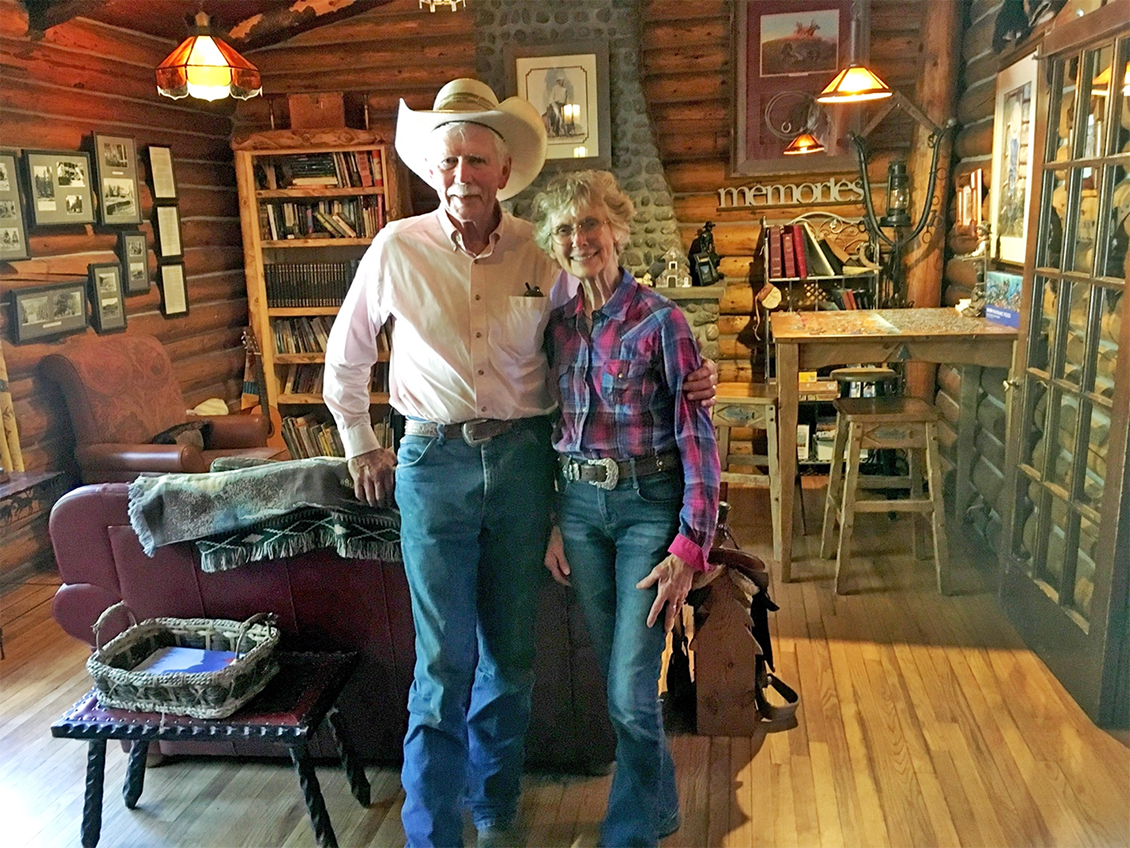
 Owners Linda and Doug Van Berkum in 2022 in a side room of the Rainbow Trout Ranch – Fuller Lodge’s older cousin. Photo by G. Strickfaden
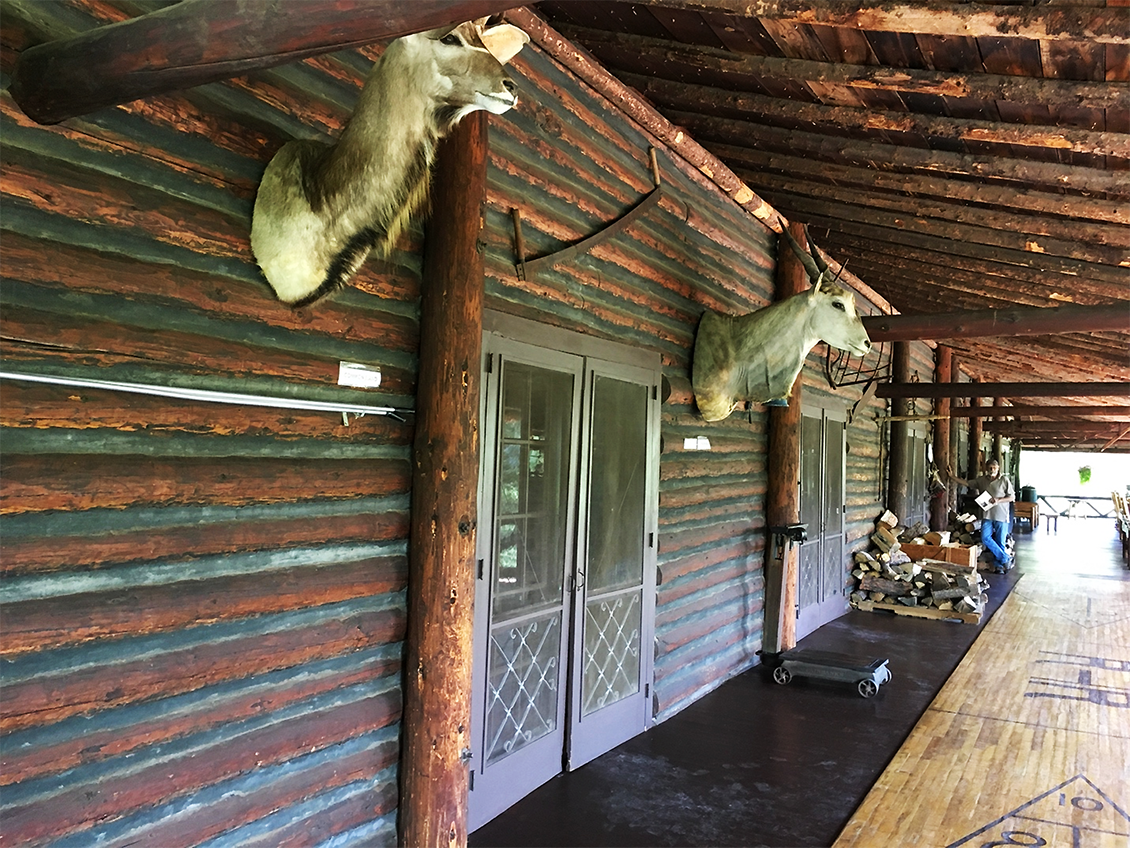 Georgia Strickfaden standing on the south porch of Rainbow Trout Ranch. Courtesy photo
By GERRY STRICKFADEN
Los Alamos
In their essential book about Los Alamos Ranch School buildings, Of Logs and Stone, authors Heather McClenahan and Craig Martin described the selection of a contractor to build the Edward P. Fuller Lodge. As planning and log harvesting proceeded in 1927, Ranch School Director A.J. Connell and architect John Gaw Meem got a letter from George Teats of Rocky Ford, Colo., expressing his interest in the log lodge project and stating that he was currently finishing a recreation hall for the Conejos Recreation Association. Meem presumably went to Colorado to inspect Teats’ work, approved of it, and thus George Teats Construction Company built Fuller Lodge in 1928.
This story intrigued me. Where was this other lodge? What did it look like? Was there any chance it was still standing? Internet searches for the Conejos Recreation Association produced no information, as did inquiries to historical societies in southern Colorado where the Conejos Country is located. On a scouting expedition, my wife, Georgia, and I drove down Forest Service Road (FSR) 250 and Colorado Hwy 17 to follow the Conejos River from Platoro to Antonito. We stopped at a couple of large log lodges along the way, but in each case there was information that indicated they were not the structure we sought.
I adopted a practice of making a couple of internet searches per year in case any new information had been posted. After considerable time, I got a hit, an odd one but ultimately useful. In the 1928 edition of the handbook of an American electric power generation association, it was noted that the Conejos Recreation Association was installing a 40 hp hydropower generator on La Manga Creek at a cost of $15,000. La Manga Creek tumbles steeply from the mountains near Cumbres Pass into the Conejos Valley to join Elk Creek. The combined flow quickly enters the Conejos River about 0.6 miles west of the intersection of FSR 250 and Colorado Hwy 17.
This discovery called for a session of squinting at Google Earth. It appeared that there was a single substantial building in the vicinity. It is approximately 1.7 miles west of FSR 250 and the CO 17 junction. Sometime later, Georgia and I drove to Colorado to look from eye level. Peering steeply up hill to the north of FSR 250 confirmed that there were trees in the way, but yes, a big building was up there. We learned three other things. The name of the place is The Rainbow Trout Ranch, and second, it’s closed up tight in the off season. Third, whoever deals with off-season email from the website link is not interested in corresponding about history. Satellite imagery also showed that only the section of La Manga Creek near its confluence with Elk Creek would have been accessible enough to install a generator on its bank.
Finally, Georgia and I made a visit to The Rainbow Trout Ranch when it was open. Our timing was fortuitous, as owners Linda and Doug Van Berkum were present and available to talk. They were justly proud of their large log lodge and had prepared a history of the building, although they had no inkling that during construction it served as a sample leading to more work in New Mexico. It was built after 1925, when the original lodge burned down, so 1927 is a reasonable estimate and consistent with Of Logs and Stone. There are construction photos posted on the wall, but there may be some confusion between the original build and the post-fire rebuild. The Van Berkums say that the builder (Teats, we know now) described his crew as “Swedish farmers from Rocky Ford needing work after the harvest.” I wonder if he brought the same crew to the Pajarito Plateau? The written history confirms that there was indeed a hydroelectric generator on La Manga creek that the lodge used into the 1950s. Things were falling into place.
Originally operated as the Rainbow Trout Lodge by the Conejos Recreation Association (CRA), the “Lodge” was changed to “Ranch” in 1992, after the property had changed hands several times. The structure that George Teats built for the CRA was designed by an unknown architect who was instructed by W.B. Hamilton, chairman of the CRA, to make it like a Bavarian hunting lodge he had enjoyed in Europe. It seems substantially larger than Fuller Lodge, though I don’t have dimensions to compare. Notably, the peak of the pitched ceiling over the sitting and dining rooms is 40-plus feet above the floor, compared to, say, 25 feet in the Pajarito Room of Fuller Lodge. The logs are all horizontal and predominantly spruce.
Rainbow Trout Ranch is an active, popular vacation destination in season for customers from all over the world. There is a neighborhood of cabins near the lodge for housing dudes, since it is now a ranch. The lodge is surrounded and shaded by tall trees, making it difficult for me to get good photos. Others have tried, and there’s a group of shots at tripadvisor.com.
The circle is not complete. We failed to get to the spot where the hydroelectric generator was located. Google Earth shows a patch of what looks like weathered concrete next to La Manga Creek, just south of the Elk Creek campground. The bank of La Manga Creek at that point is very heavily overgrown, and we found it impassable. In addition, there are several fences suggesting private ownership of one or both banks. Perhaps more research and preparation will get us access in the future.
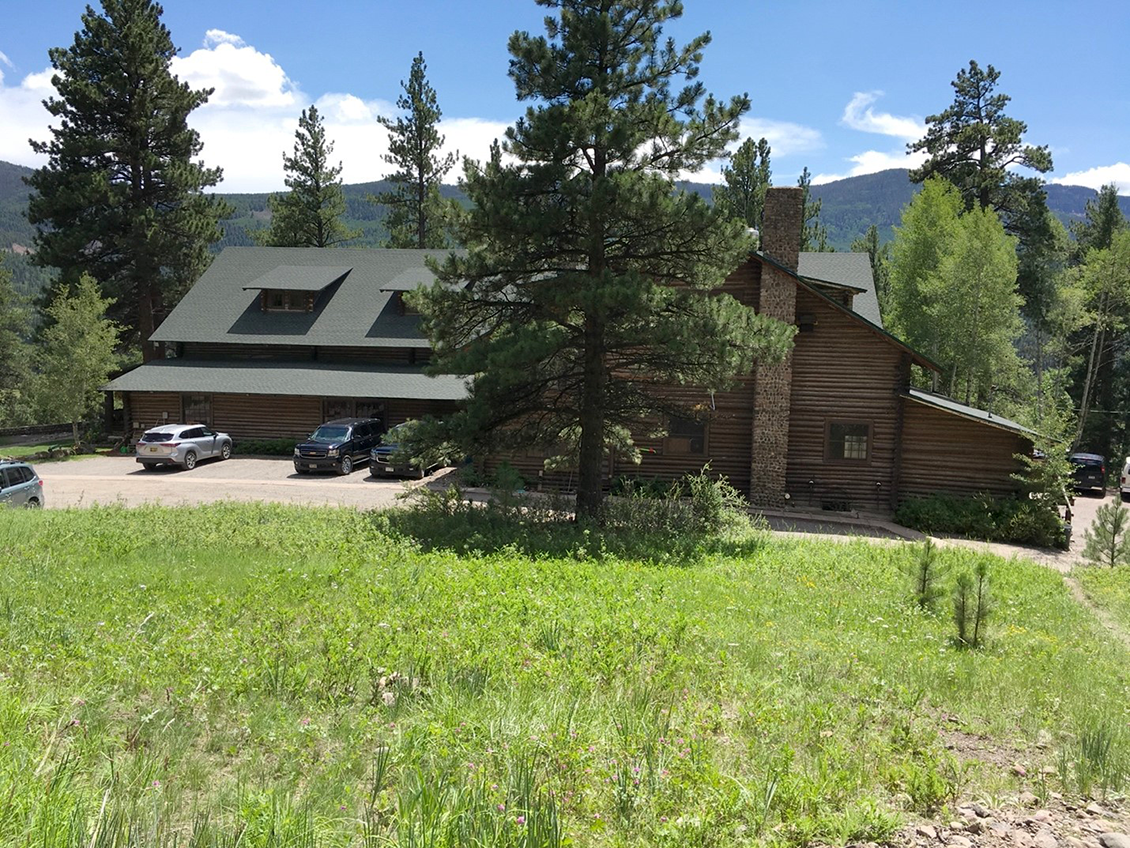 North entrance to the Rainbow Trout Ranch. Courtesy photo
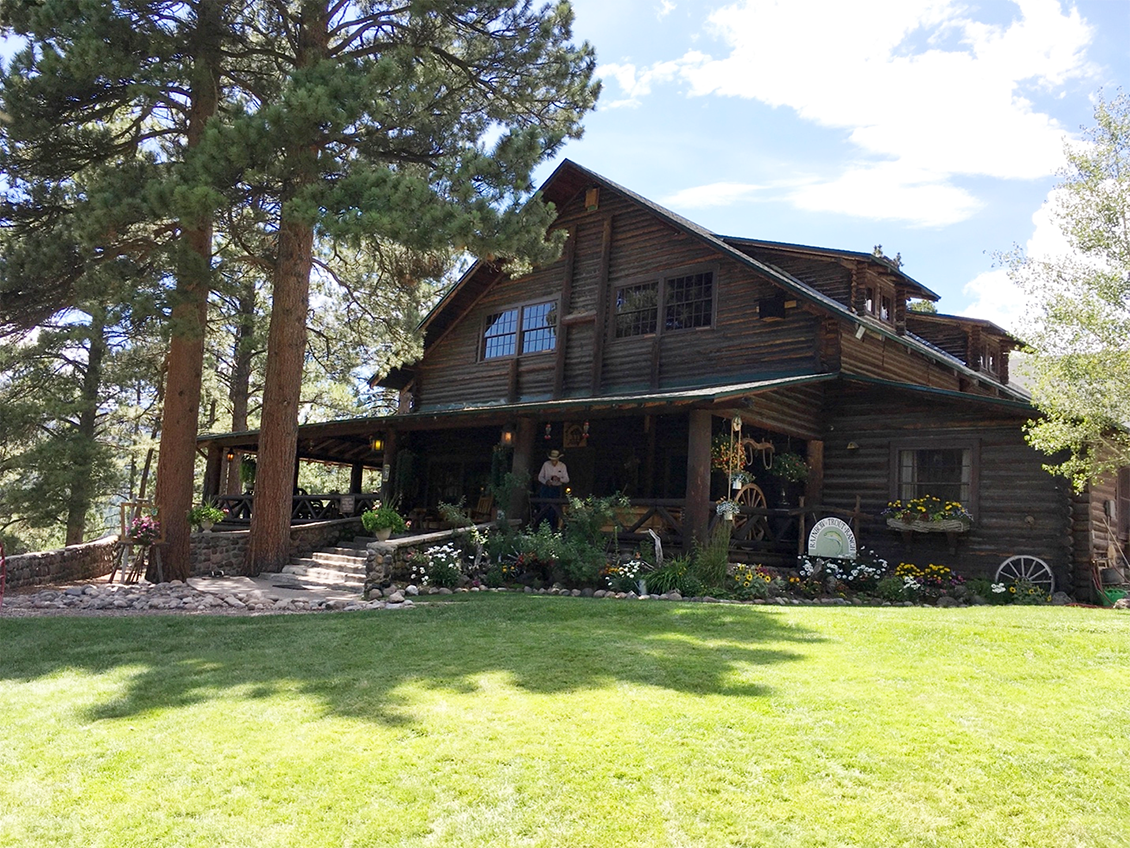 East entrance to the Rainbow Trout Ranch. Courtesy photo