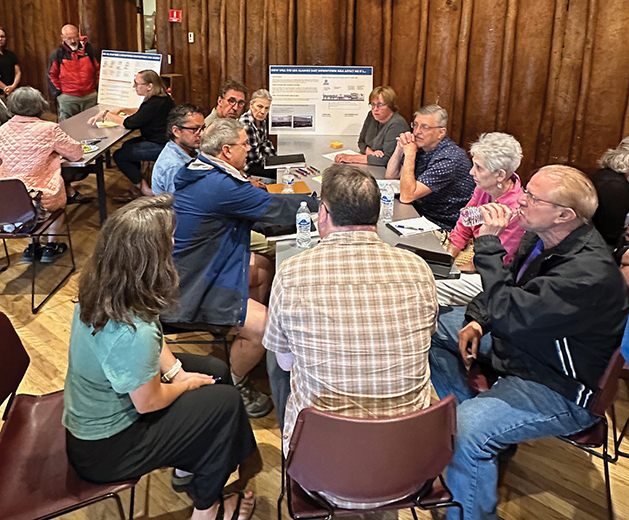
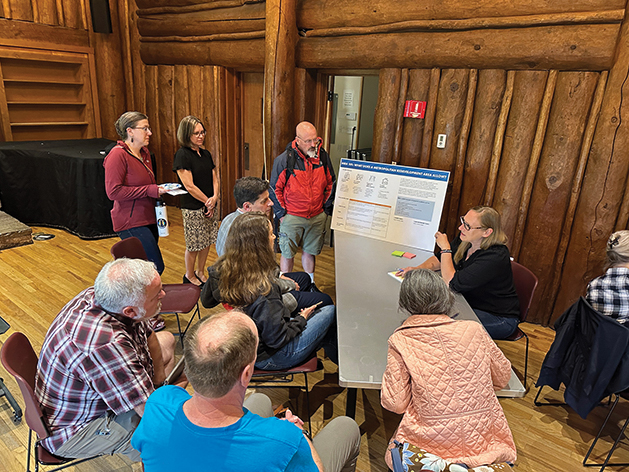
 A scene from the public meeting on the MRA plan for the eastern portion of downtown Los Alamos. Photo by Kirsten Laskey/ladailypost.com
By KIRSTEN LASKEY
Los Alamos Daily Post
kirsten@ladailypost.com
It was explained during a public meeting Thursday that a Metropolitan Redevelopment Area plan (MRA) is one tool in a toolbox to build vitality into an area.
But what is this tool and how does it work? Amy Bell from Groundworks Studio, the consultant assisting with developing a MRA plan for the eastern portion of downtown Los Alamos, discussed the MRA during the meeting, which was held at Fuller Lodge.
Groundworks Studio, she said, is providing its services free of charge. It is also partnering with Los Alamos County and MainStreet Los Alamos to create the plan.
MRA is part of a statewide code, which provides local municipalities with additional flexibility to support revitalization or redevelopment in areas that are experiencing obstacles to redevelopment, Bell said.
A MRA designation and plan “is going to outline eligible redevelopment policies, programs and projects to address declining conditions,” Bell said. “Once that MRA plan is adopted it allows for contribution of public resources to eligible … entities without violating the state’s anti-donation clause.”
Bell emphasized the plan is very important because “it identifies clear goals and strategies for what the community would like to see in that MRA and only projects that achieve those goals are going to be able to receive those public funds.”
In a sense, she said the public has potentially more control over the type of development in that area.
MRA projects vary in communities. It depends on what is needed and what the community would like to see. There are five main tools that a MRA enables, Bell said.
One is a MRA fund. She clarified that a MRA designation or plan doesn’t come with funding. It gives flexibility to the county to contribute funds to projects. So, it is recommended to create a fund for projects specifically for a MRA. A MRA board typically oversees the fund, Bell said. The board reviews the projects and recommends allocations of public funds to those projects for County Council consideration.
A third tool is tax increment financing. She said it captures an increment rise in property tax revenue. As vacant properties get developed, there is a rise in revenue and the increase in revenue is captured and reinvested in the area. This is not required and would probably need an ordinance, Bell said.
Public/private partnerships are a big tool, she said. These are cooperative agreements between local government and private sector entities. They enable implementation of projects that are too costly or have too much risk for either entity to do by itself.
Development incentives and direct contributions are another tool. She said these can be redevelopment tax abatements or storefront or infrastructure improvement grant programs. The final main tools are zoning code exceptions. According to Bell’s presentation, zoning code ordinances, amendments and exceptions will only be applied to projects and properties within the MRA. Any changes would go through the standard procedure for code updates.
Bell noted that properties in the MRA are not required to participate in any of these programs. She added that projects can also be catered to the community’s needs. Development agreements can be created and can include claw-backs so the developer would need to return any funds if they do not complete the project. There are things that a MRA doesn’t do, Bell said. It does not raise taxes, allow for imminent domain or damage property values.
Attendees at Thursday’s meeting weighed in on the MRA for Los Alamos. After breaking up into groups and rotating to several tables that focused on various aspects of the MRA, common questions included:
- How much communication has there been about the MRA? It was shared that all the businesses included in the MRA have been notified about it.
- Another asked if the businesses’ needs were being addressed. The response was that the hope is through the process of developing the plan that the ways to support businesses will be identified.
- It also was asked if all businesses could benefit from the projects and programs of the MRA, not just ones inside the boundary lines of the MRA. The answer was that the boundary lines can be expanded or other MRAs can be formed.
- How can it be ensured that the plan will be implemented was another question. It was stated that the MRA board would be useful to deciding the process of utilizing the MRA.
- An attendee commented that there needs to be administrative procedures for the MRA.
Thursday’s meeting will not be the only opportunity for the public to weigh in on the MRA plan. A survey can be taken at com/EDLAMRASurvey and more information on the MRA can be found at lacnm.com/mra
 A scene from the public meeting on the MRA plan for the eastern portion of downtown Los Alamos. Photo by Kirsten Laskey/ladailypost.com