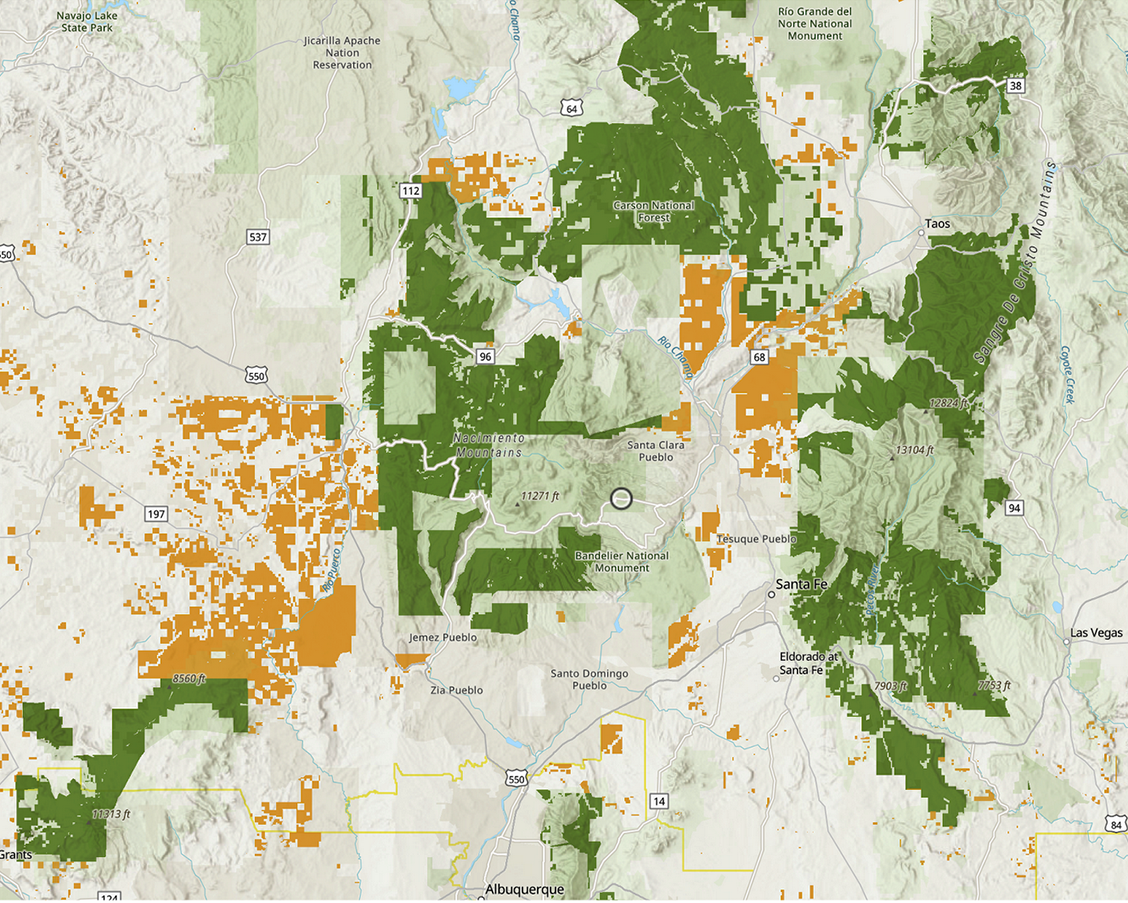
 This map, released by the Wilderness Society, shows eligible lands scattered across New Mexico at risk in a new bill proposing to reverse long-standing public land protections. Courtesy/The Wilderness Society
By MARLENE WILDEN
Los Alamos Daily Post
marlene@ladailypost.com
A sweeping new proposal backed by U.S. Senate Republicans has sparked widespread concern across New Mexico, as it would make up to 14 million acres of the state’s federally managed public lands eligible for sale. Conservation groups, tribal leaders, and outdoor recreation advocates are sounding alarms over the potential consequences for wildlife, water resources, cultural heritage, and local economies.
The bill, introduced by Utah Sen. Mike Lee, is part of a broader GOP-led budget reconciliation package and would reverse long-standing protections on hundreds of millions of acres across the U.S. West — with New Mexico poised to be among the most affected.
Critics say the legislation effectively green lights the privatization of land owned collectively by the American people.
“What we’re seeing is a deliberate, coordinated attack on the very idea of public lands—an effort to chip away at protections, silence public input, and open the door to privatization,” Mark Allison, executive director of New Mexico Wild, said. “These aren’t just empty spaces on a map. They’re where we hunt, hike, pray, and pass down traditions. To lose them is to lose part of who we are as New Mexicans. We will not stand by while our shared heritage is quietly bargained away behind closed doors.”
A Deeply Western Issue
In New Mexico, nearly one-third of the state is federal public land, administered by agencies like the U.S. Forest Service (USFS) and the Bureau of Land Management (BLM). These lands support a broad range of uses: cattle grazing, hiking, camping, hunting, renewable energy development, and critical wildlife corridors. For many rural communities, they are also an economic engine.
Outdoor recreation alone contributes an estimated $3.2 billion annually to New Mexico’s economy, according to the Outdoor Industry Association.
“Senator Mike Lee and his anti-public lands partners are setting a dangerous precedent for fast-tracking sales of public lands, and they’re threatening Americans’ access to our outstanding outdoor spaces,” Michael Carroll, director of the BLM Campaign at the Wilderness Society, said. “Shoving the sale of public lands back into the budget reconciliation bill, all to fund tax cuts for the wealthy, is a betrayal of future generations and folks on both sides of the aisle.”
Advocates and Lawmakers Push Back
 U.S. Sen. Martin Heinrich
The backlash to the bill has been swift and widespread. New Mexico’s all-Democratic congressional delegation has denounced the proposal.
In a June 18 statement, U.S. Sen. Martin Heinrich, D-N.M., ranking member of the U.S. Energy and Natural Resources Committee, wrote, “Our public lands hold our shared identity: they are where we gather, fish, hunt, and hike. These lands house our collective history, support jobs, and sustain our rural economies. From the hiking trails near the Sandia Crest to the biking trails of the Monumental Loop to the lands surrounding the Santuario de Chimayó, these places are the anvil on which our identities are forged.”
U.S. Sen. Ben Ray Luján, D-N.M., and Rep. Teresa Leger Fernández, D-N.M., who represents the 3rd District, have voiced similar concerns in recent town halls.
The Bigger Picture
While the bill’s sponsors argue that it is intended to reduce national debt and address the housing crisis, environmental advocates see it as part of a broader ideological effort to reduce the federal estate and transfer lands to private hands.
Maps released by the The Wilderness Society show eligible lands scattered across New Mexico, including parcels near Santa Fe, Albuquerque, and Taos — areas that draw thousands of visitors each year for their natural beauty and cultural history. In Los Alamos County, at-risk areas include St. Peter’s Dome Trail, Forest Service land and trails around Pajarito Ski Area, and hiking trails north and east of Los Alamos.
 Dist. 43 Rep. Christine Chandler
“The end game here is privatization,” said New Mexico state Rep. Christine Chandler, D-Los Alamos. “It’s part of a decades-long agenda to shrink public access, reduce environmental protections, and open up these lands to extraction and development.”
What’s Next?
The GOP proposal remains in committee, but advocates warn that it could be quickly pushed through as part of broader budget negotiations. A Senate reconciliation is a special legislative process that allows Congress to pass certain budget-related legislation with a simple majority (51 votes) in the Senate, bypassing the usual 60-vote supermajority needed to overcome a filibuster. This expedited process is designed to make it easier to enact changes to spending, revenue, and the debt limit.
The Senate is expected to vote on the larger budget reconciliation package before the July 4 recess.
Local and national conservation groups, including the Center for Biological Diversity and New Mexico Wild, and public lands supporters will protest Monday outside the Western Governors’ Association’s annual meeting. Governors from across the West, including New Mexico’s Michelle Lujan Grisham, will be discussing regional challenges such as water management, wildfire prevention, and land use. Interior Secretary Doug Burgum, a supporter of the legislation, is scheduled to deliver the keynote address.
Participants will gather at 3:30 p.m. Monday, June 23, at De Vargas Park (302 W. De Vargas St., Santa Fe, N.M. 87501) and march to the El Dorado Hotel (309 W. San Francisco St.).