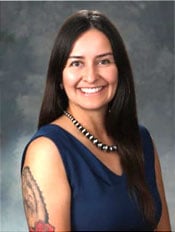
 Rep. Micaela Cadena
By MILAN SIMONICH
The Santa Fe New Mexican
Storefront loan companies that charge impoverished people annual interest rates as high as 175 percent aren’t out of business yet.
But they lost a crucial round Wednesday when the House Judiciary Committee voted 7-5 to cap interest and fees at 36 percent.
Acting at the behest of storefront lenders, the same committee last year rewrote a reform bill to allow 99 percent rates. That measure died, enabling the industry to continue charging its staggering 175 percent interest rate.
All seven supporters of the 36 percent cap are Democrats. The committee’s four Republicans and Democratic Rep. Eliseo Alcon of Milan voted against the measure, House Bill 132.
The 13th member of the committee, Democratic Rep. Micaela Cadena of Mesilla, vanished just before she was to cast her vote over the internet. Cadena is sponsoring a competing proposal, House Bill 172, that would allow storefront lenders to charge a mix of 99 percent and 36 percent rates.
The most compelling speeches Wednesday came not from legislators but from two people who know storefront lenders well.
Will Hancock, a law student at the University of New Mexico, said he worked for a storefront lender. He did not identify the company, but said its business model was built around ensnaring people in more and more debt.
If a customer arrived to pay off a loan, Hancock said, his company’s policy was to “dangle more money” in front of the consumer. The word “refinance” was never used. Rather, the customer would receive a pitch asking if he or she could use more money that very day.
“I felt I was actively ruining people’s lives,” Hancock told the committee.
He quit the job and became a supporter of the proposed 36 percent cap.
More poignant testimony came from a woman who called herself Patricia. She said she fell into financial trouble after working as a housekeeper in Santa Fe for 40 years.
She borrowed $6,000 from a storefront company at 130 percent annual interest, well below the maximum allowable in New Mexico. Patricia said the principal and interest ended up costing her $34,000 as she labored to make payments of $710 a month.
Democrats on the Judiciary Committee who voted to limit interest rates to 36 percent were bolstered by testimony from Juan Fernández, president and CEO of the Credit Union Association of New Mexico.
He said federal credit unions already are limited to 28 percent interest rates. Fernández said credit unions typically are making installment loans without credit checks at rates below 36 percent.
Why then do consumers turn to storefront lender? asked Rep. Jim Townsend, (R-Artesia).
Fernández said not-for-profit credit unions haven’t marketed themselves as well as they could.
Of course, many storefront lenders have an enormous advantage in promoting themselves. They are part of national corporations with budgets for advertising to lure desperate consumers through the door.
Storefront lenders also are ubiquitous in New Mexico. A legislative staff analysis of HB 132 cited a 2018 Pew Research Center report showing New Mexico had almost eight of these installment loan companies for every 100,000 people. Most states had fewer than two storefront lenders per 100,000 people.
Rep, Alcon voted against the bill for 36 percent interest rates after complaining HB 132 should not have been considered at all. Democratic Gov. Michelle Lujan Grisham declined to place the broad topic of storefront lending rates on the legislative agenda for this 30-day session.
Sponsors of the bill sidestepped the governor by initially placing a $180,000 budget appropriation in the bill to teach kids about money management. That made it germane for session devoted mostly to the state budget. But the appropriation was removed before the bill was heard by its first committee.
Alcon and two Republicans on the committee cried foul, saying legislative process was violated. But they couldn’t stop a vote by the Judiciary Committee.
Rep. Greg Nibert, (R-Roswell), also complained about House Speaker Brian Egolf adding another Democrat to the committee only an hour before debate began on the bill. Nibert claimed if anyone was added it should have been a Republican, not Democratic Rep. Deborah Armstrong of Albuquerque.
Egolf, (D-Santa Fe), said carping by Republicans was inconsistent with their own actions. Egolf said he added Republicans to a handful other House committees at the request of GOP members. They never complained about his authority then, he said.
HB 132 goes next to the full 70-member House of Representatives. Lobbyists for the storefront lending industry, led by former New Mexico House Speaker Raymond Sanchez, (D-Albuquerque), know they will have to kill the reform measure in the House. If they don’t, the bill is almost a sure bet to pass the Senate.
The industry will try to protect its cash cows, though the milk they emit is anything but pure.
Ringside Seat is an opinion column about people, politics and news. Contact Milan Simonich at msimonich@sfnewmexican.com or 505.0986.3080.