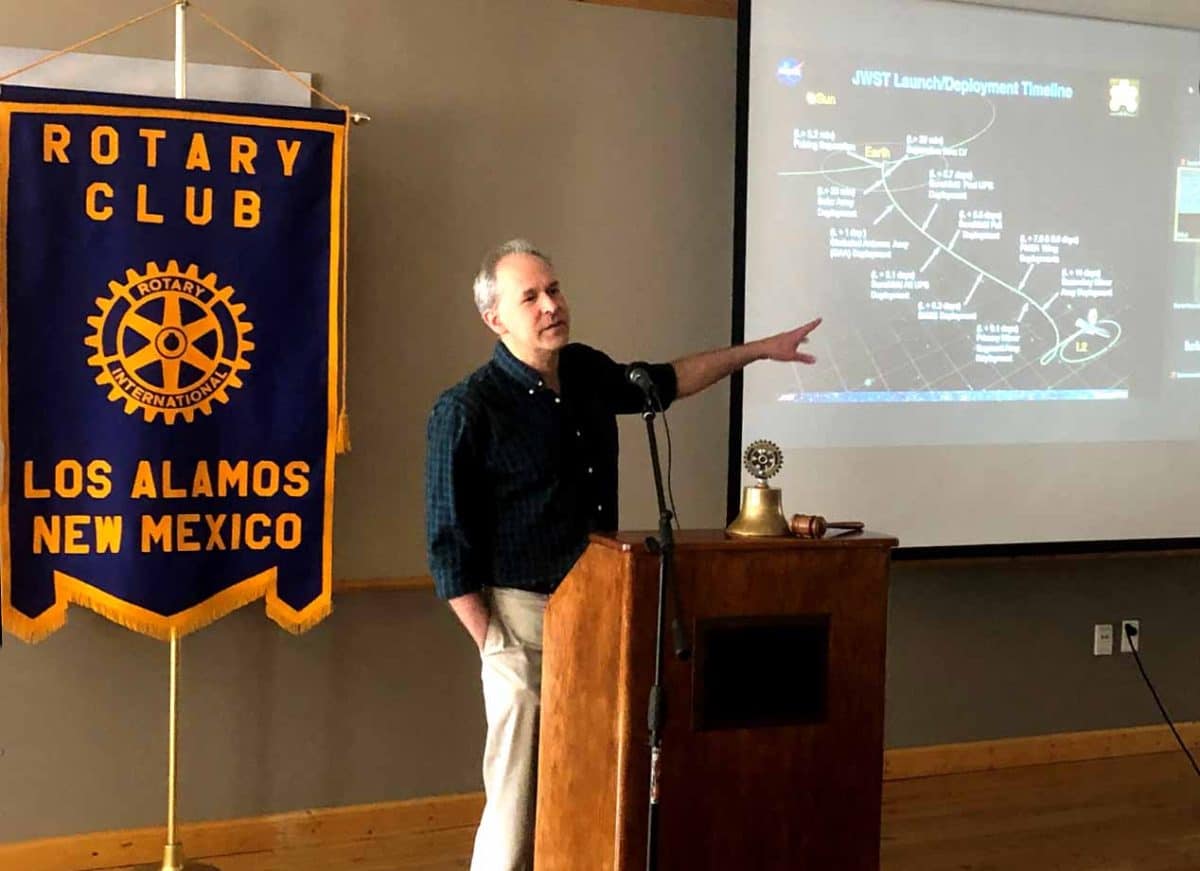
 Dr. Daniel Reisenfeld describing the mission of the James Webb Space Telescope at a recent Rotary Club meeting at Cottonwood on the Greens. Here he explains the timeline of the telescope’s launch and deployment. Photo by Linda Hull
By LINDA HULL
Vice President
Rotary Club of Los Alamos
“It took a lot of science,” began Dr. Daniel Reisenfeld, a Senior Scientist at Los Alamos National Laboratory, drawing good-natured chuckles from the Rotary Club audience as he introduced his April 19 program, The James Webb Space Telescope and Its Science.
With an impressive PowerPoint presentation and videos, Reisenfeld’s observation was clearly an understatement as he described the monumental planning, construction, launch, and operation of the James Webb Space Telescope (JWST). The telescope is named after James Webb, the head of NASA from 1961-1968. The primary mirror of the telescope is roughly 21 feet across with an area of 273 square feet, six times the area of the Hubble telescope’s mirror, making it the largest telescope ever launched into space. Although significantly larger than the Hubble’s mirror, it actually weighs less, thanks to advances in materials technology over the last 30 years.
Construction on the JWST began in 2004. The following year the European Space Agency’s Centre Spatial Guyanais in French Giana was selected as the launch site. On Christmas Day 2021 the JWST was successfully launched from the spaceport there.
The JWST took over 18 years to build at a cost of almost $9 billion with over $860 million to operate for the first five years of its primary mission. A 10-year mission is planned, and a 20-year mission is expected if there is enough propellant for the telescope to “station-keep” in its fixed position, 1 million miles away from the Earth.
Designed primarily for infrared astronomy, the JWST is “engineered to detect light outside the visible range to show us otherwise hidden regions of space,” Reisenfeld explained. The JWST “detects near-infrared and mid-infrared wavelengths, the light beyond the red end of the visible spectrum.” He continued, “The JWST’s infrared resolution and sensitivity will allow it to see objects too old, too far, and too faint to be observed by the Hubble.”
Reisenfeld described its resolution as 0.1 arcseconds (1/36,000th of a degree.) More easily explained, this means the JWST could see a penny from 24 miles away.
Its primary mirror is “18 hexagonal segments of beryllium, gold-plated to capture faint infrared light.” These segments fold together to create one image and are just one astounding feature of the telescope which also features a solar power array, a secondary mirror, trim flaps, scientific instruments, a multilayered sunshield, small star tracker telescopes, an Earth-pointing antenna, computers, reaction wheels, and spacecraft steering and control machinery.
To deploy this complex feat of scientific engineering once in space, 340 “failure points” had to be successfully passed for the JWST to operate. These points were undertaken in increments, one moving without failure to the next until all were completed.
Near the conclusion of this presentation, Reisenfeld posed the question, “So what’s it all about?” As his PowerPoint noted, the telescope “will search for the first galaxies or luminous objects that formed after the Big Bang; it will reveal how galaxies evolved from formation to the present; it will observe the formation of stars from their first stages to the formation of planetary systems; it will measure the physical and chemical properties of planetary systems; and it will investigate the potential for life in those systems.”
The first images from the JWST are expected this summer, in July or August.
In closing, Reisenfeld remarked, “The Universe is 13.8 billion years old; the JWST will be able to see all the way back to the first stars and galaxies, about 13.6 billion years ago.”
Yes, that’s a lot of science.
For more information about the James Webb Space Telescope, go to https://www.jwst.nasa.gov/
Dr. Daniel Reisenfeld has been a Senior Scientist in the Space Science and Applications group at Los Alamos National Laboratory since 2018. For the 14 years before that, he was a professor of physics and astronomy at the University of Montana, and before that, he was actually a scientist at Los Alamos. Reisenfeld is a native of Cincinnati, Ohio. He received his PhD in Astronomy from Harvard University, and a bachelor’s degree in Physics from Yale University.
While in Los Alamos (the first time), Reisenfeld participated in solar wind missions, and was the LANL instrument lead for the Ion Mass Spectrometer on board the Cassini mission to Saturn.
Although Reisenfeld found his career at LANL to be quite gratifying, he had always had the teaching bug, which led him to search for a college faculty position. He didn’t want to leave the West, so he accepted a position at the University of Montana in 2004. Reisenfeld enjoyed being in the classroom, teaching everything from introductory physics to quantum mechanics, stellar astrophysics, and even galactic astrophysics and cosmology.
Throughout his time in Montana, he maintained strong ties with Los Alamos.
After coming to his senses, Reisenfeld says, he is back at LANL. He is leading the development of the Interstellar Mapping and Acceleration Probe (IMAP) for a new NASA mission, with an expected launch in 2025.
The Rotary Club of Los Alamos, through its Club Foundation, is a 501(c)3 non-profit and one of over 34,000 clubs worldwide. Rotary, which now has 1.5 million members, was founded in 1905; the local Club was chartered in 1966. Rotary areas of focus include promoting peace; fighting disease, particularly polio; providing clean water, sanitation, and hygiene; supporting education; saving and enhancing the lives of mothers and children; growing economies; and protecting the environment.
The Rotary Club of Los Alamos meets in person noon to 1 p.m. Tuesdays in the Community Room, Cottonwood on the Greens at the Los Alamos County Golf Course. A Zoom option is available by contacting Rotary Club Vice President Linda Hull at 505.662.7950. Hull is happy to provide information about the Club and its humanitarian service.