







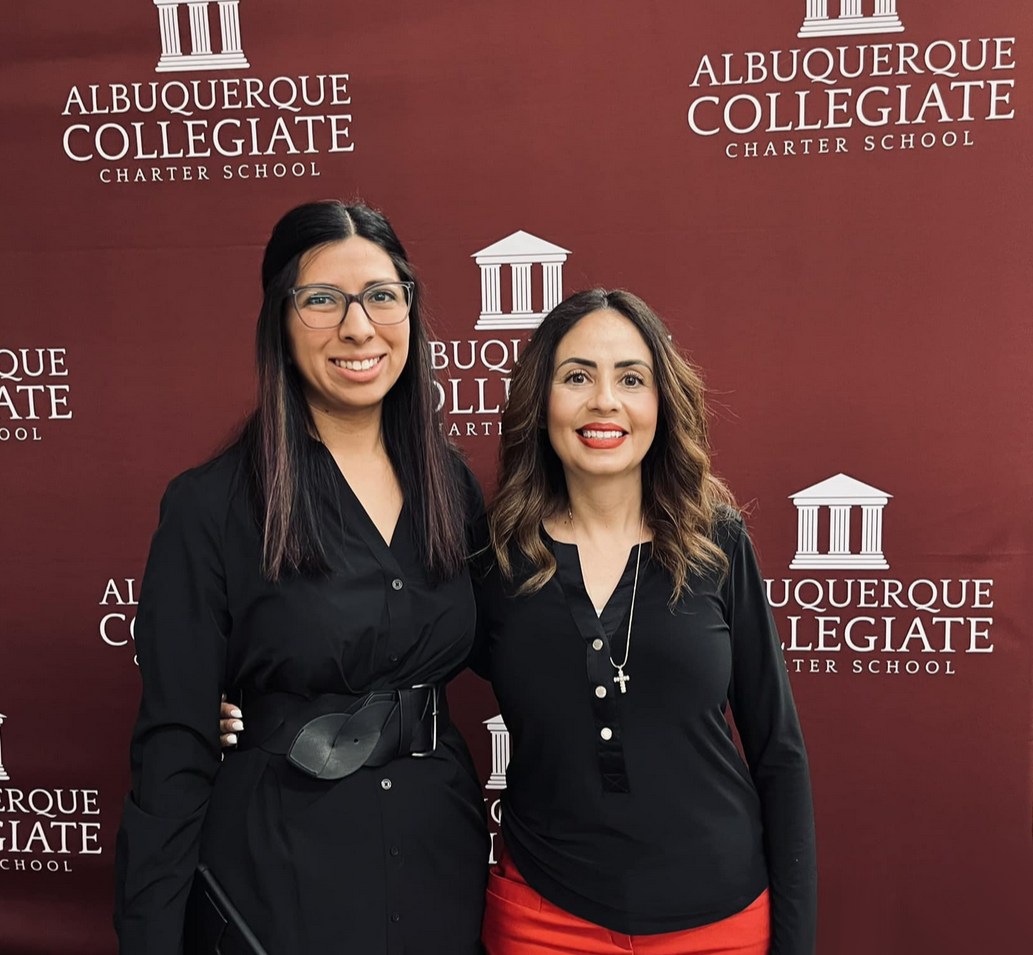
 Julia Burrola – Middle School Principal in Residence and Teach Plus Alumna and Hope Morales – Executive Director for Teach Plus NM. Courtesy photo
By HOPE MORALES
Executive Director
Teach Plus, New Mexico
During a recent visit to Albuquerque Collegiate Charter School, I watched Elizabeth Leung, kindergarten teacher at the school and a Teach Plus New Mexico Policy Fellow, seamlessly guide a cluster of her young students in practicing sounds. In a different part of the classroom, Elizabeth’s co-teacher worked with a group on verbalizing words, while other kids interacted with sounds behind computer screens.
The kindergartners were so engaged that they paid no mind to me as I stood in the room surrounded by this wonderful hum of learning. This K-6 school in central Albuquerque serves a diverse student population that mirrors its community and the state, but surpasses the state average in every academic area. For example, 66 percent of students were proficient in reading in 2023-24, with only 38.9 percent statewide.
As executive director of Teach Plus New Mexico, I frequently see such examples of excellence in our state. For the past three years, we have honored charter schools like Albuquerque Collegiate with our Innovation in Education awards for leading boldly to improve teaching and learning, creating school cultures focused on shared goals, and using data to ensure students are set up for success. These schools have seen boosts in student attendance and achievement, as well as staff morale. But while schools like Albuquerque Collegiate are a testament to what’s going right in our state, recent NAEP data is sobering: Our system is not doing what it can to support all our students.
Many examples of innovation and excellence that we should be lifting up to improve opportunities and outcomes for students exist in our charter schools and one of the ways to fix our system is to lift up these exceptional and innovative systems. Our current system of charter authorization at the state level, through the Public Education Commission (PEC), is working. The primary function of the PEC is the review, and approval or disapproval, of applications to authorize state charter schools. I know from traveling across the state that there is a lot of good conversation about what works and what doesn’t in charter schools and that the PEC recognizes the expertise of charter school teachers like Elizabeth.
A new proposal threatens to undermine this effective system. Although New Mexico voters approved a constitutional amendment in 2003 that removed a state board of education, Senate Joint Resolution 3 (SJR 3) would dismantle the PEC and instead bring back an elective state board whose primary focus will be to select and oversee the state superintendent. The state board would eliminate the PEC, becoming the entity in charge of authorizing charter schools like Albuquerque Collegiate. Because charter authorization would not be the state board’s main purpose, that process is likely to become much more lengthy and cumbersome, making it more challenging for excellent charter schools to become part of New Mexico’s landscape and serve students. The new process would also strip away the rigorous accountability measures that the PEC requires of charter schools to fulfill their mission.
To give all our students high-quality education, we must continue to implement statewide systems like the PEC that work. That will help to ensure that excellent teachers like Elizabeth can continue to work in excellent, innovative schools like Albuquerque Collegiate. Our students deserve nothing less.


























